Showing posts with label slides. Show all posts

Tuesday, September 20, 2022

Fonts, Syllabi, and Poop | TAPP 123


Host Kevin Patton revisits the concept of using the syllabus and other course documents to build a positive and productive course culture. Poop—it's everywhere! Does the font or typeface we use affect students—especially regarding learning and memory? We look for answers in this episode!

00:00 | Introduction

00:52 | Revisiting the Syllabus

16:28 | Poop. Poop. Poop.

19:00 | Sponsored by AAA

19:59 | Fonts Are Important in Teaching & Learning

30:54 | Sponsored by HAPI

31:57 | Desirably Difficult Reading?

42:00 | Sponsored by HAPS

43:00 | Fluent & Dysfluent Fonts

56:12 | Staying Connected


★ If you cannot see or activate the audio player, go to: theAPprofessor.org/podcast-episode-123.html

🏅 Apply for your credential (badge/certificate) for listening to this episode: theAPprofessor.org/podcast-episode-123.html/#badge

❓ Please take the anonymous survey: theAPprofessor.org/survey

☝️ Questions & Feedback: 1-833-LION-DEN (1-833-546-6336)

✔️ Follow The A&P Professor on Twitter, Facebook, Blogger, Revue, Tumblr, or Instagram! @theAPprofessor

📰 Get the thrice-weekly TAPP Science & Education Updates theAPprofessor.org/updates


Typography must often draw attention to itself before it will be read. Yet in order to be read, it must relinquish the attention it has drawn. (Robert Bringhurst)


Revisiting the Syllabus

15.5 minutes

Creating and nurturing a course culture can be influenced by our syllabus and other course materials. We revisit this idea with a few more tips and tweaks.

Anatomy &; Physiology Syllabus: It's an Art | TAPP 120

Are We Answering Student Questions? | Science Updates | TAPP 92

★ Wendy Riggs has a huge collection of anatomy, physiology, and general bio, instructional videos she uses in her flipped classes youtube.com/user/wendogg1

★ Natalie Wade has engaging short videos about A&P content and study tips at The Anatomy Gal youtube.com/c/TheAnatomyGal

★ Jamie Chapman has a collection (Chapman Histology) of short (under 3 minutes) videos guiding students through lessons in histology youtube.com/c/ChapmanHistology
Fonts, Syllabi, and Poop | TAPP 123


Poop. Poop. Poop.

2.5 minutes

After releasing The Poop Episode | Using Fecal Changes to Monitor Health | TAPP 121, I learned of a whole movement of poop listening on smart speakers. And that there are actually poop songs that are viral hits. Really.

★ When kids yell 'Alexa, play poop,' you'll hear these songs (story from All Things Considered on National Public Radioo) AandP.info/wv2

The Foot Book (Bright & Early children's book by Dr. Seuss; can be read as The Poop Book) geni.us/afvGc

★ CHOC Stool Diary AandP.info/4yq

★ Bowel Symptom Journal (from Alberta Health Services) AandP.info/6fw

★ Poop Apps: 5 Tools for Tracking Your Stools AandP.info/5ow


Sponsored by AAA

56 seconds

A searchable transcript for this episode, as well as the captioned audiogram of this episode, are sponsored by the American Association for Anatomy (AAA) at anatomy.org.

Searchable transcript

Captioned audiogram 

Don't forget—HAPS members get a deep discount on AAA membership!

AMERICAN ASSOCIATION FOR ANATOMY STATEMENT OF RESPONSIBILITY FOR ITS HISTORY OF RACISM (Press release from AAA, giving the full text of the statement) AandP.info/eei

AAA logo


Fonts Are Important in Teaching & Learning

11 minutes

At the suggestion of listener Dr. David Curole, we examine the roles that different fonts can play in teaching, learning, and memory. This segment reviews some past discussions of fonts, then introduces some new concepts of using fonts in teaching. Featured is a Word Dissection of the terms fluent font and dysfluent (disfluent) font.

Communication, Clarity, & Medical Errors | Episode 55

Anatomy & Physiology Syllabus: It's an Art | TAPP 120

Why Anatomy & Physiology Students Need Sectional Anatomy | TAPP 116


Sponsored by HAPI Online Graduate Program

59 seconds

The Master of Science in Human Anatomy & Physiology Instruction—the MS-HAPI—is a graduate program for A&P teachers, especially for those who already have a graduate/professional degree. A combination of science courses (enough to qualify you to teach at the college level) and courses in contemporary instructional practice, this program helps you be your best in both on-campus and remote teaching. Kevin Patton is a faculty member in this program at Northeast College of Health Sciences. Check it out!

northeastcollege.edu/hapi

Logo of Northeast College of Health Sciences, Human Anatomy & Physiology Instruction

Desirably Difficult Reading?

10 minutes

The article How Fonts Affect Learning and Memory by Carla Delgado takes our conversation a step further by looking the potential role of dysfluent fonts in learning.

★ How Fonts Affect Learning and Memory (article in Discover Magazine by Carla Delgado mentioned in this segment) AandP.info/wof

★ A Review of the Cognitive Effects of Disfluent Typography on Functional Reading (review article from The Design Journal) AandP.info/mwt

★ Fortune Favors the Bold (and the Italicized): Effects of Disfluency on Educational Outcomes (article from Proceedings of the Annual Meeting of the Cognitive Science Society) AandP.info/jjt

★ Changing Fonts in Education: How the Benefits Vary with Ability and Dyslexia (article from The Journal of Educational Research) AandP.info/yt4

★ Fluency and the Detection of Misleading Questions: Low Processing Fluency Attenuates the Moses Illusion (article from the journal Social Cognition) AandP.info/jul


Sponsored by HAPS

56 seconds

The Human Anatomy & Physiology Society (HAPS) is a sponsor of this podcast.  You can help appreciate their support by clicking the link below and checking out the many resources and benefits found there. Watch for virtual town hall meetings and upcoming regional meetings!

Anatomy & Physiology Society

theAPprofessor.org/haps

HAPS logo


Fluent & Dysfluent Fonts

13 minutes

We identify some potentially fluent fonts, as well as a few dysfluent fonts (see image below or at AandP.info/ihy). Sans Forgetica font was developed specifically to be dysfluent in a way that promotes remembering what is read. Does it work? Should we incorporate dysfluent fonts in our teaching materials?

★ Fonts and Fluency: The Effects of Typeface Familiarity, Appropriateness, and Personality on Reader Judgments (thesis by Tim Wang) AandP.info/0hf

★ Previously claimed memory boosting font 'Sans Forgetica' does not actually boost memory (story from ScienceDaily) AandP.info/zp4

★ The science of Sans Forgetica - The font to remember (video from the creators of Sans Forgetica) AandP.info/ox5

★ An unforgettable year – Sans Forgetica turns one (article from the RMIT University website) AandP.info/fo3

★ Sans Forgetica: Study Mode by RMIT University (plugin for Chrome browser lets you read any web page in Sans Forgetica) AandP.info/fc3

★ Sans Forgetica (free download for personal use) AandP.info/o4g

★ Can very small font size enhance memory? (article from journal Memory & Cognition) AandP.info/rlk

★ Sans Forgetica is not desirable for learning (article from the journal Memory) AandP.info/hmu

★ The role of font size and font style in younger and older adults' predicted and actual recall performance (article from
Neuropsychology, development, and cognition. Section B, Aging, Neuropsychology and Cognition) AandP.info/r6s
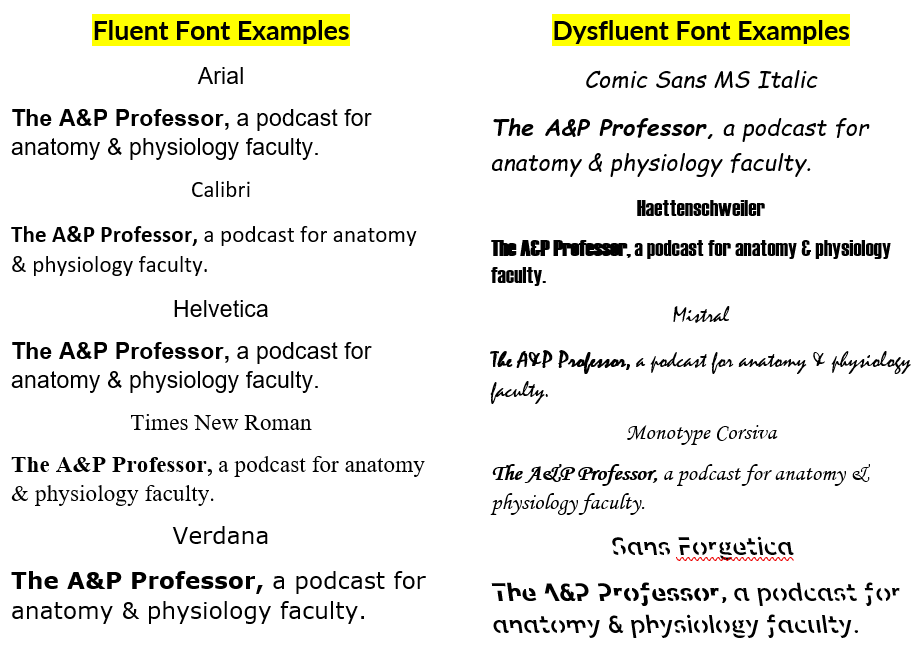
samples of fluent and dysfluent fonts


People

Contributors: David Curole, Terry Thompson

Mentions: Wendy Riggs, Natalie Wade, Jaime Chapman, Robert Bringhurst, Carla Delgado

Production: Aileen Park (announcer), AndrĂŠs Rodriguez (theme composer,  recording artist), Rev.com team (transcription), Kevin Patton (writer, editor, producer, host)


If the hyperlinks here are not active, go to TAPPradio.org to find the episode page.

★ More details at the episode page: theAPprofessor.org/podcast-episode-123.html

★ Transcript available in the transcript box: theAPprofessor.org/podcast-episode-123.html

★ Need help accessing resources locked behind a paywall? Check out this advice from Episode 32 to get what you need! my-ap.us/paywall

Take The A&P Professor experience to the next level!

theAPprofessor.org/community

Earn cash by referring other A&P faculty to this podcast:

theAPprofessor.org/refer

Tools & Resources

★ TAPP Science & Education Updates: theAPprofessor.org/updates

★ Amazon: amzn.to/2r6Qa3J

★ Text Expander: theapprofessor.org/textexpander

★ Rev.com: try.rev.com/Cw2nZ

★ Snagit & Camtasia: techsmith.pxf.io/9MkPW

★ Krisp Free Noise-Cancelling App: theAPprofessor.org/krisp

★ JotForm (build forms for free): theAPprofessor.org/jotform

★ QuillBot (writing tools): theAPprofessor.org/quillbot

★ The A&P Professor Logo Items: https://www.teepublic.com/stores/the-a-p-professor

Sponsors

★ Transcript and captions for this episode are supported by the American Association for Anatomy | anatomy.org

★ The Human Anatomy & Physiology Society provides marketing support for this podcast | theAPprofessor.org/haps

★ Distribution of this episode is supported by the Northeast College of Health Sciences online graduate program in Human Anatomy & Physiology Instruction (HAPI) | northeast.edu/hapi

Clicking on sponsor links helps let them know you appreciate their support of this podcast!

Follow The A&P Professor on  Twitter, Facebook, Blogger, Revue, Tumblr, or Instagram @theAPprofessor

The A&P Professor® and Lion Den® are registered trademarks of Lion Den Inc. (Kevin Patton)

As an Amazon Associate I earn from qualifying purchases. I may be compensated for links to sponsors and certain other links.


Click here to listen to this episode—or access the detailed notes and transcript.

Friday, January 5, 2018

Platelets vs. Bacteria

Platelets as potent scavengers of bacteria? Really?

Something like 750 billion tiny cell fragments called platelets circulate in the human blood stream. When an injury to a blood vessel occurs, they stick to the exposed collagen in groups—forming platelet plug. And trigger additional reactions that eventually result in a blood clot.

But did you know that they have other helpful jobs, too? Like rounding up bacteria and feeding them up to immune cells, which devour them to make us safe.

This innate immune function of platelets has recently been outlined by researchers, as the information below summarizes.

Read through the quick points below to get an overview of some immune functions of platelets. Then read the full articles if you want to know more about these discoveries—including some great diagrams, micrographs, and videos.

[A short item on this topic also appears in today's edition of my daily Nuzzel newsletter of curated headlines for A&P professors.]

Quick points about platelets as bacterial scavengers


  • At sites of vessel injury/inflammation, platelets that contact intact collagen stick together—but platelets that do not contact collagen are motile.

  • Motile platelets change shape from a "fried egg" to a polarized "half moon" to better navigate the shearing forces of blood flow.

    • They can even navigate "upstream" against the flow of blood.

  • Platelets can use mechanical force to pull particles—including bacteria—from surrounding substrates.

  • Platelets collect and bundle bacteria, which facilitates neutrophil activation and subsequent phagocytosis. 

Migration pattern of motile platelet (left). Platelets collecting bacteria into bundles.

What can we use from this in teaching undergraduate A&P?


  • Yeah, okay we don't have time to go into all the ins and outs of platelets in a typical A&P course, but we can mention that platelets are now known to have immune functions.

    • Consider circling back to this mention later, when (if) you cover innate immune mechanisms a bit later in the course.

  • Consider calling attention to the sensory functions needed for platelets to analyze their microenvironment within the bloodstream.

  • Consider pointing out the specialized structure and function of the platelet's plasma membrane.

    • Integrins (integral membrane proteins) have a role in detecting particles for adhesion, binding to them, and sorting them.

    • Invaginations of the plasma membrane facilitate bundling of bacteria.

  • The shape changes needed for migration and handling of bacteria require actin-myosin reactions to power them. As in muscle fibers, these contractions are triggered by influx of extracellular calcium. In case you want to circle back to that.

  • Perhaps we should make a stronger point in reminding students that although they are "cell fragments" without a nucleus, they're more than just bags of hemostatic chemicals.

  • All these opportunities to "circle back" to previously studied concepts helps students make connections in their developing conceptual framework. And help them form a better understanding of the "big picture."

Want to know more?


Platelets, On Your Marks, Get Set, Migrate!

  • Bambach S, Lämmermann T. Cell. 2017 vol: 171 (6) pp: 1256-1258
  • Introduction to the Gaertner, et. al., paper below—giving background and overview to enhance understanding of the new discoveries. Great diagram, too! Click "Supplemental information" in the article to access video clips. 
  • my-ap.us/2EbU6Eu


Migrating Platelets Are Mechano-scavengers that Collect and Bundle Bacteria.

  • Gaertner F et. al. Cell. 2017 vol: 171 (6) pp: 1368-1382.e23
  • Journal article describing the scavenger role of platelets. Includes a few very nice, simple diagrams—and some cool micrographs and data graphs. These can also be downloaded as PowerPoint slides. Click "Supplemental information" in the article to access video clips. 
  • my-ap.us/2F5iM2U


Platelets Mediate Host Defense against Staphylococcus aureus through Direct Bactericidal Activity and by Enhancing Macrophage Activities.

  • Ali R et. al. Journal of immunology. 2017 vol: 198 (1) pp: 344-351
  • Journal article that supports the concept that platelets can kill MRSA bacteria and enhance their phagocytosis by macrophages.
  • my-ap.us/2EaO5be


[NOTE: If you can't access the full text of any resource, ask your school's reference librarian for help. If they can't provide direct access, they'll probably know how to get a copy of the resource for you. Quickly.]


Photos: LMU

Saturday, November 18, 2017

Got High Blood Pressure Covered? The 2017 Hypertension Guidelines.

With the new guidelines for high blood pressure popping up all over the news recently, we may wonder what we need to know when this comes up in our A&P classrooms. And we know it will—students love, love, love to connect what they are learning in A&P with what they are experiencing in their lives. 

It turns out that although the new 2017 Guideline For the Prevention, Detection, Evaluation, and Management of High Blood Pressure in Adults is focused on how physicians should make diagnoses and manage patient care, the definitions of exactly what constitutes high blood pressure (hypertension or HTN) are important learning points in the undergrad A&P course.

I'll outline the main things for us A&P professors to know here, but do check out the resources I've linked below to deepen your understanding of current thinking regarding approaches to blood pressure (BP) health.

First, there are revised guidelines as to what constitutes high blood pressure or HTN:

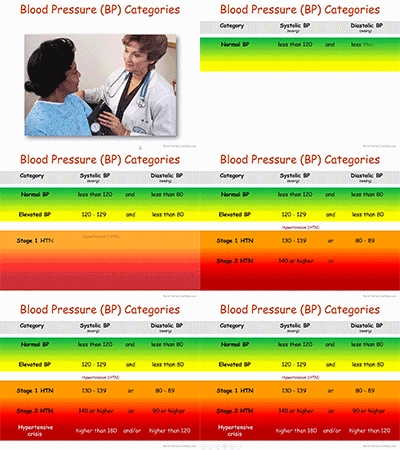
  • Normal BP: Less than 120/80 mm Hg;
  • Elevated BP: Systolic between 120-129 and diastolic less than 80;
  • Stage 1 HTN: Systolic between 130-139 or diastolic between 80-89;
  • Stage 2 HTN: Systolic at least 140 or diastolic at least 90 mm Hg;
  • Hypertensive crisis: Systolic over 180 and/or diastolic over 120, with patients needing prompt changes in medication if there are no other indications of problems, or immediate hospitalization if there are signs of organ damage.


Regardless of the precise cutoffs listed above, in an interview discussing the new guidelines, the main author states that, "120/80 is normal, the same as we had before" the new guidelines. So I think we're safe in using 120/80 as an example of BP when discussing the normal science, even though technically it could be designated as "elevated." Not that we can't use an elevated variable measurement as an example when discussing the physiology of anything. The fact that even the main author of the guidelines uses 120/80 as the starting point of discussion makes me feel more confident in using it as the starting point of my course discussions, too.

The main thing to note in the categories above is that the cutoffs for HTN categories have been lowered. This puts many more people in an HTN category that were not there before. The main goal is for those folks to have conversations with their physicians to evaluate their risk for complications and develop a personalized prevention and care plan.

Note also that the category of prehypertension has been eliminated.

The new guidelines also recommend prescribing medication for Stage 1 HTN if the patient already had a cardiovascular event—or is at a high risk for such an event. They also recognize that many patients will need more than one medication to manage BP and that combining meds into one pill is likely to help folks take them consistently.

There are a lot of other recommendations, so reviewing the Executive Summary or similar resource (see below) may be a good idea.


What can we use from this in teaching undergraduate A&P?

  • If you discuss hypertension, or use case studies in teaching, you need to update the cutoff BPs you are using.
  • A BP of 120/80 is still considered the starting point for discussing blood pressure.
  • Consider discussing the impact of the changes in the new guidelines for ordinary people.
  • Discuss why such diagnosis, prevention, and treatment recommendations often change over time. Consider discussion other recent clinical updates.
  • Consider discussing specific changes suggested in the new guidelines.
  • Consider having students explore the Executive Summary and/or other documents and write their own summary or interpretation of key points. Perhaps they can create their own chart or concept map.


Need some free teaching materials?


SLIDE SET: High Blood Pressure
  • Kevin Patton. Lion Den Slide Collection. 18 Nov 2017
  • Small slide deck that includes an animated version of the BP Category chart pictured above. Part of the Lion Den Slide Collection (requires free registration to download). You can also download a static PNG image file of the chart in the slide collection set.
  • my-ap.us/2ivoql5


VIDEO: AHA 2017 | New High Blood Pressure Guidelines
  • America Heart Association. 13 Nov 2017.
  • Free video (viewable in the player above) features a chat with the main author of the new guidelines and summarizes the main points. Very practical and easy to understand.
  • youtu.be/rvYL-7ergDs


SLIDE SET: 2017 Guideline For the Prevention, Detection, Evaluation and Management of High Blood Pressure in Adults
  • American College of Cardiology. 13 Nov 2017
  • Free set of almost 100 PowerPoint slides to use in teaching. And it has a decided focus on clinical applications, rather than the basic science. These are way, way beyond the coverage desirable in an undergrad A&P course. But some slides may be useful to you.
  • my-ap.us/2itMBjY


Want to know more?


New blood pressure guidelines put half of U.S. adults in unhealthy range
  • A. Cunningham Science News. 13 Nov 2017 
  • Plain-English article summarizing the first major update since 2003 aims to spur heart-healthy lifestyle changes. Has a useful graph and links to other articles and resources.
  • my-ap.us/2itVnOR

New Multisociety Hypertension Guideline Is Released
  • Allan S. Brett, MD reviewing Whelton PK et al. J Am Coll Cardiol 2017 Nov 13. NEJM Journal Watch Nov 2017.
  • Brief review of the larger report (listed below), summarize key take-away points.
  • my-ap.us/2iumCc1

2017 ACC/AHA/AAPA/ABC/ACPM/AGS/APhA/ASH/ASPC/NMA/PCNA Guideline for the Prevention, Detection, Evaluation, and Management of High Blood Pressure in Adults: Executive Summary
A Report of the American College of Cardiology/American Heart Association Task Force on Clinical Practice Guidelines
  • PK Whelton et al. Hypertension, Dec 2017, Volume 70, Issue 6.  DOI: 10.1161/HYP.0000000000000066
  • Free PDF of the Executive Summary of the larger report. I recommend reading this first, then decide if you need to read the whole report.
  • my-ap.us/2iuzvCT

2017 ACC/AHA/AAPA/ABC/ACPM/AGS/APhA/ASH/ASPC/NMA/PCNA Guideline for the Prevention, Detection, Evaluation, and Management of High Blood Pressure in Adults
A Report of the American College of Cardiology/American Heart Association Task Force on Clinical Practice Guidelines
  • PK Whelton et al. Hypertension. Dec 2017, Volume 70, Issue 6.  DOI: 10.1161/HYP.0000000000000065
  • Free PDF of the entire report. It's huge, so make a whole pot of tea before starting it.
  • my-ap.us/2irTUZj

Potential U.S. Population Impact of the 2017 American College of Cardiology/American Heart Association High Blood Pressure Guideline
  • Paul Muntner et al. Journal of the American College of Cardiology. November 2017. DOI: 10.1016/j.jacc.2017.10.073
  • Free abstract briefly outlines the impact of the new HTN guidelines.
  • my-ap.us/2iu8BLi


Friday, January 2, 2015

Fat Cells in Skin Kill Bacteria


Scientists reported today that adipocytes in mouse and human skin produce an antimicrobial peptide (AMP) called cathelicidin is response to Staph aureus infections, including MRSA. Experimental animals that were deficient in the AMP were more susceptible to skin infections.

Adipocytes may recognize S. aureus by detecting bacterial peptides with toll-like receptors (TLRs), but more work is needed to fully understand the mechanisms.

This finding adds more to our understanding of human skin as a vital part of our body's defenses against infection. It also opens the door to understanding how diabetes, metabolic syndrome, and other conditions can reduce resistance to skin infections by altering the availability of AMPs in the fat associated with skin.

All of this may eventually lead to additional—perhaps more effective—strategies in preventing or curing serious skin infections such as MRSA.

I realize that we generally think of fat cells as belonging to the hypodermis, not the dermis, as described in the research. However, recent evidence shows the presence of adipocytes in the dermis that are distinct from those in the hypodermis. These adipocytes derive from a common precursor cell that produces both dermal fibroblasts and intradermal adipocytes. These dermal adipocytes have been shown to have a role in wound healing and the regeneration of hair follicles. And the research summarized here suggests that they also have a role in immunity.


What can we use from this in teaching undergraduate A&P?

  • Mention this discovery when discussing the roles of adipose tissue and adipocytes in your coverage of tissues of the body.

    • Consider clarifying that dermal adipocytes are distinct from fat cells in the hypdermis. And perhaps mention that it's a detail often left out of introductory discussions of skin.

  • This is a good point to mention when discussing the protective functions of the skin when covering the integumentary system.

  • When discussing the immune system, this concept helps illustrate several important principles:

    • The role of the skin as the first line of defense against infection

      • The variety of mechanisms available in the skin to act defensively

    • The role of TLRs and pattern recognition in immunity

    • The fact that immunity is a role for many tissues—not just lymphocytes and other WBCs

  • Take a moment NOW to add this to your course notes!

Want to know more?


Killer Fat
  • J. Alcorn and J. Kolls. Science 2 January 2015: Science Vol. 347 no. 6217 pp. 26-27 DOI: 10.1126/science.aaa4567
  • Editorial summary of the research in plain English. Includes a really nice, simple illustration of the concept (includes FREE teaching slide)
  • my-ap.us/1vBWbNP

Dermal adipocytes protect against invasive Staphylococcus aureus skin infection
  • L. Zhang1, et al. Science 2 January 2015: Vol. 347 no. 6217 pp. 67-71 DOI: 10.1126/science.126097
  • Original research article. Additional images available here, including some nice micrographs showing increase in adipocytes in response to S. aureus infection
  • my-ap.us/1xePNS4

Defining dermal adipose tissue.
  • Driskell RR, et al. Exp Dermatol. 2014. Exp Dermatol. 2014 Sep;23(9):629-31. doi: 10.1111/exd.12450.
  • Review article describing dermal adipocytes.
  • my-ap.us/1GuH3bL

FREE teaching slide
Click the image
to download a


Adipose image credit: my-ap.us/13MYGWO
This post was updated 6 OCT 2015

Monday, December 8, 2014

5 Useful Features of The A&P Professor Blog That You May Have Missed


Okay, the title is a bit misleading because a some of the five features you may have missed are new, so it may just be too early to have noticed them yet.  But there are some that have been around a while and you may not have given them much thought until now.

  1. Top menu bar.  

    I recently added a menu bar to the top of the blog page, just under the blog description.   You can link to the Home Page, Site Map, Subscription and various off-blog resources.  Explore each one to see if it's useful to you.

  2. Site Map.

    This new feature is a table of contents that lists blog posts in alphabetical lists by topic.  It's pretty big because I've been doing this blog for many years, and some posts are listed under more than one topic.  But if you are "into" the teaching of A&P, this might be a fun treasure hunt to find things you may have missed—or have simply forgotten about.

  3. Email Newsletter.

    The email newsletter for this blog, powered by Feedblitz, is a way to subscribe to this blog and be notified by email each time a new article is posted in blog.  It's free and you can safely unsubscribe at any time.  Then re-subscribe later when you find that you missed getting updates!  You may not realize that by subscribing, you also get additional content.  For example, once a month, I send out a Throwback Thursday newsletter reprising a popular article from the past that remain relevant.  I occasionally send out other "extra issues" that do not appear in the blog itself.

  4. Social Media.

    As more and more of you join the rest of the world on Facebook, Twitter, and other social media networks, you may want to follow The A&P Professor there, too.  As with the email newsletters, my Twitter and Facebook followers get additional content not found on the blog or other channels.  You can even follow my YouTube channel, where I post videos with study tips for A&P that you can share with your students.

  5. Family of Blogs and Websites.

    I have other blogs that are focused on particular topics that overlap your interest in teaching A&P.  For example, The A&P Student blog is directed at, er, A&P students.  Teachers who follow that blog pick up ideas for sharing with students who are having difficulty in your class, or link to blog posts in their course pages or syllabus.  My o-log-y blog relates specifically to the terminology of human science and medicine.  There, you may find tips for helping your students learn the language of A&P or you may find information about some of the tricky aspects of terminology that you may not already know. Check out each one to see if any of them interest you.

    Oh, and don't forget the separate website theAPprofessor.org, where you can find my free image library, sign up to get free bookmarks for your students, participate in teaching seminars, and gain access to my free library of teaching slides.

Play around the edges of this blog and see what other helpful little tools you may have missed.

Monday, September 15, 2014

Updated Cell Transport Slides


Many longtime readers of this blog know that I have a set of animated PowerPoint-compatible slides available for you to use FREE in your A&P classes.  These slides—the Lion Den Slide Collection— supplement the publisher-supplied slides or homegrown slides that you are already using.

I recently updated, improved, and expanded the set of slides that animate several key cell transport processes such as diffusion, osmosis, endocytosis, etc.

If you've accessed the Lion Den Slide Collection in the last several months, you've already registered in the system and probably have already received an email notification of the update.

If you're new to the collection (or accessed it before June 2014) then you need to go to the Lion Den Slide Collection page and click on the link to the form.  It takes a few steps, but by filling out the brief forms you register for a service that will notify you (if you want it) of any updates or additions to the collection.

Here is a preview the newly updated Membrane Transport Animations
Click image for download

When you download the linked file, you'll be able to play it in PowerPoint or any other program that plays "show" or PPTSX files.  The slides can only be viewed, not edited or added to your own slide deck.  To do that, you must download the fully editable PPTX files from the Lion Den Slide Collection

Once you download any slide deck from the Lion Den Slide Collection, you can mix and match them to blend them with your existing presentations.  You can also alter the content or timings to suit your needs.  

I'm hoping you'll also get some ideas from them to create new additional slides!  If you modify, create, or already have any slides (for which you own the content) that you want to place in the collection for sharing, please contact me directly. 

Want to know more?


Presentation Zen
  • Kevin Patton The Electronic Professor 6 August 2014
  • The zen approach to presentations.  Includes a video and links to resources.
  • my-ap.us/1mZjY7e

Are your students dodging bullets?
  • Kevin Patton. The Electronic Professor. 28 July 2011
  • My blog article on improving slide presentations.  With illustrated examples.
  • my-ap.us/1ni8c72

Handling bullets safely
  • Kevin Patton. The Electronic Professor.  3 August 2012
  • Another of my blog articles on improving slide presentations. Includes my own video on how to trim down those wordy slides to something that actually works in a slide.
  • my-ap.us/1ooEced

Monday, September 1, 2014

Help Your A&P Students Get Off to a Good Start

Your Brain on A&P


I recently posted an article in The A&P Student called Getting a Good Start in Your Anatomy & Physiology Course. In it, I run down a brief list of practical strategies students can employ from the start of their course to get a solid start in a rigorous course—a course that intimidates many beginners who are not fully prepared.

My suggested strategies are organized under three subheadings:

  • Learn to read and raid your textbook
  • Brush up on your study skills
  • Take A&P seriously

For each of these broad categories, I list several practical and proven tips for A&P students to get a handle on things early in the course.  All have links to more detailed and specific advice from various resources.


What can we use from this in teaching undergraduate A&P?


  • Early in your course, mention the importance of getting off to a good start—not waiting until the first test looms to get organized and begin working.
  • Link to the article in your syllabus and/or your course web page or LMS course shell.
  • QR code for the Getting a Good Start article
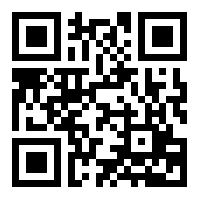
    • Consider putting an unlabeled QR code (shown) in your syllabus or on your classroom wall.  Many students will scan the code and find the article simply out of curiosity.  Just like a snare trap!
  • Have a link to the article ready to give to students who contact you about being overwhelmed with the rigor of your course.
  • Consider suggesting to your students that they subscribe to The A&P Student newsletter (delivered by email, FB, LinkedIn or Twitter).
    • Consider subscribing yourself—a great way to keep up with various tips and strategies you can pass on to your students.
  • Even if your course has already started it's not too late to share these strategies with your students!


Want to know more?


Getting a Good Start in Your Anatomy & Physiology Course

  • Kevin Patton The A&P Student 26 August 2014
  • Outlines several practical strategies to begin the anatomy and/or physiology course on solid footing.  Link to this article from your syllabus and/or course web page.
  • my-ap.us/1onII8I

Subscription for The A&P Student

  • Choice of FREE delivery by email, Facebook, Twitter, or LinkedIn
  • my-ap.us/1oxkJIM

A&P is the Foundation

  • Kevin Patton Lion Den Slide Collection
  • FREE animated PowerPoint slide you can use in your introductory course presentation.  The link takes you to information on accessing the entire collection.  Find this one in v2, Study Tips, AP-is-foundation
  • lionden.com/slides-form.htm
Download free slides, including this one, to use in your A&P course
Free animated slide

Friday, June 13, 2014

Online lectures and previews


For many years, I've been producing online lecture presentations as previews and supplements to the classroom experience in my A&P courses. Sometimes, I use these to keep "teaching" while away at a conference or meeting.

In 2006, long before "flipping" became a common phrase among professors, I decided to make my classroom more interactive by putting some of the "you don't really need me in person for this"  material online for preview before coming to class. I wasn't creative enough to call it something catchy and cool like flipping, but simply it "Preview Presentations." For each module in the course, students were required to watch these before coming to class for discussion, questions, and additional lecture presentations on the "hard to understand" concepts that require some back-and-forth between me and my students.

I summarized my case of putting interactive, narrated PowerPoints that include built-in self-testing quizzes in an online presentation on our companion website The A&P Professor.  That was a version of a well-received workshop I presented at a regional HAPS conference in Macon GA a few years ago.

Recently, I re-created my presentation to focus on the latest generation of software plugin that allows for video or audio narration and more types of interactivity in quizzes.

Rather than summarize my experience here and suggest ways that you might consider adapting some of it to your A&P course, I'll just give you the link to my presentation (using said technology) that includes a summary handout that you can print out:

Monday, August 19, 2013

Death spreads throughout body

C. elegans
In class discussions, we talk about what happens when the body dies.  And it's always a bit tricky when the discussion gets around to the idea that not every cell dies simultaneously.

And of course, that can lead to a discussion of how tissue death occurs, even in the case of necrosis that occurs as a result of ischemia or other damage. There are certainly many mechanisms involved—quite a few of which have yet to be clarified.

Recently, researchers have brought a step closer by mapping out some of these mechanisms.  In their report (cited below), they reveal that in the gut of the C. elegans worm, calcium ions flowing into cells cause the lysosomes to burst suddenly.  And we know what that means! Intracellular destruction leading to cell death.

What causes the calcium ions to rush into the cells? Gap-junction ion-channel proteins called innexins (analogous to connexins in humans) open up and allow calcium ions to flow into one cell then the next, producing a wave of destruction along the gut.

In interesting phenomenon is that esters of anthranilic acid (formed from the amino acid tryptophan) in the lysosomes not only produce acidosis in the cytosol, they also fluoresce brightly with a bluish glow during this process of cell death.

The video below shows an amazing anterior-to-posterior wave of fluorescent blue in C. elegans worms as this "wave of death" travels along the gut wall.


Okay, now here's the kicker.  By knocking out the innexin channels, the researchers were able to stop the wave of death!  Whoa!  A cure for . . . death?!

Not so fast.  This worked in a WORM, which is not as complex as a vertebrate like the human.  And it only worked in INJURED worms, not elderly worms dying of old age.  So it won't stave off death entirely—or unusually prolong life—but it could lead to treatments for preventing or reducing necrosis that occurs as a result of ischemia and other injuries.

This information—and that dramatic video—could be an interesting addition to your class.  It ties in why it's important to understand concepts such as:

  • ions
  • amino acids
  • ion flow into cells
  • gap-junction ion channels
  • lysosomes
  • cell death and organismal death
  • necrosis (and factors leading to necrosis)
  • use of animals in research
  • the intersection of basic science research and medical applications

Want to know more?


Anthranilate Fluorescence Marks a Calcium-Propagated Necrotic Wave That Promotes Organismal Death in C. elegans. 

  • Coburn C, et al.  PLoS Biology 11(7): e1001613. 2013. doi:10.1371/journal.pbio.1001613
  • The original research article.  Includes FREE images and PowerPoint slides you can use in your course.
  • my-ap.us/19SRjOG


Glowing, Glowing, Gone: Cell Fluorescence Casts Light on How Death Spreads Throughout Body

  • By Christopher Crockett. Scientific American online 2 August 2013
  • Brief, less technical, article explaining that researchers have identified a key molecular pathway for animal death that may provide clues for better managing traumatic injury and disease in humans.
  • my-ap.us/13MxJjs


Saturday, January 7, 2012

Academic integrity in the A&P course

How do you prevent cheating in your A&P class?  Or do you even think about it?

One of my favorite "teaching" books is What the Best College Teachers Do.  After examining diverse "master teachers," the author (Ken Bain) lists some of the characteristics most often seen in such individuals.  One of them is that master teachers do not fret much about cheating in their courses.  Instead, they seem to focus more on developing a culture in each learning community that naturally discourages dishonesty by building trust and integrity.

That revelation changed the way I look at cheating in my courses.  Rather than working hard at developing complex anti-cheating strategies, I work hard at educating my students about the value of academic integrity. Although one can never be absolutely certain of the extent of cheating in one's courses, the tools I do have available tell me that cheating is not a significant problem in my courses.

Of course, I do pay attention to setting things up in ways that discourage cheating, but I don't go overboard . . . and I don't worry about it.

How, exactly, do I promote academic integrity?  And what are some of the specific methods that I use to discourage cheating?   Those answers and more can be found in the resources below:

Want to know more?
Why be honest?
Kevin Patton
The A&P Student 5 January 2012
[Brief article for students.  Explains why they should want to be honest. You can link to this in your syllabus or course website.]
my-ap.us/zHHd7H

Academic Integrity
Kevin Patton
The A&P Professor accessed 5 January 2012
[Extended version of this article.  It also gives specific tips and examples, as well as free resources such as handouts, syllabus example, and PowerPoint slides.]
my-ap.us/xSDoxP

Monday, May 9, 2011

FREE animated function of the appendix

When in comes to explaining the role of the human vermiform appendix, I must dispel students' belief that it has no role. And then I must try to convey that it has an immune function while at the same time promoting microbial growth.

Being a visual learner by preference, and therefore preferentially a visual teacher, I find any concept easier to teach if I can draw a picture of it.  Even better if I can put that picture into motion.

I recently uploaded a new set of animated PowerPoint slides that anyone can use to explain the immune function of the appendix.

To download and view the FREE set of slides, go to http://www.mediafire.com/file/jqgizrv1xr8s6kd/AppendixFunction-LionDen-KPatton.pptx

To access the file, you'll need a password.  If you don't already have a current password to the Lion Den Slide Collection, you can get one by filling out the form at http://my-ap.us/eOtyVq

Feel free to use it in your classroom or website (or both).

I'll be adding a narrated version to my YouTube channel soon at youtube.com/user/kevintpatton

Want to know more?
New "old" news about the appendix
K. Patton
The A&P Professor 24 Aug 2009
[From the archive of this blog, includes some interesting comments from our readers plus links to journal articles]
http://my-ap.us/eIHUKI

The Cecal Appendix: One More Immune Component With a Function Disturbed By Post-Industrial Culture
Michel Laurin et al.
The Anatomical Record. Article first published online: 2 MAR 2011 DOI: 10.1002/ar.21357
[Recent review article that outlines an interesting perspective on the function of the appendix.]
http://my-ap.us/fUeGPX

Saturday, March 12, 2011

More study tool slides

In a recent post, I briefly discussed some presentations that I do regarding using Running Concept Lists and Concept Maps to learn anatomy and physiology concepts and how they relate to one another.  I posted links to slides, narrated YouTube videos of brief versions of the presentation, and related study tip pages in my Lion Den website for students.  As promised, this week I'm posting links and short descriptions of four more presentations that may help your students succeed in A&P.

Want to present your own version of any of these study tips? Perhaps embed parts of them into your own presentations? You are welcome to use the slides, which can be found in the Lion Den Slide Collection.  (To use the slides, you'll need the password for downloading them.  Just fill in the form to get the password if you don't already have it.)

Don't forget . . . when using the direct links below, you need to have the super-secret, magic password ready!

In an upcoming post, I'll let you in on some secrets for creating some additional time with you students so that you can cover these study tips without sacrificing "content time" in your A&P course.

Previously described slides available in the Lion Den Slide Collection:


More Slides also available in the Lion Den Slide Collection:

Flash Cards: Reducing Your Study Time 
Some practical tips for using study cards to reduce your study time and get a solid foundation in learning any topic. This video also includes some surprising advanced techniques that show how to use flash cards to also learn higher-level thinking in any subject. Includes discussion of the Leitner system (plus Patton's adaptation of the Leitner system), color codes and symbols, using cards to learn processes and ordered structures, and using cards to build concept maps (mind maps).
Muscle Names Have Meaning
Learning muscles is hard enough without dealing with those crazy convoluted Latin names. But if you pay attention to those names, you'll find that they are actually phrases that help you find the muscles AND help you to remember them in the long term. Find out how this works . . . and where to find lists to help you figure out the meaning of common muscle names.
Exam Strategies
Proven strategies for success in taking tests and exams. What you can do before, during, and after an exam to improve performance in your anatomy and physiology course.
Learn from Your Mistakes: TEST ANALYSIS 
How do you effectively "go over" your tests or exams? Learn how to analyze your tests to see what went wrong and how to fix it.

Don't forget that your students can keep up with all these study tips (and more) on their own by subscribing to my blog The A&P Student.

I have some handy (and bizarre) bookmarks giving students information about The A&P Student blog that you can distribute FREE to your classes!  Just go to my bookmark request page to get bookmarks for your students now.

    Monday, February 28, 2011

    Prezi practice practicals

    In my blog The Electronic Professor, I recently wrote about the Prezi alternative to PowerPoint presentations.

    In a nutshell, Prezi creates large, complex sets of information that you can zoom into either at will or in a preplanned way.

    As I was exploring around the Prezi presentations that have been made public, I found a great idea . . . why not use Prezi to create practice lab practicals?

    My students always find it hard to get ready for practicals.  Obviously, part of the issue is the massive amount of content that we ask them to learn.  But, perhaps more imporatantly, it's hard for them to imagine the kinds of questions that they are likely to get. We set up "practice practicals" in our open lab when we can . . . and that helps a lot.  But wouldn't it be great to have an easy to access online place our students can practice for their praticals?

    Well, Rob Swatski at the York Campus of Harrisburg Area Community College (York, PA) has already cracked this egg!

    Take a look at his Virtual Lab Exam for muscles in A&P 1.


    You have to start clicking around and get the feel for how this practice lab practical is set up . . . but once you have the hang of it, it's amazing.  You can see how students can practice the content and also get a feel for EXACTLY the kinds of things they'll be asked to do on their practical.

    Another idea that Rob came up with is shown in this presentation that introduces the microscope.  Rob uses the particular characteristics of Prezi to full advantage to produce a resource that is useful for both teaching and learning in the A&P lab.


    Imagine how useful this sort of thing can be for
    • online tests and quizzes for labs
    • exploring large, complex anatomical structures in a lecture class
    • virtual dissections
    • student presentations
    • zooming in on tissues or bone markings while teaching histology
    Let's hear YOUR ideas!

    Thursday, February 17, 2011

    Concept Lists and Concept Maps

    I've recently posted two new videos that help students learn A&P to my YouTube channel.

    You are welcome to use them in your course by linking to them or by embedding them in your website, LMS (learning management system), or PowerPoint presentation.  Or you can just keep them in mind when students come to you looking for study tips.  Or they may just spark some ideas of your own!


    Concept Lists - A Powerful Study Strategy 
    Running concept lists are a great way to build up what you are learning layer by layer, while at the same time learning relationships between different concepts. If you run your concept lists faithfully, you will also have a handy "personal encyclopedia" of concepts and how they are related.  (Closed Captioned)


    The Concept Lists video is also embedded in one of my Lion Den Study Tips & Tools pages entitled Concept Lists.


    Concept Maps - A Learning & Study Strategy 
    Concepts maps (mind maps) help you understand relationships in human anatomy and physiology in ways that deepen understanding. This video summarizes what a concept maps is, how to make and use one, and outlines some examples of different styles of concept maps.  (Closed Captioned)


    The Concep Maps video is also embedded in one of my Lion Den Study Tips & Tools pages entitled Concept Maps


    Want to present your own version of any of these study tips? Perhaps embed parts of them into your own presentations? You are welcome to use the slides, which can be found in the Lion Den Slide Collection.  (To use the slides, you'll need the password for downloading them.  Just fill in the form to get the password if you don't already have it.)
    When using the direct links, you need to have the super-secret, magic password ready!

    Want more slides? More study tip materials to share with your students?  In an upcoming post, I'll be sharing a few more, ok? 

    Don't forget that your students can keep up with all these study tips (and more) on their own by subscribing to my blog The A&P Student.


    I have some handy (and bizarre) bookmarks giving students information about The A&P Student blog that you can distribute FREE to your classes!  Just go to my bookmark request page to get bookmarks for your students now.


    Thursday, January 6, 2011

    Lion Den Slide Collection

    As you think about getting started in a new semester, you may find that sets of FREE animated slides might help you spice up your classroom presentations.

    For the last several years, I sent a set of hundreds of slides from my Lion Den site for students to anyone who donated to keeping that site up and running.  But starting in this new year of a new decade of a (relatively new) century, I'm now opening up the "secret vault" for anyone who wants them.  And promises to use them for good and not evil.

    If you go to the Lion Den downloads page and join the Lion Den, you'll get acccess to all the slide files.

    Once you are in the download location, you can access the original set of slides in the folder marked  Lion Den Slide Collection Version 1.0. Newer and updated slide collections will be available in the folder Lion Den Slide Collection Version 2.0.  You can follow the links to the folders to see what's there, but you cannot download any of the slide sets until you fill out the form and get the super-secret password.

    You can preview some of the slides by going to the Lion Den slide page.  However, not all the slides in the Lion Den Slide Collection are posted on that website, the slides are posted individually (not in sets), and they are in "slide show" format (which may not be fully editable by you).  The slide sets in the downloadable collection are in fully editable .ppt or .pptx format.  It's much easier to go to the Lion Den download page, join the highly-classified-super-secret membership roster and download the sets of slides.

    All the slides can be freely used (and adapted) for noncommercial educational purposes (see the license embedded in the Notes section of each slide).

    As the User Manual states, these slides are not necessarily as detailed (or as simplified) as you would like to use in your own presentation.  But because they are editable, you can change that, right?  Also, some of these slides were originally intended for a particular purpose (such as introducing a topic that will be explored more fully later).

    Another thing to remember is that the slide sets are not meant to be a complete set of slides covering all topics of A&P.  In my classroom, I use a lot of images from the textbook (provided by the publisher).  The slides in the Lion Den Slide Collection are meant to be supplemental slides.

    Keep in mind that the slide sets are NOT created by a professional graphic artist . . . just old Kevin hacking away in PowerPoint.  So they may not be as slick as some slides you've seen.

    All the slides are in PowerPoint-compatible files.  The newer slides are in the newer XML PowerPoint format (.pptx).

    Wednesday, September 29, 2010

    More FREE images!

    http://my-ap.us/cw3HK2
    I've recently posted some more FREE images in the collection posted at The A&P Professor website.


    Although it's just a beginning effort in a project that will take years to complete (if it really ever is "complete"), I do have quite a few images available in many different topics within A&P.

    I've been focusing mainly on images that are not likely to already be present your textbook or lab manual.  That's so you can supplement your course with these additional images.  Perhaps you could use them in PowerPoint slides or online tutorials.

    Some images are additional examples of specimens (such as tissues) where additional specimens are helpful (but would never all fit in a typical textbook).

    http://my-ap.us/dsQ5hd
    As always, if you have any specific requests for images I'll do my best to track them down for you and add them to the collection.  And if you have any images you've found that you think I should add, let me know that, too!

    And stay tuned for next week's announcement of the Nobel Prize in Medicine or Physiology!  I'll be posting links to resources you can use in your course to "bring the news home" to your students.

    I'm predicting that the discovery of the hormone leptin will be the focus of this year's prize. Let's see if I called it correctly!

    Wednesday, July 29, 2009

    Metabolism Case Study


    This just in from the National Center for Case Study Teaching in Science . . .

    Our latest case study is “Why Is Patrick Paralyzed?” by Maureen Knabb, Department of Biology, West Chester University.

    This clicker case introduces students to a rare genetic disease in which an enzyme is deficient in a critical metabolic pathway—the first step in aerobic respiration. This case challenges students to make connections between energy production, enzymes, and metabolic diseases.

    Students are exposed to a real life story that serves as a basis for discussing the uses of energy-rich molecules and the importance of complex metabolic pathways catalyzed by protein enzymes.

    Overall, students should appreciate the importance of each step in a metabolic pathway and the side effects as well as treatments that can emerge from discovering the underlying enzyme deficiency.

    Case: http://www.sciencecases.org/patrick_paralyzed/prelude.asp

    Teaching Notes: http://www.sciencecases.org/patrick_paralyzed/notes.asp

    Case Collection: http://ublib.buffalo.edu/libraries/projects/cases/ubcase.htm
    This module also includes a nice PowerPoint slide presentation.

    If you use this case in your course, why not let us know how it works for you?

    Tuesday, July 21, 2009

    SlideWorld--FREE slides for your A&P course


    I've stumbled across yet another source of FREE slides you can use in your A&P course!

    The website SlideWorld.org has a collection of nearly 8 million PowerPoint-compatible slide presentations, many of which cover topics in human anatomy and physiology. The site focuses on "medical" content, but there's quite a bit that's geared toward undergraduate anatomy and physiology education. But even some of the professional-level material can be mined for content useful in your secondary or undergrad course.

    Each presentation has a number of slides--sometimes a hundred or more--any one or more of which could be added to your presentation.

    Once you're there . . . and signed up (membership is FREE) . . . then you search or browse for the topic you are interested in.

    Once you find a presentation that you want to borrow from, you can . . .
    • preview it in an embedded slide show viewer (see the embedded viewers below)

    • copy the code (provided on the page) to embed the slide show (with viewer) into your webpage (such as a course syllabus, outline, or module page in you online platform)

    • download the slide presentation file (which you can then edit, borrow selected slides, add your own slides, etc.)

    • save your favorite slides in your personal Myworld collection
    Of course, you can also upload and share your own A&P slide presentations for others to use.

    Here's the link to get started:
    SlideWorld.org

    One of two issues that I have with the site is that it's kinda quirky. For example, links sometimes take you to a totally unexpected (and unrelated) presentation. And there seem to be a lot of hiccups where the server is down or returns bizarre error messages that are readable only by a network programmer. But for a FREE collection of a bazillion or so slides . . . I think I can put up with the quirks.

    The other issue is a bit more serious (meaning possible fines or disciplinary actions) . . .

    While, as some of you already know, I'm a huge fan of sharing and "open access" teaching material, there is one very troubling aspect to this collection. Some of the slide shows that I found use COPYRIGHTED images that CANNOT BE USED LEGALLY in your classroom.

    To make your use legal, you'd have to get permission from the copyright owner to use it in your course. Since many of the images do not have their sources listed, well, good luck with that.

    Wait! Doesn't teaching/education constitute "fair use" under copyright law? NO . . . you have NO RIGHT to use copyrighted images in teaching without the permission of the copyright holder.

    I don't want to make this article about copyright issues, so I'll save that for another time. But if you upload any of your own presentations, make sure that they do not contain copyrighted images unless you are certain you have permission to do so.

    All the FREE slides for A&P that I share are copyrighted by me . . . but I've given blanket permission to use them in your course. For more information, or to browse my slides, go to:


    Here are some samples from SlideWorld.org . . .

    Heart Anatomy and Physiology (contains copyright images!)


    Hypertension:
    New Concepts, Guidelines, and Clinical Management


    And now for something silly . . .
    Why women live longer than men


    [The video players embedded here may not appear in your news feed or emailed newsletter. Go to The A&P Professor blog to access the video viewer. Go to The A&P Professor website to learn how to embed the video players in your PowerPoint or webpage . . . or how to simply link to it from your own email or webpage.]


    Want
    more FREE slides for your A&P course?

    See my FREE slide page at The A&P Professor website!