Showing posts with label methods. Show all posts

Tuesday, September 20, 2022

Fonts, Syllabi, and Poop | TAPP 123


Host Kevin Patton revisits the concept of using the syllabus and other course documents to build a positive and productive course culture. Poop—it's everywhere! Does the font or typeface we use affect students—especially regarding learning and memory? We look for answers in this episode!

00:00 | Introduction

00:52 | Revisiting the Syllabus

16:28 | Poop. Poop. Poop.

19:00 | Sponsored by AAA

19:59 | Fonts Are Important in Teaching & Learning

30:54 | Sponsored by HAPI

31:57 | Desirably Difficult Reading?

42:00 | Sponsored by HAPS

43:00 | Fluent & Dysfluent Fonts

56:12 | Staying Connected


★ If you cannot see or activate the audio player, go to: theAPprofessor.org/podcast-episode-123.html

🏅 Apply for your credential (badge/certificate) for listening to this episode: theAPprofessor.org/podcast-episode-123.html/#badge

❓ Please take the anonymous survey: theAPprofessor.org/survey

☝️ Questions & Feedback: 1-833-LION-DEN (1-833-546-6336)

✔️ Follow The A&P Professor on Twitter, Facebook, Blogger, Revue, Tumblr, or Instagram! @theAPprofessor

📰 Get the thrice-weekly TAPP Science & Education Updates theAPprofessor.org/updates


Typography must often draw attention to itself before it will be read. Yet in order to be read, it must relinquish the attention it has drawn. (Robert Bringhurst)


Revisiting the Syllabus

15.5 minutes

Creating and nurturing a course culture can be influenced by our syllabus and other course materials. We revisit this idea with a few more tips and tweaks.

Anatomy &; Physiology Syllabus: It's an Art | TAPP 120

Are We Answering Student Questions? | Science Updates | TAPP 92

★ Wendy Riggs has a huge collection of anatomy, physiology, and general bio, instructional videos she uses in her flipped classes youtube.com/user/wendogg1

★ Natalie Wade has engaging short videos about A&P content and study tips at The Anatomy Gal youtube.com/c/TheAnatomyGal

★ Jamie Chapman has a collection (Chapman Histology) of short (under 3 minutes) videos guiding students through lessons in histology youtube.com/c/ChapmanHistology
Fonts, Syllabi, and Poop | TAPP 123


Poop. Poop. Poop.

2.5 minutes

After releasing The Poop Episode | Using Fecal Changes to Monitor Health | TAPP 121, I learned of a whole movement of poop listening on smart speakers. And that there are actually poop songs that are viral hits. Really.

★ When kids yell 'Alexa, play poop,' you'll hear these songs (story from All Things Considered on National Public Radioo) AandP.info/wv2

The Foot Book (Bright & Early children's book by Dr. Seuss; can be read as The Poop Book) geni.us/afvGc

★ CHOC Stool Diary AandP.info/4yq

★ Bowel Symptom Journal (from Alberta Health Services) AandP.info/6fw

★ Poop Apps: 5 Tools for Tracking Your Stools AandP.info/5ow


Sponsored by AAA

56 seconds

A searchable transcript for this episode, as well as the captioned audiogram of this episode, are sponsored by the American Association for Anatomy (AAA) at anatomy.org.

Searchable transcript

Captioned audiogram 

Don't forget—HAPS members get a deep discount on AAA membership!

AMERICAN ASSOCIATION FOR ANATOMY STATEMENT OF RESPONSIBILITY FOR ITS HISTORY OF RACISM (Press release from AAA, giving the full text of the statement) AandP.info/eei

AAA logo


Fonts Are Important in Teaching & Learning

11 minutes

At the suggestion of listener Dr. David Curole, we examine the roles that different fonts can play in teaching, learning, and memory. This segment reviews some past discussions of fonts, then introduces some new concepts of using fonts in teaching. Featured is a Word Dissection of the terms fluent font and dysfluent (disfluent) font.

Communication, Clarity, & Medical Errors | Episode 55

Anatomy & Physiology Syllabus: It's an Art | TAPP 120

Why Anatomy & Physiology Students Need Sectional Anatomy | TAPP 116


Sponsored by HAPI Online Graduate Program

59 seconds

The Master of Science in Human Anatomy & Physiology Instruction—the MS-HAPI—is a graduate program for A&P teachers, especially for those who already have a graduate/professional degree. A combination of science courses (enough to qualify you to teach at the college level) and courses in contemporary instructional practice, this program helps you be your best in both on-campus and remote teaching. Kevin Patton is a faculty member in this program at Northeast College of Health Sciences. Check it out!
northeastcollege.edu/hapi

Logo of Northeast College of Health Sciences, Human Anatomy & Physiology Instruction

Desirably Difficult Reading?

10 minutes

The article How Fonts Affect Learning and Memory by Carla Delgado takes our conversation a step further by looking the potential role of dysfluent fonts in learning.

★ How Fonts Affect Learning and Memory (article in Discover Magazine by Carla Delgado mentioned in this segment) AandP.info/wof

★ A Review of the Cognitive Effects of Disfluent Typography on Functional Reading (review article from The Design Journal) AandP.info/mwt

★ Fortune Favors the Bold (and the Italicized): Effects of Disfluency on Educational Outcomes (article from Proceedings of the Annual Meeting of the Cognitive Science Society) AandP.info/jjt

★ Changing Fonts in Education: How the Benefits Vary with Ability and Dyslexia (article from The Journal of Educational Research) AandP.info/yt4

★ Fluency and the Detection of Misleading Questions: Low Processing Fluency Attenuates the Moses Illusion (article from the journal Social Cognition) AandP.info/jul


Sponsored by HAPS

56 seconds

The Human Anatomy & Physiology Society (HAPS) is a sponsor of this podcast.  You can help appreciate their support by clicking the link below and checking out the many resources and benefits found there. Watch for virtual town hall meetings and upcoming regional meetings!
Anatomy & Physiology Society

theAPprofessor.org/haps

HAPS logo


Fluent & Dysfluent Fonts

13 minutes

We identify some potentially fluent fonts, as well as a few dysfluent fonts (see image below or at AandP.info/ihy). Sans Forgetica font was developed specifically to be dysfluent in a way that promotes remembering what is read. Does it work? Should we incorporate dysfluent fonts in our teaching materials?

★ Fonts and Fluency: The Effects of Typeface Familiarity, Appropriateness, and Personality on Reader Judgments (thesis by Tim Wang) AandP.info/0hf

★ Previously claimed memory boosting font 'Sans Forgetica' does not actually boost memory (story from ScienceDaily) AandP.info/zp4

★ The science of Sans Forgetica - The font to remember (video from the creators of Sans Forgetica) AandP.info/ox5

★ An unforgettable year – Sans Forgetica turns one (article from the RMIT University website) AandP.info/fo3

★ Sans Forgetica: Study Mode by RMIT University (plugin for Chrome browser lets you read any web page in Sans Forgetica) AandP.info/fc3

★ Sans Forgetica (free download for personal use) AandP.info/o4g

★ Can very small font size enhance memory? (article from journal Memory & Cognition) AandP.info/rlk

★ Sans Forgetica is not desirable for learning (article from the journal Memory) AandP.info/hmu

★ The role of font size and font style in younger and older adults' predicted and actual recall performance (article from
Neuropsychology, development, and cognition. Section B, Aging, Neuropsychology and Cognition) AandP.info/r6s
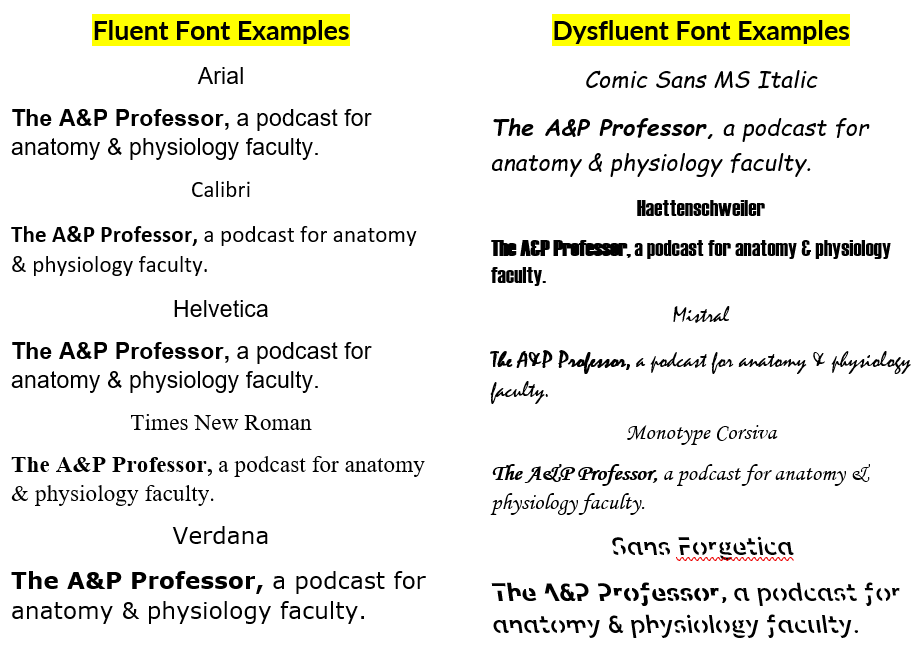
samples of fluent and dysfluent fonts


People

Contributors: David Curole, Terry Thompson

Mentions: Wendy Riggs, Natalie Wade, Jaime Chapman, Robert Bringhurst, Carla Delgado

Production: Aileen Park (announcer), Andrés Rodriguez (theme composer,  recording artist), Rev.com team (transcription), Kevin Patton (writer, editor, producer, host)


If the hyperlinks here are not active, go to TAPPradio.org to find the episode page.

★ More details at the episode page: theAPprofessor.org/podcast-episode-123.html

★ Transcript available in the transcript box: theAPprofessor.org/podcast-episode-123.html

★ Need help accessing resources locked behind a paywall? Check out this advice from Episode 32 to get what you need! my-ap.us/paywall

Take The A&P Professor experience to the next level!

theAPprofessor.org/community

Earn cash by referring other A&P faculty to this podcast:

theAPprofessor.org/refer

Tools & Resources

★ TAPP Science & Education Updates: theAPprofessor.org/updates

★ Amazon: amzn.to/2r6Qa3J

★ Text Expander: theapprofessor.org/textexpander

★ Rev.com: try.rev.com/Cw2nZ

★ Snagit & Camtasia: techsmith.pxf.io/9MkPW

★ Krisp Free Noise-Cancelling App: theAPprofessor.org/krisp

★ JotForm (build forms for free): theAPprofessor.org/jotform

★ QuillBot (writing tools): theAPprofessor.org/quillbot

★ The A&P Professor Logo Items: https://www.teepublic.com/stores/the-a-p-professor

Sponsors

★ Transcript and captions for this episode are supported by the American Association for Anatomy | anatomy.org

★ The Human Anatomy & Physiology Society provides marketing support for this podcast | theAPprofessor.org/haps

★ Distribution of this episode is supported by the Northeast College of Health Sciences online graduate program in Human Anatomy & Physiology Instruction (HAPI) | northeast.edu/hapi

Clicking on sponsor links helps let them know you appreciate their support of this podcast!

Follow The A&P Professor on  Twitter, Facebook, Blogger, Revue, Tumblr, or Instagram @theAPprofessor

The A&P Professor® and Lion Den® are registered trademarks of Lion Den Inc. (Kevin Patton)

As an Amazon Associate I earn from qualifying purchases. I may be compensated for links to sponsors and certain other links.


Click here to listen to this episode—or access the detailed notes and transcript.

Friday, February 16, 2018

Concept Maps Help Students Find Their Way| TAPP Radio 5


Use concept mapping for student learning and assessment.
Blood doping is a perennial news topic that helps apply central concepts of A&P.

If you cannot see the audio player click here.

(0:48) Blood doping stories related to the 2018 Winter Olympics (or in any context) are effective in helping student students apply and integrate diverse concepts in anatomy and physiology

(6:32) The featured topic is concept mapping and its uses in helps students learn and helping instructors assess learning and diagnose misconceptions and other learning concerns.
Sample concept map

Click here to listen to this episode—or access the detailed notes and transcript.

Monday, February 12, 2018

Cumulative Testing Makes Learning Last | TAPP Radio 4


Kevin shares his experience of using cumulative testing to strengthen long-term learning.
Use video walk-throughs to help students navigate your digital course platforms.
Sometimes other people's genes influence an individual's biological traits.

If you can't see the audio player, click here.

(0:50) Things will get a lot more interesting if listeners start calling in with questions, comments, teaching tips, programming suggestions, updates, ...or anything else on your mind!

(2:20) A recent article in Science explores the idea the genomes of parents and others can affect traits—not just the genes within the individual's genome. This concept of "genetic nurture" expands the notion of the measurable biological influences of genes.

(7:34) You can help your colleagues and others find episodes of this podcast by influencing the search algorithms that guide the process. How? By subscribing to The A&P Professor podcast in iTunes or your favorite podcast app. Even better, consider giving a rating and leaving a brief review. Unless you really hate my podcast, in which case, please click here. Fans, please click on one (or all of these):

(8:14) In this age of digital teaching and learning, we must be able to help our students navigate their digital platforms: learning  management systems, adaptive learning platforms, college/department/course websites, and more. Brief narrated video walkthroughs (screencasts) are simple and quick ways to provide clear guidance to individuals and whole classes.

(13:13) In the featured segment, Kevin shares his case story of using cumulative testing to strengthen long-term learning in his course. Using an easy method of adding a few questions from prior tests to each test and exam, Kevin was able to better prepare his students for the comprehensive final exam. And hopefully carry the essential concepts of A&P forward into future courses and careers.

More details at the episode page.
Transcript available at the script page.

taking an exam

Click here to listen to this episode—or access the detailed notes and transcript.

Monday, January 2, 2017

Checkmarks Make Me Happy

http://my-ap.us/2hBvIVL
It's true. Like most of you, I have a long list of tasks that need to be done in any one day or week.

I am pretty good about remembering what I have to get done by when, what I've already finished, and what has just been added to my plate. But my brain is not 100% reliable with that, so I make lists.

Sometimes these are lists on my computer desktop or in my online Task List. But those are too easily hidden. I have to see them to be reminded. So I often make paper lists. There is something very satisfying about having the kinesthetic experience of physically ticking something off my list with my trusty green pen.

I was talking about this last summer when I was presenting a bunch of practical tips to help textbook authors stay on track at the Textbook and Academic Authors conference. During the talk, my buddy Mike Kennamer tweeted, "'Checkmarks make me happy...' Kevin Patton". When I saw that tweet later in my Twitter feed, I chuckled that he took this out of the discussion—but I also realized how important a point that it is.

Whether it's a textbook revision or a long semester of teaching A&P, those little surges of dopamine that happen when we can check something off our lists really do help keep us motivated.  Seeing the progress we are making as we add ticks to our checklists provides some additional satisfaction, which also helps keep us going.

checklist with green checksAnd checklists also keep us from forgetting important things to do.

In an online course I teach, it's easy to forget what needs to be graded each week because there are no stacks of tests or papers sitting there on my desk glaring at me. Those assignments are hidden away on a server somewhere and I need to intentionally call them up to grade them. So I need a checklist. the one pictured here lists grading duties organized by module (we have two-week modules A, B, C,...) and by week.

Each Friday, during my scheduled grading session, I look at my checklist. I note that, even though it may not always feel like it, the trimester is actually progressing. And I see what I need to grade this week. And—hooray!—I get to check it off my list when I'm done. What a great way to start the weekend, eh?

I recently posted my grading checklist in that online course. It's a bit late for this last term, but next time I teach the course, my students can print out my checklist to help them keep track of what they've submitted each week. Sure, they have a syllabus. Like they're going to use that to make their own list? Really? What planet do you live on?

What can we use from this in teaching undergraduate A&P?


  • Grading checklists help us make sure that no graded assignments fall through the cracks.

  • Grading checklists provide happiness and motivation. At least a little.

  • Scheduled grading sessions help us keep up with our grading tasks, preventing them from piling up and disturbing our mental health.

  • We can share grading checklists (and an exhortation to use them) with students to help keep them on track—and stay motivated.


Monday, September 5, 2016

Cumulative Testing Enhances Learning

One of the most effective enhancements I've ever made to my human anatomy & physiology course was switching to cumulative testing. What I mean by that is instead of testing on each topic once, then moving on to a test on the next topic, I started testing my students on all the covered topics (thus far in the course) in each successive test.

I've always had a comprehensive exam at the end of the course—and eventually added a comprehensive midterm exam, too. I found that adding that midterm helped my students relearn what they'd forgotten during the first half of the semester—making them better prepared for the comprehensive final. But not a whole lot better.

As I got older and wiser—or at least grayer—and got more serious about seeking out solid research on how people actually learn new information and retain it for the long term, I realized that my thinking was sort of alongside the right track. But not fully on the right track. It finally dawned on me that I could not expect my students to really "get it" and "keep it" unless they were repeatedly challenged with a variety of test items that required them to dig back into their memories and drag out those "old" ideas from early in the course.

Learning experts sometimes call this retrieval practice. The students practice retrieving their stored knowledge and skills. One of the key elements of using retrieval practice in learning is that it is most effective when it is spaced out over time. That is, it occurs after the brain has had time to do some forgetting.

The "re-learning" and "re-remembering" that must happen after a spaced interval is one of the keys to getting it all solidly embedded into our memory. As my tai chi teacher always tells me, "you can't master it until you've forgotten it." The forgetting, making mistakes, and relearning also enhances our ability to get those concepts and skills back out of memory—thus enabling us to retrieve it when we need to apply it.

Of course, most of the effort in getting my course on the right track in this regard was getting over that same old, often insurmountable, hurdle of taking a step outside of the "way we've always done it." This nearly universal mindset not only holds me back from trying new things—it encourages my colleagues and students to tell me how wrong I am when I do.

After at least a year of self-doubt, I just forged ahead and tried it. Every one of my tests now includes test items from all previous topics. I told my students ahead of time why I was doing it and why. And guess what? They were okay with it! I didn't tell any of my colleagues what I was doing because, er, my internal voice was already telling me I was doing it all wrong.

And you know what? Without changing much else in my course that semester, the comprehensive exam grades—and even the course grades—went up almost a whole letter grade on average. In other words, my course activities and testing covered the same content, at the same level of rigor, but my students were apparent much more successful in their ability to recall the information and skills they need to solve problems at the end of the course.

This was about ten or so years ago, and I probably still have the numbers somewhere. I didn't do a statistical analysis and I didn't have a control group—unless you count sections of the course in previous semesters. But I didn't—and still don't—feel I really need that. My student grades that semester (and ever since) show a dramatic increase that I'm not willing to reverse.

Looking back through the lens of 20/20 hindsight, I can see that this should have been plain to me all along. How can we expect anyone to learn something deeply and for the long term, if they only get one chance to have their knowledge and skills challenged? Only through repeated challenges can we master concepts at a level of usefulness.

We expect our students to build a complete enough conceptual framework to see patterns and understand relationships among concepts. To really see the big picture. But do we give them enough practice to do that effectively? Or do we let them forget what they know and fail to give them those critical opportunities to relearn, thereby solidifying, key concepts?

In my experience, cumulative testing is a valuable strategy to enhance learning in our courses.


What can we use from this in teaching undergraduate A&P?


  • Adding items to every test that review all previous topics convert your testing strategy to cumulative testing. This may provide the repetitive, spaced retrieval practice that students need for learning for the long term.

  • Consider using a cumulative strategy for other forms of retrieval practice in your course. For example:
    • Quizzes
    • Clicker questions
    • Pre-lecture and pre-lab videos or reviews
    • Adaptive learning assignments
    • Homework/review assignments
    • In-class, small group reviews
    • Recommended study strategies for individuals and study groups

Want to know more?


The critical role of retrieval practice in long-term retention
  • Roediger H Butler A. Trends in Cognitive Sciences. 2011 vol: 15 (1) pp: 20-27. DOI: 10.1016/j.tics.2010.09.003
  • Scholarly review of the superiority of spaced retrieval practice over more traditional educational strategies.
  • my-ap.us/2cyDK0j


Make It Stick
  • Peter C. Brown, Henry L. Roediger, Mark A. McDaniel. Harvard University Press, Apr 14, 2014. 313 pages.
  • This is book written for the average teacher or student to help them understand what we now know about effective learning that may be different then the traditional approaches. You really need to read this book! It's well written, engaging, and has a wealth of great ideas.
  • amzn.to/2sfm40Q
Photos: Bob Smith

Thursday, September 24, 2015

Noisy A&P Classrooms and Labs

I'll never forget the feedback a dean gave me a few years ago when he visited my (then) new A&P supplement course. The feedback was memorable because it seemed to miss the whole point (learning outcomes) of the course!

Should A&P students always be quiet?
I was very happy with the way that day's class went. Meant to be an informal coaching and collaboration course to provide supplemental support for my human anatomy and physiology students, we had more fun than usual that day. Held in a teaching lab with about 22 students, we started with questions submitted on index cards as the students entered the room. They freely commented "Yeah!" to concerns about a topic being hard to understand. They piped up to give advice to the whole group about what worked for them.

Then we moved on to an active learning session with students working collaboratively in small groups. But not quietly. At all. Some occasionally "shouted" a remark to another group. Once or twice members of one group talked across the aisle to another group about their progress or to get "unstuck" on a concept. And few shouted, "Kevin! We need you over here!"

After that, we wrapped up with the usual "need for speed" activity where I'd put up slides of lab specimens—it was either bone markings or tissue types that day—and they'd have five or ten seconds to give the correct response with their clickers. A bit like a game show, my students are not shy about expressing their enthusiasm loudly. They groan when most of them get one wrong.  They cheer when most of them get it right. They sometimes, yell out a "No way that's hyaline cartilage!" and we have a chance to work out the "differential diagnosis" in a way that helps them all get better at identifying tissue types.

In fact, my students love the chaotic need-for-speed session so much that they complained that our class was just too short. So we eventually changed the schedule to give more time in class for this activity.

That classroom-visit day was particularly chaotic and raucous. And I walked out on cloud nine, as did my students. How often does such enthusiastic and effective learning take place?

So when I later met with my dean after the classroom visit, I was eager for his feedback. Being a fellow A&P teacher himself, known for his informal and playful approach to both teaching and college administration, I thought he'd have enjoyed the experience. And he did. But he expressed concern about the potential of the class being "so close" to getting "out of control."

Yikes. The aspect of the class that I had thought went particularly well, was seen by him as a cause for concern. And this guy is a bright, insightful educator who is usually very constructive in any criticism he gives. Being the self-analytical dude that I am, I spent many months thinking about this. I even discussed it with teaching colleagues and former students—was I doing it all wrong?

I (and others) eventually concluded that my dean wasn't fully appreciating the "big picture" of what was really going on that day—the way he usually does.

As a former lion tamer who presided over many raucous—but highly productive—training sessions, I can appreciate that anyone "outside the pride" may not understand what they are witnessing. It easily could seem more like a dangerous, chaotic, mess than a particularly wonderful day inside the lion den. They don't know the personalities of the animals (and people) involved, how their comfortable (and loud) relationship developed, and how the loudness was an indicator of enthusiasm rather than distraction (or menace).

So I was particularly heartened to read a blog post from the Center for Teaching Quality today on this very topic—learning is loud. Have a read yourself and see if there's anything you can glean from it that may fit your own teaching style—or that may want to make part of your teaching style.

There are some other related resources listed below, too!

Want to know more? 


Learning is Loud
  • J. Keigan. Center for Teaching Quality-Teaching in the Present Tense. 20 Sep 2015.
  • Blog post that explores the value of loudness in pre-college classrooms has lessons for college teachers, too. It was this post that dredged up the memory described above.
  • my-ap.us/1FwFv5R

When Is a Good Day Teaching a Bad Thing?
  • T. Slater. The Physics Teacher. 41, 437 (2003); doi: 10.1119/1.1616492
  • Brief article that contrasts the "hidden contract" of students keeping quiet may be at odds with successful teaching and learning.
  • my-ap.us/1FwJdMS

How ‘Deprogramming’ Kids From How to ‘Do School’ Could Improve Learning
  • K. Schwartz. KQED News - Big Ideas 15 Dec 2014
  • Brief article that explores the idea the many classrooms do not resemble what we know about how people learn best.
  • my-ap.us/1FwJGhW


Using Supplemental Courses to Reinforce Concepts and Promote Learning Skills
  • K. Patton. The A&P Professor. Accessed 24 Sep 2015.
  • Want to know more about the A&P Supplement course I referred to in this post? This online presentation explores a case study outline the use of supplemental courses to helps student prepare effectively for their first A&P course, and to improve their learning skills as they begin their first A&P course.
  • my-ap.us/fmemoT

Photo credits: click image

Tuesday, May 19, 2015

Testing as a Learning Tool | UPDATE

I radically changed my approach to testing my A&P students about 13 years ago. It was was one of those experiments that had me questioning my sanity leading up to its roll-out. That's because in some fundamental ways, it challenged my experience of how I and others had always thought about the role of testing in the learning process.

But when it did finally roll out in the first set classes in which I tried it, my new method of using tests as learning tools was a phenomenal success. The class averages on my exams went up by a whole letter grade! Students were working harder—but grumbling less. And student attitudes, which I'm grateful have always been pretty positive anyway, suddenly became downright sunny!

About six years ago, I published an article about online testing as a method of teaching in my blog The Electronic Professor. In the article, I shared my experience in using frequent online tests in my anatomy & physiology courses as a way to get students engaged with the material on an ongoing basis. It outlines how they used testing as a way of learning—promoting construction of a cognitive framework of concepts that helped them prepare for their in-class exams.

Almost a year later, research published in Science further supported this idea. Not that I needed the support . . . my own experience over many years has confirmed for me that it works. In fact, it works VERY well in enhancing student learning. But as a scientist, a variety of independent confirmations of a topic is always valuable and appreciated.

Of course, the concept of frequent, online formative testing (as opposed to summative testing) is not at all new. But like a lot of breakthroughs in teaching and learning, it hasn't caught on with many professors "out in the trenches" yet. But it's really worth taking a look at--and trying it out yourself.

First, check out an updated version of a seminar that I've given on this topic several times over the years.
Seminar: Testing as Teaching
  • Kevin Patton The A&P Professor.
  • Narrated presentation outlining a method to produce randomzed formative tests for A&P.
  • my-ap.us/qtAclX
Next, check out my article from 2009 to get my take on some reactions I've gotten from other professors.
Teaching as Testing
  • Kevin Patton. The Electronic Professor. 27 Feb 2009.
  • Article outlining my use of online, randomized formative tests in teaching A&P.
  • my-ap.us/p3rM6B
After that, take a look at the research published in Science a year ago.
To Really Learn, Quit Studying and Take a Test
  • Pam Belluck. The New York Times. 20 January 2011.
  • Brief summary of the research, including a graph of the results.
  • my-ap.us/yP6jZ0 
Retrieval Practice Produces More Learning than Elaborative Studying with Concept Mapping
  • J.D. Karpicke, J. R. Blunt. Science. Published Online January 20 2011. DOI: 10.1126/science.1199327
  • Original research mentioned above.
  • my-ap.us/yTr2b7
Next, read these brief articles on a few of the many adaptive learning tools that are now available to accompany many of the major A&P textbooks. Oh, if only I'd had something like this back then!
Students Have Fun and Learn Quickly with EAL Adaptive Learning
  • Kevin Patton. Anatomy & Physiology 18 March 2015
  • Article outlining a self-quizzing tool based on the popular Cerego system.
  • my-ap.us/1zgNLEg
Adaptive Quizzing Helps Students Get Ready for Tests and Exams
  • Kevin Patton. Anatomy & Physiology 25 March 2015
  • Brief article outlining a quizzing system that helps students prepare for their exams.
  • my-ap.us/1xzwB3W
Lastly, just take the plunge and try it. Come on—the water's fine and you'll have a blast!

Content updated from a
previous post in
The A&P Professor 
Photo: M. Bowden

Monday, September 29, 2014

No Red Pens!

Red F grade

All teachers use red pens to grade student work, right?  Not this teacher.  I haven't used a red pen in over a decade.  I have strong reasons for that.

Many years ago, I happened to be scanning some information about research on the psychological effects of colors.  I was planning a major overhaul of my writing studio and wanted to find a paint color that would not interfere with my focus and productivity—or perhaps even enhance my productivity.  That's when I ran across something that pointed out some unintended adverse effects of using a red pen for grading student work.

As we all know, red is an alarm color.  Red signals danger, right?  So it's alarming—perhaps downright scary—to see red.  That works great when you are designing a stop sign or painting an alarm box.  But perhaps it's not so great when you are trying to provide helpful feedback.

Yes, I know that red ink stands out from the black or blue ink in student work so it can be easily distinguished.  But you know what?  So does green ink!

I've found that making comments in green, whether praising a great effort or correcting an error, has an overall positive effect on reactions by my students.  Green is the color of growth and reassurance, after all.  A whole different signal than red's message of danger and anger.

There's some evidence that blue ink may be a better choice.  But some of my students use blue ink themselves, so my comments would blend in too much. I've had good luck with green, so I'm sticking with it for now.

It may just be that by switching to green ink, it was me that changed.  Perhaps every time I grade with a green pen, I'm reminded that I want to be nurturing and positive in my feedback—not mean and condescending.

Don't take my word for it!  Try it yourself.  I realize that this seems silly and trivial, but it works. I doubt whether you'll go back to red for grading again.


What can we use from this in teaching undergraduate A&P?


  • Grading papers and assigning grades in green sends a nurturing signal, not an angry message.
  • Providing written feedback in green to colleagues (peers, supervisors, subordinates) maintains a positive, constructive tone rather than an angry tone.

Want to know more?


Color and psychological functioning: The effect of red on performance attainment.

  • Elliot, A J. et al. Journal of Experimental Psychology: General, Vol 136(1), Feb 2007, 154-168. doi: 10.1037/0096-3445.136.1.154
  • Research reporting a negative effect of using red in learning situations.
  • my-ap.us/1qhNrNp

EFFECTS OF FOUR PSYCHOLOGICAL PRIMARY COLORS ON ANXIETY STATE. 

  • KW Jacobs and J. Suess Perceptual and Motor Skills 1975,Volume 41, Issue , pp. 207-210. doi: 10.2466/pms.1975.41.1.207
  • Research article showing that red tends to increase anxiety levels in undergraduates.
  • my-ap.us/VR3vud

Parents to teachers: No more red pencils

  • Associated Press. 4 March 2005
  • Article on reactions to grading in red.
  • my-ap.us/1vnk7JG

Red Ink May Lead to Lower Grades

  • Guy Raz National Public Radio 29 May 2010
  • Audio reporting on the unintended effects of color use in grading—actually affecting the grade.
  • my-ap.us/1rAJR4M

School Bans Teachers From Using Red Ink Because Everyone Knows Red Ink Is Mean

  • Maria Guido Mommyish 20 March 2014
  • Blog post by a mom reacting to a local school's ban on grading in red ink.
  • my-ap.us/1lwvV9v

Update


Monday, September 8, 2014

Pre-A&P


A story broadcast recently on National Public Radio (NPR) highlighted the role of a Pre-A&P course in student success.

Listen to the story yourself (link below) and tell me you don't recognize the issues brought up there.  Students failing A&P because they just don't know how to read a science textbook, don't know how to study, and don't have higher-order thinking skills.

You may recall my bringing up some of these issues in a recent blog post Help Your Students Get Off to a Good Start.

The story mentions a course to help students through these difficulties at West Kentucky Community and Technical College.  But I know of a lot of colleges that are taking this approach to improving student success, including my own.

Some of you have already participated in one of my past seminars on how we did it.  It involves a two-phase approach:

  • Pre-A&P Foundations in Science
    • An elective, developmental-level one-credit course.
    • Completely online, self-paced course.
    • Ten modules reviewing basic concepts needed for success in A&P:
      • Science Basics
      • Introductory Chemistry
      • Biological Chemistry
      • Introduction to Cells
      • Cell Transport
      • Getting Energy
      • Making Proteins
      • Introductory Genetics
      • Tissues
      • The Human Body
    • Each module is comprehensive, reviewing all prior modules.
    • Mastery-based: students proceed to the next module only if they pass the current module by 85% or better. 
    • Passing the comprehensive final exam at mastery level earns a "Pass" grade.

  • A&P 1 Supplement
    • An elective, 200-level one-credit course.
    • Runs concurrently with A&P 1 lecture/lab sequence.
    • Addresses basic study skills, as applied to what students are studying in A&P
    • Specifically addresses "trouble spots" typically encountered
    • Provides coaching and support of students in real time


What can we use from this in teaching undergraduate A&P?


Look at what others have done and consider trying your own version of Pre-A&P and/or supplemental A&P study-skills courses! 

If you are interested in our take on this, then listen to my seminar (link below). But I've helped several other colleges get their own version of this strategy off the ground, and it's working. 


Want to know more?


The Toughest Class In Nursing School Is The First One

  • Zoe Chace. Planet Money (NPR). September 02, 2014
  • Radio story of one example of Pre-A&P helping students (and increasing A&P success rates).
  • my-ap.us/1AfRNXV

Helping Students Succeed: Using Supplemental Courses to Reinforce Concepts and Promote Learning Skills

  • Kevin Patton. The A&P Professor. Accessed 5 September 2014.
  • Narrated video seminar with handout outlining my two-phase approach to helping A&P students succeed.
  • my-ap.us/1rIhHCD

Pre-A&P Foundations in Science

  • Kevin Patton. Lion Den. Accessed 5 September 2014.
  • Peek at some course documents describing my course.  Includes a brief video "rationale" for such a course (used to recruit students).
  • my-ap.us/1hZrKBm

A&P 1 Supplement

  • Kevin Patton. Lion Den. Accessed 5 September 2014.
  • Peek at some course documents describing my course.
  • my-ap.us/1rQkc8b

Survival Guide for Anatomy & Physiology

  • Kevin Patton. Lion Den. Accessed 5 September 2014.
  • In case you haven't seen it yet, this is a short description of my handy student-success handbook.
  • my-ap.us/16aa5zg

Thanks Maureen Loomer at Wayne Community College for passing along the NPR story!


Monday, August 11, 2014

Start A&P 1 with a Comprehensive Exam. Really.


A while back, I recommended starting the second semester of A&P 2 with an exam. In that article, I stated that it's a good opportunity to get everyone started on the right track—and on the same track—before jumping right back into it.

If you think about it, even the first semester of A&P is "jumping back into it."  That is, if we assume that our students have had some learning in biology already.  Don't we want them to already know at least a little bit about:
  • basic chemistry (like what an atom is)
  • cell biology (at least what a cell is and perhaps a few organelles)
  • scientific terminology (like what roots, prefixes, and suffixes are)
  • genetics (what a gene is, what DNA stands for, basic inheritance)
  • metric system (at least the basics)
  • main organs of the body (like what a muscle or stomach is)
Then why not start them off with an open-book online or take-home exam covering these topics?  Or more topics?  Or fewer?

By starting off with a low-pressure "open" exam, we accomplish several goals:

  • Students learn how we will be testing them.  
    • They'll become comfortable with the formats we use for test items, how our LMS quizzes work, how to fill out an exam book (or scan sheet or test paper), our personal quirks in testing, the depth and breadth of our assessments, and more.

  • They review-refresh-solidify their prior learning.  
    • The "review exam" is a learning experience in and of itself, making sure that students fill in any gaps that may have occurred since they last encountered these concepts—even if they finished their last bio course only a few weeks ago.

  • Solves the "we don't have a prerequisite for A&P" problem.  
    • Well, it doesn't completely solve it.  But it does put quite a dent in it.

  • Allows students to work at their own pace to catch up.
    • Some students will breeze through their review.  Others will wonder how they missed (or forgot) all these concepts.  Still others have challenges in learning, reading, remembering, using English, and more.  This will help even out the playing field, at least at the start of the game.

  • You won't have to wonder what they've learned before reaching you.
    • The review will ensure that they know the concepts you want them to know before they begin.  And which terminology you'll using.

  • Saves you time in your course.
    • By not having to stop and review basic concepts when your students stumble, you have more class time for learning activities.

  • Students will have less of that oppressive, overwhelming feeling of stress a few weeks into A&P.
    • Many students, especially returning learners, feel like they are drowning because of the pace and sheer volume of information in their A&P course.  But a review exam can get a lot of that "you should already know this"— "I should perhaps, but I don't"—stress out of the way from the get-go.

  • Gives students confidence as they face their new challenges in your course.
    • This one cannot be overstated.  Much of our success in learning comes from how confident we are in our preparedness and our abilities.  A review exam can be a positive learning experience that establishes a good attitude for learning from the beginning. And it won't be false confidence—they really will know the foundational concepts they need for success in A&P!


Want to Know More?


Start A&P 2 with a Final Exam

  • Kevin Patton. The A&P Professor.   21 Jan 2013
  • My previous article on using the first exam in the second semester of A&P to review, refresh, and solidify concepts from A&P 1.
  • my-ap.us/1lKVnTh


Teaching as Testing
  • Kevin Patton. The Electronic Professor 27 Feb 2009
  • Article outlining my use of randomized online testing as a mechanism of needed practice.  Includes links to a full video presentation.
  • my-ap.us/p3rM6B

Practice. Practice. Practice.
  • Kevin Patton. Lion Tamers Guide to Teaching 3 Dec 2010
  • Article on the role of practice in teaching and learning, using the analogy of taming lions.
  • my-ap.us/WjNHLn
Image credit: kelvinsong

Wednesday, July 16, 2014

The Life Science Teaching Resource Community

Have you heard that the American Physiological Society (APS) has expanded their Archive of Teaching Resources into The Life Science Teaching Resource Community?

This new online community—LifeSciTRC for short—offers thousands of FREE resources that you can use in your A&P course!

This transition marks a culmination of efforts of APS and several other scientific societies to advance the Archive of Teaching Resources beyond an online library into a community of practice for life science educators at the K-12, undergraduate, graduate, and professional levels.

The LifeSciTRC offers more than 6,000 free, scientifically-accurate teaching resources along with many new tools that allow educators to share their ideas and teaching expertise including:
  • Community pages with news and recommended teaching resources
  • Blogs focusing on classroom and science topics relevant to educators
  • Forums for educator-led discussions
  • Resource rating and commenting areas where educators can share their experiences of using resources
  • Monthly newsletters highlighting community members, news, and resources
I can't speak highly enough of the quality and diversity of teaching resources available in the archive.  These are peer-reviewed submissions from all levels of teaching and learning.  Case studies, experiments, demonstrations, slide presentations—all kinds of great stuff!

The new system is really easy (and fun) to use.  It has a starred rating system, so you can see how others have rated each resource.  And you can earn badges by submitting and reviewing items.

In addition to the new name, the LifeSciTRC will feature three new scientific society partners:
  • The Physiological Society
  • Genetics Society of America
  • American Society of Plant Biologists
These societies will join the current partners:
  • APS
  • Human Anatomy and Physiology Society
  • Society for Developmental Biology
  • American Association of Anatomists
  • Massachusetts Society for Medical Research
  • Northwest Association for Biomedical Research
Educators looking for new teaching ideas or interaction with other educators are invited to visit LifeSciTRC.org and discover what they have to offer.

For more information, contact our colleague at APS, Miranda Byse, PhD, Program Manager at mbyse@the-aps.org or 240-743-8045.  Be sure to tell her where you heard the message!

Some content in this post came from APS

Friday, June 13, 2014

Online lectures and previews


For many years, I've been producing online lecture presentations as previews and supplements to the classroom experience in my A&P courses. Sometimes, I use these to keep "teaching" while away at a conference or meeting.

In 2006, long before "flipping" became a common phrase among professors, I decided to make my classroom more interactive by putting some of the "you don't really need me in person for this"  material online for preview before coming to class. I wasn't creative enough to call it something catchy and cool like flipping, but simply it "Preview Presentations." For each module in the course, students were required to watch these before coming to class for discussion, questions, and additional lecture presentations on the "hard to understand" concepts that require some back-and-forth between me and my students.

I summarized my case of putting interactive, narrated PowerPoints that include built-in self-testing quizzes in an online presentation on our companion website The A&P Professor.  That was a version of a well-received workshop I presented at a regional HAPS conference in Macon GA a few years ago.

Recently, I re-created my presentation to focus on the latest generation of software plugin that allows for video or audio narration and more types of interactivity in quizzes.

Rather than summarize my experience here and suggest ways that you might consider adapting some of it to your A&P course, I'll just give you the link to my presentation (using said technology) that includes a summary handout that you can print out:

Sunday, May 26, 2013

Student success strategies at HAPS 2013

If you happen to be here in Las Vegas at the 2013 Human Anatomy and Physiology Society (HAPS) Conference, then you may want to check out my workshop on Tuesday morning:

105

Helping A&P Students Succeed: 
Using Supplemental Courses and Workshops to Reinforce Concepts and Promote Learning Skills

LAS 221
Kevin Patton and Suzanne Hembrough
St. Charles Community College, Cottleville, MO 

Do your A&P students struggle with the whole process of learning? Do they seem ill prepared in their study skills and their knowledge of basic principles of biology? Explore case studies in which optional student workshops and short supplemental courses provide underprepared and unskilled students with knowledge and skills that make them better able to succeed in the A&P course and beyond. You will also receive free resources to help your own students succeed.

Monday, October 12, 2009

Virtual autopsies


Wow, this goes on my wish list for the holiday season. Take a look at the Virtual Autopsy system at visualiseringscenter.se

After scanning a body, users can manipulate the images on what my editor, Jeff Downing, calls "an iPhone on steroids." It's a big table-top, touch-screen monitor that shows high-resolution 3D images of the scanned body.

The creators tout their project as a potential solution to situations where traditional autopsies cannot be performed (for example, in areas where cultural taboos prohibit it). It can also be a complement to traditional autopsies because it can show things that may not be visible during the routine type of examination.

Besides the gee-whiz, ain't that cool factor you'll experience when you check it out, you may want to consider showing one of the FREE video clips to your students to show them what's happening out there on the cutting edge of anatomy applications. This might be a great bit to add to your "first lecture" dog-and-pony show to get your students engaged and excited about human A&P.

There are also some cool case study ideas included at the demo page.

If you get one of these things, let me know. I want to come and play with it!

Visual Analogy Guides


Well, it's "book order" time here at my college and I'm going to be recommending a series of student supplements for A&P that I've found to be really, really helpful. The Visual Analogy Guide series has been used by my students for a couple of years now and my students love them.

Created by my friend Paul Krieger at Grand Rapids Community College (GRCC), the Visual Analogy Guides really meet the students where they are at to help them master some of those little tricks for learning the core concepts of an A&P course.

Using his considerable skills as an illustrator and his great talent as a teacher, Paul has put together some great tools that help students focus their study time by using visual and kinesthetic processes to help them learn "the hard parts" of A&P.

Check out his video
, in which he explains how the Visual Analogy Guides work.

Tuesday, March 3, 2009

My use of clickers

I've already sung the praises of using student response systems (clickers) as a really effective teaching tool.

I know you don't believe me. I didn't believe the "true believers" either . . . for a while. But eventually I "got it" and well . . . forgive me . . . I'm now a missionary for the cause.

Want to hear my "testimony" . . . even if it's just to knock holes in it?

i>clicker, the company that makes the system that I use, has recently published my case at their website . . . along with testimonials from other biology faculty (and faculty across many disciplines).

Check out My clicker case at my The Electronic Professor blog for an intro to my case . . . and the link to find it.

Tuesday, November 25, 2008

Drop.io (The Next Generation)


Y'all know how much I've been raving about the drop.io "instant web locker" and its potential uses for communicating with our students . . .

Well, they just keep rolling out new improvements! So a great tool just keeps getting better!

I recently heard about the rollout of the "next generation" or redesign of drop.io . . . and "dropped" you a phone message moments later at this blog's "sample drop" at
[NOTE: those of you who have already "subscribed" to or regularly visit the drop heard about this redesign yesterday . . . when I dropped a voicemail there.]

drop.io, as they say, is the simplest way to privately share any sort of media or data online, period.

In literally a matter of 2 clicks with no registration drop.io allows you to take anything ranging from photos and video to documents, voice notes, web links, email etc. add them all to a private space online, and then share them with exactly whom you want, how you want, for as long as you want.

Files you share on drop.io are not searchable, and they are not networked. In a sense, each 'drop' you make is a very simple private 'website' which you can password protect and set to expire, designed to help you take control of how you share.

This is an easy way to make a course blog!

With this release drop.io is making the interface significantly easier to interact with, and adding both customization options, and much richer collaboration options (with things like in-line commenting).

Want to check it out? There are details at http://drop.io/blog


There is a great video explanation you can spin through http://drop.io/howto

and there's a drop with some media about the redesign http://drop.io/redesign2008

Please let me know if YOU are using drop.io, and how you are using it!

{a few statements in this message were adapted from a drop.io email}

Tuesday, November 18, 2008

At the Clicker Conference!


Remember that Clicker Conference I recommended?

I didn't see any of you there! What's with that?!

Oh well, I guess you knew that anything wonderful I learned would eventually get back to you, right? Of course . . .

I can't give it all to you in one dose, so here's the first little bit . . .

The folks at i>clicker hosted a reception the night before the conference. Kevin's Rule #1 of professional conferences is "always go to the cocktail parties." Even if you don't drink cocktails (or anything at all), there's usually some goodies to be had there. I don't mean stuff to eat. Well, OK, I do mean that. But also . . . it's a great opportunity to meet people and learn things and expand your professional network.

Of course, Kevin's Rule #1 worked like a charm this time, too.

One of the many wonderful folks I met was Derek Bruff, who has written a book about the best practices in using clickers in your classroom. The book is about to come out and, after hearing Derrek's stories about all he learned when interviewing all kinds of master teachers who use clickers, I can't wait to read it!

You can learn more about Derrek and his book at his blog Teaching with Classroom Response Systems. While you're there you can learn some things about the conference and about teaching with clickers.

Coming soon . . . specific lessons I learned at the conference . . . and why you really should consider using clickers in your classroom!


Don't forget about my online clicker seminar!

Tuesday, October 21, 2008

drop.io Firefox Extension

Wow this drop.io thing is fun!

What, you ask, is drop.io? Just go back to my original article on drop.io to find out that it's a nifty FREE web tool to communicate and share with students, colleagues, or total strangers.

I just found out that they have a Firefox plugin that adds just one more set of magical features to an already crazy magical tool.

First, if you haven't been using Firefox browser, which is a FREE download from Mozilla, then why not?!

It's a great browswer and has a bazillion (or so) plugins and ways to customize it.

Firefox 3

One of the plugins is the one from drop.io, which adds "drag 'n drop.io" features to Firefox.

After downloading and installing the plugin (just a few keystrokes as you regular Firefox users know), a small red drop.io dot (see the logo pictured here) will appear in the lower toolbar of the browser frame. You can drag files or web items to the red dot and a drop.io drop is created automatically with your item(s) right there already in it! Wow.

Or if you have a particular drop open, you can just drag things into the screen where the drop appears and they'll now be part of the drop.

Click here for the link to the drop.io demo on this plugin. It does even more that I'm saying, but they say it better than I do! I'll also drag it into the A&P Professor sample drop using the plugin itself (hey, I want to play with it, OK?).

Go ahead into the drop (especially if you have yet done so), and be sure to sign up for notifications of new drops (by email, text messages, or whatever). That's because I continue to drop things there and you'll want to see/hear/watch them.

AND you'll want to gain some experience with drop.io so you'll be comfortable using it for your own courses/committees/poker clubs.

[Remember the drop password? APROCKS]