Showing posts with label tests. Show all posts

Tuesday, September 20, 2022

Fonts, Syllabi, and Poop | TAPP 123


Host Kevin Patton revisits the concept of using the syllabus and other course documents to build a positive and productive course culture. Poop—it's everywhere! Does the font or typeface we use affect students—especially regarding learning and memory? We look for answers in this episode!

00:00 | Introduction

00:52 | Revisiting the Syllabus

16:28 | Poop. Poop. Poop.

19:00 | Sponsored by AAA

19:59 | Fonts Are Important in Teaching & Learning

30:54 | Sponsored by HAPI

31:57 | Desirably Difficult Reading?

42:00 | Sponsored by HAPS

43:00 | Fluent & Dysfluent Fonts

56:12 | Staying Connected


★ If you cannot see or activate the audio player, go to: theAPprofessor.org/podcast-episode-123.html

🏅 Apply for your credential (badge/certificate) for listening to this episode: theAPprofessor.org/podcast-episode-123.html/#badge

❓ Please take the anonymous survey: theAPprofessor.org/survey

☝️ Questions & Feedback: 1-833-LION-DEN (1-833-546-6336)

✔️ Follow The A&P Professor on Twitter, Facebook, Blogger, Revue, Tumblr, or Instagram! @theAPprofessor

📰 Get the thrice-weekly TAPP Science & Education Updates theAPprofessor.org/updates


Typography must often draw attention to itself before it will be read. Yet in order to be read, it must relinquish the attention it has drawn. (Robert Bringhurst)


Revisiting the Syllabus

15.5 minutes

Creating and nurturing a course culture can be influenced by our syllabus and other course materials. We revisit this idea with a few more tips and tweaks.

Anatomy &; Physiology Syllabus: It's an Art | TAPP 120

Are We Answering Student Questions? | Science Updates | TAPP 92

★ Wendy Riggs has a huge collection of anatomy, physiology, and general bio, instructional videos she uses in her flipped classes youtube.com/user/wendogg1

★ Natalie Wade has engaging short videos about A&P content and study tips at The Anatomy Gal youtube.com/c/TheAnatomyGal

★ Jamie Chapman has a collection (Chapman Histology) of short (under 3 minutes) videos guiding students through lessons in histology youtube.com/c/ChapmanHistology
Fonts, Syllabi, and Poop | TAPP 123


Poop. Poop. Poop.

2.5 minutes

After releasing The Poop Episode | Using Fecal Changes to Monitor Health | TAPP 121, I learned of a whole movement of poop listening on smart speakers. And that there are actually poop songs that are viral hits. Really.

★ When kids yell 'Alexa, play poop,' you'll hear these songs (story from All Things Considered on National Public Radioo) AandP.info/wv2

The Foot Book (Bright & Early children's book by Dr. Seuss; can be read as The Poop Book) geni.us/afvGc

★ CHOC Stool Diary AandP.info/4yq

★ Bowel Symptom Journal (from Alberta Health Services) AandP.info/6fw

★ Poop Apps: 5 Tools for Tracking Your Stools AandP.info/5ow


Sponsored by AAA

56 seconds

A searchable transcript for this episode, as well as the captioned audiogram of this episode, are sponsored by the American Association for Anatomy (AAA) at anatomy.org.

Searchable transcript

Captioned audiogram 

Don't forget—HAPS members get a deep discount on AAA membership!

AMERICAN ASSOCIATION FOR ANATOMY STATEMENT OF RESPONSIBILITY FOR ITS HISTORY OF RACISM (Press release from AAA, giving the full text of the statement) AandP.info/eei

AAA logo


Fonts Are Important in Teaching & Learning

11 minutes

At the suggestion of listener Dr. David Curole, we examine the roles that different fonts can play in teaching, learning, and memory. This segment reviews some past discussions of fonts, then introduces some new concepts of using fonts in teaching. Featured is a Word Dissection of the terms fluent font and dysfluent (disfluent) font.

Communication, Clarity, & Medical Errors | Episode 55

Anatomy & Physiology Syllabus: It's an Art | TAPP 120

Why Anatomy & Physiology Students Need Sectional Anatomy | TAPP 116


Sponsored by HAPI Online Graduate Program

59 seconds

The Master of Science in Human Anatomy & Physiology Instruction—the MS-HAPI—is a graduate program for A&P teachers, especially for those who already have a graduate/professional degree. A combination of science courses (enough to qualify you to teach at the college level) and courses in contemporary instructional practice, this program helps you be your best in both on-campus and remote teaching. Kevin Patton is a faculty member in this program at Northeast College of Health Sciences. Check it out!
northeastcollege.edu/hapi

Logo of Northeast College of Health Sciences, Human Anatomy & Physiology Instruction

Desirably Difficult Reading?

10 minutes

The article How Fonts Affect Learning and Memory by Carla Delgado takes our conversation a step further by looking the potential role of dysfluent fonts in learning.

★ How Fonts Affect Learning and Memory (article in Discover Magazine by Carla Delgado mentioned in this segment) AandP.info/wof

★ A Review of the Cognitive Effects of Disfluent Typography on Functional Reading (review article from The Design Journal) AandP.info/mwt

★ Fortune Favors the Bold (and the Italicized): Effects of Disfluency on Educational Outcomes (article from Proceedings of the Annual Meeting of the Cognitive Science Society) AandP.info/jjt

★ Changing Fonts in Education: How the Benefits Vary with Ability and Dyslexia (article from The Journal of Educational Research) AandP.info/yt4

★ Fluency and the Detection of Misleading Questions: Low Processing Fluency Attenuates the Moses Illusion (article from the journal Social Cognition) AandP.info/jul


Sponsored by HAPS

56 seconds

The Human Anatomy & Physiology Society (HAPS) is a sponsor of this podcast.  You can help appreciate their support by clicking the link below and checking out the many resources and benefits found there. Watch for virtual town hall meetings and upcoming regional meetings!
Anatomy & Physiology Society

theAPprofessor.org/haps

HAPS logo


Fluent & Dysfluent Fonts

13 minutes

We identify some potentially fluent fonts, as well as a few dysfluent fonts (see image below or at AandP.info/ihy). Sans Forgetica font was developed specifically to be dysfluent in a way that promotes remembering what is read. Does it work? Should we incorporate dysfluent fonts in our teaching materials?

★ Fonts and Fluency: The Effects of Typeface Familiarity, Appropriateness, and Personality on Reader Judgments (thesis by Tim Wang) AandP.info/0hf

★ Previously claimed memory boosting font 'Sans Forgetica' does not actually boost memory (story from ScienceDaily) AandP.info/zp4

★ The science of Sans Forgetica - The font to remember (video from the creators of Sans Forgetica) AandP.info/ox5

★ An unforgettable year – Sans Forgetica turns one (article from the RMIT University website) AandP.info/fo3

★ Sans Forgetica: Study Mode by RMIT University (plugin for Chrome browser lets you read any web page in Sans Forgetica) AandP.info/fc3

★ Sans Forgetica (free download for personal use) AandP.info/o4g

★ Can very small font size enhance memory? (article from journal Memory & Cognition) AandP.info/rlk

★ Sans Forgetica is not desirable for learning (article from the journal Memory) AandP.info/hmu

★ The role of font size and font style in younger and older adults' predicted and actual recall performance (article from
Neuropsychology, development, and cognition. Section B, Aging, Neuropsychology and Cognition) AandP.info/r6s
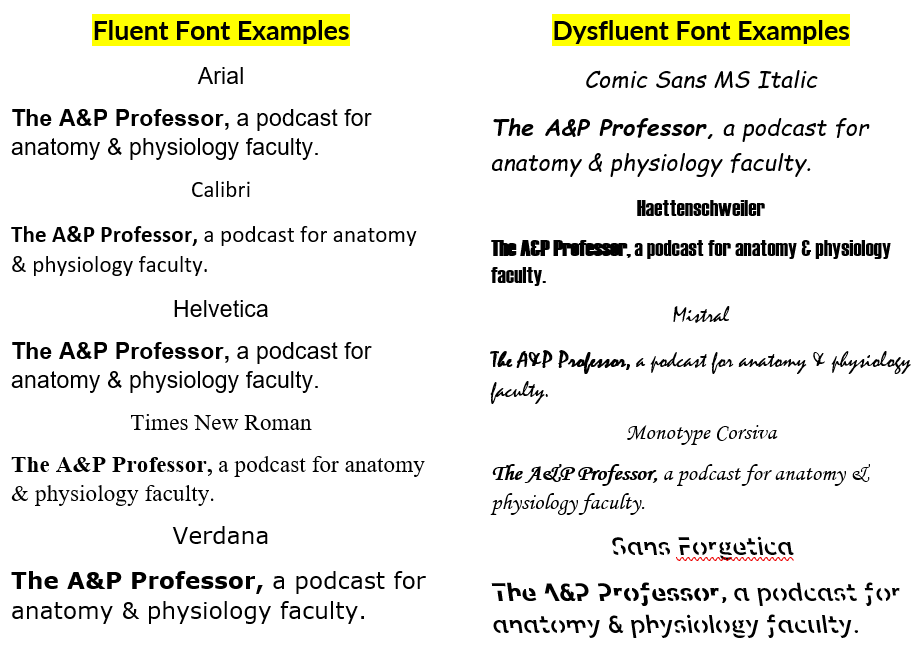
samples of fluent and dysfluent fonts


People

Contributors: David Curole, Terry Thompson

Mentions: Wendy Riggs, Natalie Wade, Jaime Chapman, Robert Bringhurst, Carla Delgado

Production: Aileen Park (announcer), Andrés Rodriguez (theme composer,  recording artist), Rev.com team (transcription), Kevin Patton (writer, editor, producer, host)


If the hyperlinks here are not active, go to TAPPradio.org to find the episode page.

★ More details at the episode page: theAPprofessor.org/podcast-episode-123.html

★ Transcript available in the transcript box: theAPprofessor.org/podcast-episode-123.html

★ Need help accessing resources locked behind a paywall? Check out this advice from Episode 32 to get what you need! my-ap.us/paywall

Take The A&P Professor experience to the next level!

theAPprofessor.org/community

Earn cash by referring other A&P faculty to this podcast:

theAPprofessor.org/refer

Tools & Resources

★ TAPP Science & Education Updates: theAPprofessor.org/updates

★ Amazon: amzn.to/2r6Qa3J

★ Text Expander: theapprofessor.org/textexpander

★ Rev.com: try.rev.com/Cw2nZ

★ Snagit & Camtasia: techsmith.pxf.io/9MkPW

★ Krisp Free Noise-Cancelling App: theAPprofessor.org/krisp

★ JotForm (build forms for free): theAPprofessor.org/jotform

★ QuillBot (writing tools): theAPprofessor.org/quillbot

★ The A&P Professor Logo Items: https://www.teepublic.com/stores/the-a-p-professor

Sponsors

★ Transcript and captions for this episode are supported by the American Association for Anatomy | anatomy.org

★ The Human Anatomy & Physiology Society provides marketing support for this podcast | theAPprofessor.org/haps

★ Distribution of this episode is supported by the Northeast College of Health Sciences online graduate program in Human Anatomy & Physiology Instruction (HAPI) | northeast.edu/hapi

Clicking on sponsor links helps let them know you appreciate their support of this podcast!

Follow The A&P Professor on  Twitter, Facebook, Blogger, Revue, Tumblr, or Instagram @theAPprofessor

The A&P Professor® and Lion Den® are registered trademarks of Lion Den Inc. (Kevin Patton)

As an Amazon Associate I earn from qualifying purchases. I may be compensated for links to sponsors and certain other links.


Click here to listen to this episode—or access the detailed notes and transcript.

Monday, January 28, 2019

Big Year in Anatomy & Physiology Teaching with The A&P Professor | Episode 36


0:42 | Adam Rich Asks About Student Feedback
10:32 | New Type of Vessel in Bones
14:17 | Big Ideas: Content Updates & Applications
20:15 | Big Ideas: This Podcast
20:45 | Big Ideas: Featured Ideas of the Year
29:45 | Big Ideas: Wrapping Up the Year

If you cannot see or activate the audio player click here.

Questions & Feedback: 1-833-LION-DEN (1-833-546-6336)
Follow The A&P Professor on Twitter, Facebook, Blogger, Nuzzel, Tumblr, or Instagram!

"Do what you can, with what you have, where you are."  (Theodore Roosevelt)

1 | Adam Rich Calls In

10 minutes
Kevin responds to a call from Adam Rich of SUNY Brockport regarding giving students feedback/corrected responses in online tests.

 Online testing


2 | New Type of Vessel in Bones

3.5 minutes
Scientists have discovered a system of small vessels that cross every part of a bone's cortical layers to supply most of the bone's blood—over 80% of the arterial supply and 59% of venous drainage. The proposed name is trans-cortical vessels (TCVs).
  • We’ve discovered a new type of blood vessel in our bones (brief article summarizing the discovery) my-ap.us/2B6tHce
  • A network of trans-cortical capillaries as mainstay for blood circulation in long bones (full research article) my-ap.us/2B6ttSq

 bone vessels


3 | Big Year: Content Updates & Applications

6 minutes
The first of several segments in a "debriefing" of the first year of this podcast.
This year brought many content updates and brief teaching snippets, from using green pens for grading to the role of platelets in immunity. Too many to mention, but Kevin gives his best shot at listing some of those that seem to be most memorable.
 Animated BP Categories


4 | Big Year: Evolution of This Podcast

9.5 minutes
What are show notes and how do they differ from the episode page? How best to listen and share? What's the episode list (theAPprofessor.org/podlist)? Preview episodes! And a word about our sponsors:
HAPS logo
The Human Anatomy & Physiology Society (HAPS) is a sponsor of this podcast. Did you know there's a one-day regional HAPS conference in March? Check it out. You can help appreciate their support by clicking the link below and checking out the many resources and benefits found there.

American Association of Anatomists
The searchable transcript for this episode, as well as the captioned audiogram of this episode, are sponsored by The American Association of Anatomists (AAA) at anatomy.org


5 | Big Year: The Big Ideas of the Past Year

 11 minutes
Each full episode usually has a "featured topic." This segment reviews some of the major topics and themes that emerged during the first year of the podcast.  From caring-empathy-compassion to integrity to storytelling, and from testing-as-teaching to elephant skin to learning science, a lot was covered! And what about those guest interviews--the Learning Scientists, media expert Barbara Waxer, anatomy educator Aaron Fried, and artist-professor Paul Krieger? And let's not forget those "lucky numbers"!
 one year

5 | Big Year: Wrapping Up

2 minutes
What do you want me to cover? I have some ideas, of course. But I want to hear  your ideas, too!
1-833-LION-DEN
1-833-546-6336
podcast@theAPprofessor.org
@theAPprofessor (Facebook, Twitter, Instagram, Pinterest, and beyond)

If the hyperlinks here are not active, go to TAPPradio.org to find the episode page.

Amazon referrals help defray podcasting expenses.
Transcript and captions for this episode are supported by the
American Association of Anatomists.anatomy.org


The Human Anatomy & Physiology Societyalso provides support for this podcast. theAPprofessor.org/haps

(Clicking on sponsor links 
helps let them know you appreciatetheir support of this podcast!)

Click here to listen to this episode—or access the detailed notes and transcript.

Monday, December 17, 2018

Test Frequency in the A&P Course | TAPP Episode 33


0:41 | Hair color inheritance
7:07 | Sponsored by AAA
7:21 | Building body maps
10:14 | Preview episodes
11:39 | Sponsored by HAPS
12:11 | Featured: Test frequency in the A&P course

If you cannot see or activate the audio player click here.
Questions & Feedback: 1-833-LION-DEN (1-833-546-6336)
Follow The A&P Professor on Twitter, Facebook, Blogger, Nuzzel, Tumblr, or Instagram!

Every science begins as philosophy and ends as art. (Will Durant)

1 | Hair color inheritance

3.5 minutes
New information about the inheritance of red hair shows that there's a lot more to it than just having two copies of the red-hair version of the gene MC1R. A lot more. Maybe its not just polygenic, but perhaps omnigenic.
  • Hair colour gene study sheds new light on roots of redheads' locks (summary of the update) my-ap.us/2zYXkeL
  • Genome-wide study of hair colour in UK Biobank explains most of the SNP heritability (the research article in Nature Communications) my-ap.us/2zWWIpU
 red-haired boy


2 | Sponsored by AAA

0.5 minute
The searchable transcript for this episode, as well as the captioned audiogram of this episode, are sponsored by The American Association of Anatomists (AAA) at anatomy.org

 American Association of Anatomists


3 | Building body maps

3 minutes
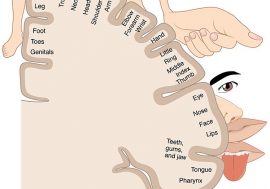
It turns out that all that kicking inside the uterus during the last trimester of pregnancy has a role in the mapping of our body in the somatosensory cortex.
  • Babies kicking in the womb are creating a map of their bodies (summary of the update; includes videos) my-ap.us/2A0t8jv
  • Newborn babies' brain responses to being touched on the face measured for the first time (some related news) my-ap.us/2zWX3ZI
  • Developmental trajectory of movement-related cortical oscillations during active sleep in a cross-sectional cohort of pre-term and full-term human infants (the research article in Scientific Reports) my-ap.us/2A0lcib
 Sensory homunculus


4 | Preview episodes

1.5 minutes
If you haven't been listening to the preview episodes released shortly before each full episode, try them out! Then let me know what you think.


5 | Sponsored by HAPS

0.5 minutes
The Human Anatomy & Physiology Society (HAPS) is a sponsor of this podcast. Did you know there's a one-day regional HAPS conference in March? Check it out. You can help appreciate their support by clicking the link below and checking out the many resources and benefits found there.
Anatomy & Physiology Society  |  theAPprofessor.org/haps
 HAPS logo

6 | Test frequency in the A&P course

13.5 minutes
Listener Krista Rompolski calls in and asks Kevin for his opinion on the best frequency of tests for the undergraduate A&P course.
Here are some previous episodes outlining Kevin's testing practices (and why he does it that way):
Here's the episode in which The Learning Scientists talk about the value of retrieval practice

tests & exams
If the hyperlinks here are not active, go to TAPPradio.org to find the episode page.
Amazon referrals help defray podcasting expenses.

Transcript and captions for this episode are supported by the American Association of Anatomists.anatomy.org

The Human Anatomy & Physiology Society also provides support for this podcast.theAPprofessor.org/haps

(Clicking on sponsor links helps let them know you appreciate their support of this podcast!)

Click here to listen to this episode—or access the detailed notes and transcript.

Monday, December 3, 2018

Helping Students With Test Anxiety | TAPP Episode 32 | BONUS


  0:53 | It's a BONUS episode!
  1:15 | Mitochondrial inheritance
  4:28 | Cardiac stem cells
  6:48 | Sponsored by HAPS
  7:20 | Help getting journal articles
11:18 | Sponsored by AAA
11:31 | Featured: Helping students with test anxiety

If you cannot see or activate the audio player click here.
Follow The A&P Professor on Twitter, Facebook, Blogger, Nuzzel, Tumblr, or Instagram!
I'm trying to stay as calm as possible and focus one day at a time, but when reality sets in, I feel everything: anxiety, excitement, nerves, pressure and joy. (Shawn Johnson)
This is a BONUS episode—which means it's a long one!

1 |Mitochondrial inheritance 3 minutes
New research shows that in some cases, paternal mtDNA may be passed along to offspring in a pattern that resembles autosomal dominant inheritance.
  • Biparental Inheritance of Mitochondrial DNA in Humans (research article) my-ap.us/2PeptDl
mtDNA
2 | Cardiac stem cells 2 minutes
Do cardiac stem cells exist? We thought so. But maybe not.
  • Dozens of Retractions Requested for Heart Stem Cell Studies (news item) my-ap.us/2PanzUx
  • Adult Cardiac Stem Cells Don’t Exist: Study (news item) my-ap.us/2Pdvdxg
  • More Doubt Cast Over Cardiac Stem Cells (older news item) my-ap.us/2Pd9a9O

3 | Sponsored by HAPS 0.5 minutes
The Human Anatomy & Physiology Society (HAPS) is a sponsor of this podcast. Did you know there's a reduced "early bird" registration rate for the annual HAPS confercnce in Portland OR next May? Check it out. You can help appreciate their support by clicking the link below and checking out the many resources and benefits found there.
Anatomy & Physiology Society  |  theAPprofessor.org/haps

HAPS logo

4 | Help getting journal articles 4 minutes
Follow one of my links (or some other hyperlink) and it takes you to journal article that's behind a paywall? Kevin explains a legal, ethical way to access the full article with no costs to you. You'll have to listen to hear this super secret trick!

5 | Sponsored by AAA 0.5 minute
The searchable transcript for this episode, as well as the captioned audiogram of this episode, are sponsored by The American Association of Anatomists (AAA) at anatomy.org
 American Association of Anatomists


6 | Helping students with text anxiety 45 minutes
Kevin's Theory of Test Anxiety states that we are ALL subject to test anxiety. Perhaps occasionally. Perhaps often. In any case, it can affect our ability to retrieve and apply the information we've practiced and thereby affect our performance—and score—on a test or exam. Sometimes significantly. What, if anything, can be done to avoid text anxiety or manage it once it strikes? What can teachers do? What can students do? Well, here's a place to start!
Here are some links you can share with your students:
test anxiety
If the hyperlinks here are not active, go to TAPPradio.org to find the episode page.
Amazon referrals help defray podcasting expenses.

Transcript and captions for this episode are supported by the American Association of Anatomists.

The Human Anatomy & Physiology Society also provides support for this podcast.

(Clicking on sponsor links helps let them know you appreciate their support of this podcast!)

Click here to listen to this episode—or access the detailed notes and transcript.
Monday, February 12, 2018

Cumulative Testing Makes Learning Last | TAPP Radio 4


Kevin shares his experience of using cumulative testing to strengthen long-term learning.
Use video walk-throughs to help students navigate your digital course platforms.
Sometimes other people's genes influence an individual's biological traits.

If you can't see the audio player, click here.

(0:50) Things will get a lot more interesting if listeners start calling in with questions, comments, teaching tips, programming suggestions, updates, ...or anything else on your mind!

(2:20) A recent article in Science explores the idea the genomes of parents and others can affect traits—not just the genes within the individual's genome. This concept of "genetic nurture" expands the notion of the measurable biological influences of genes.

(7:34) You can help your colleagues and others find episodes of this podcast by influencing the search algorithms that guide the process. How? By subscribing to The A&P Professor podcast in iTunes or your favorite podcast app. Even better, consider giving a rating and leaving a brief review. Unless you really hate my podcast, in which case, please click here. Fans, please click on one (or all of these):

(8:14) In this age of digital teaching and learning, we must be able to help our students navigate their digital platforms: learning  management systems, adaptive learning platforms, college/department/course websites, and more. Brief narrated video walkthroughs (screencasts) are simple and quick ways to provide clear guidance to individuals and whole classes.

(13:13) In the featured segment, Kevin shares his case story of using cumulative testing to strengthen long-term learning in his course. Using an easy method of adding a few questions from prior tests to each test and exam, Kevin was able to better prepare his students for the comprehensive final exam. And hopefully carry the essential concepts of A&P forward into future courses and careers.

More details at the episode page.
Transcript available at the script page.

taking an exam

Click here to listen to this episode—or access the detailed notes and transcript.
Tuesday, February 6, 2018

Pre-Testing for a Powerful Learning Boost | TAPP Radio 3

The newest episode of TAPP Radio is here!


Pre-testing is not just for assessment—it helps learning, too.
A weird sneeze injury.
The Anatomical Society's list of online resources.
How many proteins are there in a cell?

If you cannot see the audio player click here.

A recent analysis suggests that a reasonable average number of proteins in a cell is 42 million. How might we incorporate that bit of trivia in our A&P courses? (0:41)

The UK's Anatomical Society has put together a list of online resources under the auspices of their Education Committee (4:40)

Can the explosive power of a sneeze cause injury? You bet. Here's a recently reported case of a rupture of the pharynx. Yikes. (6:11)

Pre-Testing isn't just for measuring prior competence before new learning starts. By itself, regardless of its use in course assessment, it's a powerful learning tool. Listen to Kevin's experience with pre-testing in his A&P courses. (10:28)

More details at the episode page.

Transcript available at the script page.

If the hyperlinks above are not active, go to TAPPradio.org to find the episode page.

man doing online work on a park bench

Check out the detailed notes and transcript of this episode!

Saturday, January 27, 2018

Testing as a Teaching Strategy | Students Learn From Tests | TAPP Radio 2


A new episode of The A&P Professor podcast (TAPP Radio) is here!

Testing is not just for assessment—tests can be a primary way to learn.
What's in the new blood pressure guidelines?
Going to the annual HAPS conference?

I encourage all anatomy and/or physiology instructors to attend the 2018 Annual Conference of the Human Anatomy and Physiology in Columbus OH. (0:50)

I summarize a few key points from the new 2017 guidelines on hypertension and their impact on how we talk about blood pressure in our A&P course. (3:45)

A previous topic, spaced retrieval practice (Episode 1), is the basis for a new discussion of Kevin's experience using online tests to provide students with regular and required spaced retrieval practice. (10:17)

More details at the episode page.
Transcript available at the script page.

If the hyperlinks above are not active, go to TAPPradio.org to find the episode page.

Check out the detailed notes and transcript of this episode!


Wednesday, January 24, 2018

Why Spaced Retrieval Practice is Your Most Powerful Teaching and Learning Tool | TAPP Radio 1


Spaced retrieval practice may be the magic spell you are looking for.
An immune role for platelets.
Why a podcast?!

In this premier episode of The A&P Professor podcast (TAPP Radio), host Kevin Patton introduces himself and his reasons for launching this new series. (0:49)
An update regarding the role of platelets in innate immunity follows. (7:51)
Kevin then invites listeners to the Regional HAPS Conference in St. Louis. (13:04)
The featured topic is Spaced Retrieval Practice. (14:30)
More details at the episode page.
Transcript available at the script page.

If the hyperlinks above are not active, go to TAPPradio.org to find the episode page.

student taking a test

Check out the detailed notes and transcript of this episode!

Tuesday, January 31, 2017

Pre-Tests as Student Success Tools

I always thought of pre-testing as something you do before working on a unit of content, later followed up with a post-test. Comparing pre-test results with post-test results can then be used as part of the course assessment to find out what, if any, learning has happened. But that's no longer my first thought when I hear the term "pre-test."

Several years ago, I ran across a news item that referred to a piece of learning science research that described another use for pre-testing. It showed that students who took a pre-test did better than students who did not take a pre-test. It showed, I think, that just the process of pre-testing primes student learning in a way that has a demonstrable and significant effect on student success.

As with any new way of doing things that I discover, I had to let it percolate in the back of mind for a while. First, do I really believe it? Further research showed me that this was not a one-off experiment—it's been tested in both the lab and in the field with similar outcomes. Next, will it work in my courses? If so, how would I implement it? And the all-important question: would I have time to implement it? Would it then add extra effort and time to my workload every semester, in perpetuity?

Well, I finally jumped in and tried it. I figured it could do no harm. And I found a way to do it without much effort—either in initially wedging it into my course or in maintaining it across all future courses.

I'd already been using frequent online tests, each allowing multiple attempts, as a way for my students to prepare for their written exams. Each online test has a test bank of many more items than appear on any one attempt. Each test item is pulled from a group of items relating to the same learning outcome, so tests end up being different in every attempt. By using just a handful of items in each group, the odds quickly become astronomical that a student will get the same test twice—or get the same test as any other student in the course. Sort of like the classic type of slot machine.

My existing online tests were already cumulative. They included test item groups from previous tests, so that students have continuing practice with concepts introduced throughout the course, as explained in my recent article, Cumulative Testing Enhances Learning

What I did to make the pretests is simply go into my online test editor (Respondus) and make a copy of each online test. Then I removed the cumulative item groups from each test, leaving only the item groups that pertain to that particular unit of study. An easy and quick job in the test editor. Then I saved those as pre-tests and uploaded them to my learning management system (LMS). And set them up for ONE attempt only (not the usual three possible attempts).

What?! Using the same test items as their "real" test? Isn't that just like handing them a list of answers? Glad you asked! Remember, the odds of anyone ever getting "the same test" again (or as anyone else gets) is astronomically low. What they get in the pre-test is a "version" of the real test, but not the actual test that individual will end up taking later.

I then set up my LMS so that each pre-test opens about halfway through the preceding unit. Students can go into the LMS before their next unit to take the pre-test for the upcoming unit. I also set things up so that students do not have access to the course resources they need to get through the unit until after they submit the pre-test. For example, I use online Previews as part of my sorta-flipped format (I called it a half-flip with a quarter turn). If they don't take the pre-test first, then neither the Previews, nor anything else, will open up for them.

Because the "locks" that unlock the other course resources give students incentive to do the pretests, I didn't need to assign grade points or deduct grade points if they didn't do it. My pre-tests do not impact the grade directly—only indirectly by enhancing student learning.

I have been amazed at the results of that simple step. I noticed that class performance increased right away—and there has been no downward trend since then. So I guess I shoulda believed the research data when I first saw it, eh? 

I think there are several things going on. For one, pre-tests give students an overview of what they'll be expected to solve at the end of the unit. And they'll get a chance to use what they know already to predict what might be a correct answer—with immediate feedback on where they predicted incorrectly. This prediction exercise can be a powerful learning strategy.

Also, as they then struggle through the unit, they have in mind what they need to master if they're going to have a chance of passing the test. 

Along the same lines, they gain some familiarity with the upcoming material. They'll have "seen this all before" even if they don't fully understand it. As we go through it all after the pre-test, students will have already walked through that neighborhood, so it's not so unfamiliar to them.

I think pre-testing also shakes loose some prior learning. That is, students will recognize some basic principles and some patterns that they've seen before. I suggest that this stimulates their awareness of how things connect and thus gets them better prepared for their new learning.

One last thing I want to mention: I now have another assessment tool that I can use to compare before-after data and get a sense of what my students have accomplished. Even better, I suppose, is that I added a column to their LMS gradebook that calculates their "gain" by providing the percentage by which they improved between the pre-test and the real test (post test). Individuals seeing that they learned a lot in each unit is a real motivator for continued hard work in the course.

As with anything, there are potential pitfalls. The one that I didn't anticipate, but should have, is that the super-high-achievers will NOT want a "bad grade" anywhere in their gradebook. Even though students are EXPECTED TO FAIL the pre-test—and it isn't part of the course grade calculation. It's a mindset—it doesn't have to make sense.

So I would have these high-achievers in my office the day after they took their pre-test and want me to go over every item with them. I'll bet their blood pressure wasn't normal that day, either—probably even worse the night before. The solution I found, which is not 100% effective, is to repeatedly remind students that they are expected to do poorly on the pre-tests. And that they should not struggle with it—just think a moment, then give your best guess and move on.

Like any unfamiliar teaching strategy, pre-testing works best if you tell students how they will benefit.

If any of you have experiences with pre-testing that you'd like to share, please comment at the blog site, in the form below this article.

Want to know more?


Testing in A&P Courses
  • Kevin Patton. The A&P Professor. Collection (various dates).
  • An assortment of brief articles on methods and issues regarding testing in the undergraduate A&P course.
  • http://my-ap.us/2kyiffC

Cumulative Testing Enhances Learning
  • Kevin Patton. The A&P Professor. 5 Sep 2016.
  • Article on how cumulative testing can be used to promote long-term learning in A&P courses.
  • http://my-ap.us/2kydGBW

The pretesting effect: Do unsuccessful retrieval attempts enhance learning?
  • Richland, Lindsey E.; Kornell, Nate; Kao, Liche Sean. Journal of Experimental Psychology: Applied, Vol 15(3), Sep 2009, 243-257. 
  • Research article describing experiments in pre-testing.
  • http://dx.doi.org/10.1037/a0016496

Small Teaching: Everyday Lessons from the Science of Learning

  • James M. Lang. Jossey-Bass, San Francisco. 2016.
  • If you don't read anything else on teaching-learning this year, at least read this. Lang's clear writing, chunked into small chapters, reviews some of the major contemporary insights with practical "small" things you can do in your class to improve learning. Part I, Chapter 2, discusses pretesting.
  • http://my-ap.us/2knofdh


Monday, September 5, 2016

Cumulative Testing Enhances Learning

One of the most effective enhancements I've ever made to my human anatomy & physiology course was switching to cumulative testing. What I mean by that is instead of testing on each topic once, then moving on to a test on the next topic, I started testing my students on all the covered topics (thus far in the course) in each successive test.

I've always had a comprehensive exam at the end of the course—and eventually added a comprehensive midterm exam, too. I found that adding that midterm helped my students relearn what they'd forgotten during the first half of the semester—making them better prepared for the comprehensive final. But not a whole lot better.

As I got older and wiser—or at least grayer—and got more serious about seeking out solid research on how people actually learn new information and retain it for the long term, I realized that my thinking was sort of alongside the right track. But not fully on the right track. It finally dawned on me that I could not expect my students to really "get it" and "keep it" unless they were repeatedly challenged with a variety of test items that required them to dig back into their memories and drag out those "old" ideas from early in the course.

Learning experts sometimes call this retrieval practice. The students practice retrieving their stored knowledge and skills. One of the key elements of using retrieval practice in learning is that it is most effective when it is spaced out over time. That is, it occurs after the brain has had time to do some forgetting.

The "re-learning" and "re-remembering" that must happen after a spaced interval is one of the keys to getting it all solidly embedded into our memory. As my tai chi teacher always tells me, "you can't master it until you've forgotten it." The forgetting, making mistakes, and relearning also enhances our ability to get those concepts and skills back out of memory—thus enabling us to retrieve it when we need to apply it.

Of course, most of the effort in getting my course on the right track in this regard was getting over that same old, often insurmountable, hurdle of taking a step outside of the "way we've always done it." This nearly universal mindset not only holds me back from trying new things—it encourages my colleagues and students to tell me how wrong I am when I do.

After at least a year of self-doubt, I just forged ahead and tried it. Every one of my tests now includes test items from all previous topics. I told my students ahead of time why I was doing it and why. And guess what? They were okay with it! I didn't tell any of my colleagues what I was doing because, er, my internal voice was already telling me I was doing it all wrong.

And you know what? Without changing much else in my course that semester, the comprehensive exam grades—and even the course grades—went up almost a whole letter grade on average. In other words, my course activities and testing covered the same content, at the same level of rigor, but my students were apparent much more successful in their ability to recall the information and skills they need to solve problems at the end of the course.

This was about ten or so years ago, and I probably still have the numbers somewhere. I didn't do a statistical analysis and I didn't have a control group—unless you count sections of the course in previous semesters. But I didn't—and still don't—feel I really need that. My student grades that semester (and ever since) show a dramatic increase that I'm not willing to reverse.

Looking back through the lens of 20/20 hindsight, I can see that this should have been plain to me all along. How can we expect anyone to learn something deeply and for the long term, if they only get one chance to have their knowledge and skills challenged? Only through repeated challenges can we master concepts at a level of usefulness.

We expect our students to build a complete enough conceptual framework to see patterns and understand relationships among concepts. To really see the big picture. But do we give them enough practice to do that effectively? Or do we let them forget what they know and fail to give them those critical opportunities to relearn, thereby solidifying, key concepts?

In my experience, cumulative testing is a valuable strategy to enhance learning in our courses.


What can we use from this in teaching undergraduate A&P?


  • Adding items to every test that review all previous topics convert your testing strategy to cumulative testing. This may provide the repetitive, spaced retrieval practice that students need for learning for the long term.

  • Consider using a cumulative strategy for other forms of retrieval practice in your course. For example:
    • Quizzes
    • Clicker questions
    • Pre-lecture and pre-lab videos or reviews
    • Adaptive learning assignments
    • Homework/review assignments
    • In-class, small group reviews
    • Recommended study strategies for individuals and study groups

Want to know more?


The critical role of retrieval practice in long-term retention
  • Roediger H Butler A. Trends in Cognitive Sciences. 2011 vol: 15 (1) pp: 20-27. DOI: 10.1016/j.tics.2010.09.003
  • Scholarly review of the superiority of spaced retrieval practice over more traditional educational strategies.
  • my-ap.us/2cyDK0j


Make It Stick
  • Peter C. Brown, Henry L. Roediger, Mark A. McDaniel. Harvard University Press, Apr 14, 2014. 313 pages.
  • This is book written for the average teacher or student to help them understand what we now know about effective learning that may be different then the traditional approaches. You really need to read this book! It's well written, engaging, and has a wealth of great ideas.
  • amzn.to/2sfm40Q
Photos: Bob Smith

Monday, August 8, 2016

Student Success Increases When They Debrief After Tests

A new study published in Advances in Physiology Education adds additional evidence of the effectiveness that students do better when they take the time to analyze their tests immediately after taking them.

In my blog The A&P Student, I published an article in October of 2009 that outlines an easy and effective way for A&P students to "debrief" after each test and exam so that they can both clarify misconceptions and gain insights into possible weakness in test preparation.

The new research confirms that
By having students focus on missed questions coupled with addressing deficiencies in their test preparation strategies and behaviors, they likely engage in more self-regulated learning to better prepare for exams and avoid repeating past mistakes. (Favero & Hendricks 2016).

What can we use from this in teaching undergraduate A&P?


  • Encouraging students to debrief after every test and exam—individually or in study groups—can be more effective than whole-class reviews of exams or tests.

  • Test self-analysis can help students learn (or re-learn) concepts they are unable to retrieve on a test.

  • Test self-analysis can help students identify patterns of misconceptions, poor test preparation, and poor test-taking skills that make them better aware of their own thinking (metacognition) and thus more likely to succeed in later testing.

  • Consider encouraging your students to debrief after every test by providing them with the tools needed (see the links below).

  • In my many years of using this technique, I've found that the process described in the links below works equally well for either/both online tests (including adaptive quizzing) and traditional paper tests and exams


Want to know more?


Student exam analysis (debriefing) promotes positive changes in exam preparation and learning
  • Terence G. Favero, Nora Hendricks. Advances in Physiology Education Published 1 September 2016 Vol. 40 no. 3, 323-328 DOI: 10.1152/advan.00060.2016
  • The new research confirming the value of self-analysis of recent tests in an A&P course.
  • my-ap.us/2aGEoYM


Learn from your mistakes!
  • Kevin Patton The A&P Student. October 21, 2009
  • Brief blog post directed at A&P students giving them resources to perform this on their own, including an instructional video (see below), and access to a sample analysis form (see below). Consider linking to this post in your syllabus (and/or the other embedded resources).
  • bit.ly/7aK7YZ


Test Item Analysis
  • Kevin Patton Lion Den retrieved August 8, 2016
  • Entry from Kevin's library of Study Tips & Tools for A&P students, briefly runs through the advantages of debriefing after a test and provides an instructional video (see below) and sample analysis form that students can download and use (or adapt). Consider adding a link from your syllabus or course website/LMS.
  • lionden.com/testreview.htm


Learn from Your Mistakes: TEST ANALYSIS
  • Kevin Patton YouTube retrieved August 8, 2016
  • Brief instructional video that teaches students how to perform a test analysis (and why it's important). Link to this video in your course, or embed the video.
  • youtu.be/nIiZCov_fDI


Survival Guide for Anatomy & Physiology (2 ed)
  • Kevin Patton. 2014. Mosby, Inc., an affiliate of Elsevier Inc. St. Louis MO ISBN: 978-0-323-11280-2 
  • Brief paperback book that you can make available in your school or classroom library or require/suggest for purchase in your college bookstore. Covers the process of test debriefing and gives tips on how to resolves inefficient patterns of test preparation and test taking. Also contains A&P specific content tips and analogies.
  • lionden.com/tips-survival-guide.htm

Photo credit (top): relaenin