Showing posts with label drugs. Show all posts

Friday, February 16, 2018

Concept Maps Help Students Find Their Way| TAPP Radio 5


Use concept mapping for student learning and assessment.
Blood doping is a perennial news topic that helps apply central concepts of A&P.

If you cannot see the audio player click here.

(0:48) Blood doping stories related to the 2018 Winter Olympics (or in any context) are effective in helping student students apply and integrate diverse concepts in anatomy and physiology

(6:32) The featured topic is concept mapping and its uses in helps students learn and helping instructors assess learning and diagnose misconceptions and other learning concerns.
Sample concept map

Click here to listen to this episode—or access the detailed notes and transcript.

Saturday, November 18, 2017

Got High Blood Pressure Covered? The 2017 Hypertension Guidelines.

With the new guidelines for high blood pressure popping up all over the news recently, we may wonder what we need to know when this comes up in our A&P classrooms. And we know it will—students love, love, love to connect what they are learning in A&P with what they are experiencing in their lives. 

It turns out that although the new 2017 Guideline For the Prevention, Detection, Evaluation, and Management of High Blood Pressure in Adults is focused on how physicians should make diagnoses and manage patient care, the definitions of exactly what constitutes high blood pressure (hypertension or HTN) are important learning points in the undergrad A&P course.

I'll outline the main things for us A&P professors to know here, but do check out the resources I've linked below to deepen your understanding of current thinking regarding approaches to blood pressure (BP) health.

First, there are revised guidelines as to what constitutes high blood pressure or HTN:

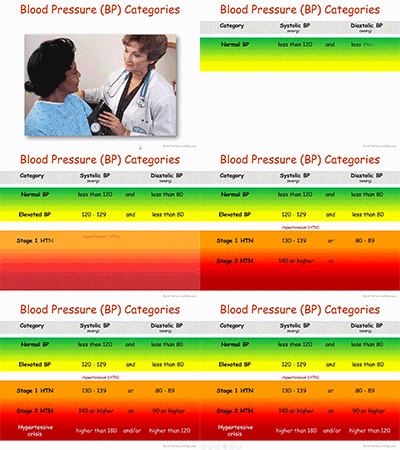
  • Normal BP: Less than 120/80 mm Hg;
  • Elevated BP: Systolic between 120-129 and diastolic less than 80;
  • Stage 1 HTN: Systolic between 130-139 or diastolic between 80-89;
  • Stage 2 HTN: Systolic at least 140 or diastolic at least 90 mm Hg;
  • Hypertensive crisis: Systolic over 180 and/or diastolic over 120, with patients needing prompt changes in medication if there are no other indications of problems, or immediate hospitalization if there are signs of organ damage.


Regardless of the precise cutoffs listed above, in an interview discussing the new guidelines, the main author states that, "120/80 is normal, the same as we had before" the new guidelines. So I think we're safe in using 120/80 as an example of BP when discussing the normal science, even though technically it could be designated as "elevated." Not that we can't use an elevated variable measurement as an example when discussing the physiology of anything. The fact that even the main author of the guidelines uses 120/80 as the starting point of discussion makes me feel more confident in using it as the starting point of my course discussions, too.

The main thing to note in the categories above is that the cutoffs for HTN categories have been lowered. This puts many more people in an HTN category that were not there before. The main goal is for those folks to have conversations with their physicians to evaluate their risk for complications and develop a personalized prevention and care plan.

Note also that the category of prehypertension has been eliminated.

The new guidelines also recommend prescribing medication for Stage 1 HTN if the patient already had a cardiovascular event—or is at a high risk for such an event. They also recognize that many patients will need more than one medication to manage BP and that combining meds into one pill is likely to help folks take them consistently.

There are a lot of other recommendations, so reviewing the Executive Summary or similar resource (see below) may be a good idea.


What can we use from this in teaching undergraduate A&P?

  • If you discuss hypertension, or use case studies in teaching, you need to update the cutoff BPs you are using.
  • A BP of 120/80 is still considered the starting point for discussing blood pressure.
  • Consider discussing the impact of the changes in the new guidelines for ordinary people.
  • Discuss why such diagnosis, prevention, and treatment recommendations often change over time. Consider discussion other recent clinical updates.
  • Consider discussing specific changes suggested in the new guidelines.
  • Consider having students explore the Executive Summary and/or other documents and write their own summary or interpretation of key points. Perhaps they can create their own chart or concept map.


Need some free teaching materials?


SLIDE SET: High Blood Pressure
  • Kevin Patton. Lion Den Slide Collection. 18 Nov 2017
  • Small slide deck that includes an animated version of the BP Category chart pictured above. Part of the Lion Den Slide Collection (requires free registration to download). You can also download a static PNG image file of the chart in the slide collection set.
  • my-ap.us/2ivoql5


VIDEO: AHA 2017 | New High Blood Pressure Guidelines
  • America Heart Association. 13 Nov 2017.
  • Free video (viewable in the player above) features a chat with the main author of the new guidelines and summarizes the main points. Very practical and easy to understand.
  • youtu.be/rvYL-7ergDs


SLIDE SET: 2017 Guideline For the Prevention, Detection, Evaluation and Management of High Blood Pressure in Adults
  • American College of Cardiology. 13 Nov 2017
  • Free set of almost 100 PowerPoint slides to use in teaching. And it has a decided focus on clinical applications, rather than the basic science. These are way, way beyond the coverage desirable in an undergrad A&P course. But some slides may be useful to you.
  • my-ap.us/2itMBjY


Want to know more?


New blood pressure guidelines put half of U.S. adults in unhealthy range
  • A. Cunningham Science News. 13 Nov 2017 
  • Plain-English article summarizing the first major update since 2003 aims to spur heart-healthy lifestyle changes. Has a useful graph and links to other articles and resources.
  • my-ap.us/2itVnOR

New Multisociety Hypertension Guideline Is Released
  • Allan S. Brett, MD reviewing Whelton PK et al. J Am Coll Cardiol 2017 Nov 13. NEJM Journal Watch Nov 2017.
  • Brief review of the larger report (listed below), summarize key take-away points.
  • my-ap.us/2iumCc1

2017 ACC/AHA/AAPA/ABC/ACPM/AGS/APhA/ASH/ASPC/NMA/PCNA Guideline for the Prevention, Detection, Evaluation, and Management of High Blood Pressure in Adults: Executive Summary
A Report of the American College of Cardiology/American Heart Association Task Force on Clinical Practice Guidelines
  • PK Whelton et al. Hypertension, Dec 2017, Volume 70, Issue 6.  DOI: 10.1161/HYP.0000000000000066
  • Free PDF of the Executive Summary of the larger report. I recommend reading this first, then decide if you need to read the whole report.
  • my-ap.us/2iuzvCT

2017 ACC/AHA/AAPA/ABC/ACPM/AGS/APhA/ASH/ASPC/NMA/PCNA Guideline for the Prevention, Detection, Evaluation, and Management of High Blood Pressure in Adults
A Report of the American College of Cardiology/American Heart Association Task Force on Clinical Practice Guidelines
  • PK Whelton et al. Hypertension. Dec 2017, Volume 70, Issue 6.  DOI: 10.1161/HYP.0000000000000065
  • Free PDF of the entire report. It's huge, so make a whole pot of tea before starting it.
  • my-ap.us/2irTUZj

Potential U.S. Population Impact of the 2017 American College of Cardiology/American Heart Association High Blood Pressure Guideline
  • Paul Muntner et al. Journal of the American College of Cardiology. November 2017. DOI: 10.1016/j.jacc.2017.10.073
  • Free abstract briefly outlines the impact of the new HTN guidelines.
  • my-ap.us/2iu8BLi


Tuesday, July 14, 2015

Dissolving Microneedle Vaccinations

Researchers recently demonstrated that a flu vaccine delivered using microneedles that dissolve in the skin can protect people against infection even better than the standard needle-delivered vaccine.


The new microneedle patch is made of dissolvable material, eliminating needle-related risks. Not to mention the sea change it may mean for patients with severe needle anxiety!  I suspect this approach may also be more tolerable for many patients than oral and nasal vaccination methods. It is also easy to use without the need for trained medical personnel—making it ideal for use where healthcare resources are limited.

“Our novel transcutaneous vaccination using a dissolving microneedle patch is the only application vaccination system that is readily adaptable for widespread practical use,” said Professor Shinsaku Nakagawa, one of the authors of the study from Osaka University. “Because the new patch is so easy to use, we believe it will be particularly effective in supporting vaccination in developing countries.”

The new microneedle patch – MicroHyala – is dissolvable in water. The tiny needles are made of hyaluronic acid, a naturally occurring substance in tissue matrix and the synovial fluid that cushions the joints. When the patch is applied sort of like a Band-Aid, the needles pierce the epidermis of skin and dissolve into the body, taking the vaccine with them.

The researchers compared the new system to traditional needle delivery by vaccinating two groups of people against three strains of influenza: A/H1N1, A/H3N2 and B. None of the subjects had a bad reaction to the vaccine, showing that it is safe to use in humans. The patch was also effective: people given the vaccine using the microneedles had an immune reaction that was equal to or stronger than those given the vaccine by injection.

“We were excited to see that our new microneedle patch is just as effective as the needle-delivered flu vaccines, and in some cases even more effective,” said Professor Nakagawa.

Previous research has evaluated the use of microneedles made of silicon or metal, but they were not shown to be safe. Microneedles made from these materials also run the risk of breaking off in the skin, leaving tiny fragments behind. The new dissolvable patch eliminates this risk because the microneedles are designed to dissolve in the skin.

What can we use from this in teaching undergraduate A&P?


  • Consider mentioning this advance when discussing the layers of the skin, this giving a clinical application to pique student interest.

  • When discussing immunity and vaccination, consider mentioning this discovery.

  • If you discuss hyaluronic acid when covering histology, this information may help students realize the importance of knowing such details because of clinical applications of materials science.

Want to know more?


  • Clinical study and stability assessment of a novel transcutaneous influenza vaccination using a dissolving microneedle patch.
    • Sachiko Hirobe, et al. Biomaterials. Vol 57 (July 2015), Elsevier. doi: 10.1016/j.biomaterials.2015.04.007
    • The original research article.
    • my-ap.us/1eXzAud


Microneedle image courtesy of S. Nakagawa
Some content adapted from an Elsevier newsroom release

Monday, October 13, 2014

RNA Interference. Again.


Five years ago, I extolled the virtues of teaching a little bit about RNA interference (RNAi) in undergraduate A&P courses.  But for a while it looked like the promise of RNAi in basic and clinical research might be sputtering.  However, a recent article by Eric Bender called The Second Coming of RNAi shows that RNAi "the gene-silencing technique [now] begins to fulfill some of its promises."

I recommend reading the entire article at my-ap.us/1BbxvB9  Before you read it, allow me to reprise my reasons of five years ago supporting my proposal to include RNAi in your course.

What can we use from this in teaching undergraduate A&P?


  • RNAi plays a role in defending our cells against viruses by stopping viral genetic code from being translated in host cells

  • RNAi likely plays a role in regulating gene activity in a cell by preventing translation of the gene product(s)

  • RNAi is increasingly used as method for "knocking out" a particular gene's effects in research animals in order to study the gene's functions

  • RNAi is being used to treat genetic disease. . . an application that will likely expand greatly over the next few decades
I'll add two more items to my previous list:
  • RNA interference is a mechanism of human disease, as has been demonstrated in some cases of inherited progressive hearing loss (for example).

  • Learning about RNAi helps clarify a general understanding of the many roles played by RNA in our lives—some perhaps still undiscovered.

I'm not sure that it's useful to expect beginning undergraduate students to learn the nitty-gritty details of RNAi mechanisms.  But I do think it's valuable to be exposed to the general concept of RNA interference and gene silencing.  A&P students are going to run up against these eventually as they learn about and then administer RNAi-based therapies, after all.  And perhaps we should prepare them.

Want to know more?


The Second Coming of RNAi
  • Eric Bender. The Scientist. September 1, 2014
  • Article mentioned above. In plain English, it shows that clinical progress in RNAi therapy against liver diseases, the gene-silencing technique begins to fulfill some of its promises. Includes useful illustrations and links to other resources.
  • my-ap.us/1BbxvB9

Why do we need to know about RNA interference?
  • Kevin Patton. The A&P Professor. 14 April 2009
  • My first article promoting the idea of teaching RNAi in the A&P course.  It links to an expanded article with additional teaching resources.
  • my-ap.us/1xbq4v6

RNA interference revisited
  • Kevin Patton. The A&P Professor. 9 June 2009
  • Brief follow-up article that references the role of RNA interference as a mechanism of human disease.  Links to other resources.
  • my-ap.us/1oDflzw

RNA Interference Animation and Slideshow
  • Nature Reviews Genetics. Accessed 3 September 2014
  • FREE animation, slideshow, and poster on RNAi, as well as a link to more details.
  • my-ap.us/1roNGYm

RNA Interference BioInteractive
  • Howard Hughes Medical Institute. Accessed 3 September 2014
  • FREE slideshow with worksheet that students fill out as they view the slideshow.  Links to FREE DVD from HMMI called The Double Life of RNA.
  • my-ap.us/1pJ9r5V


Wednesday, October 10, 2012

G-protein coupled receptors


The Royal Swedish Academy of Sciences has decided to award the
Nobel Prize in Chemistry for 2012
to

Robert J. Lefkowitz
Howard Hughes Medical Institute and Duke University Medical Center, Durham, NC, USA

and

Brian K. Kobilka
Stanford University School of Medicine, Stanford, CA, USA

"for studies of G-protein–coupled receptors"


Smart receptors on cell surfaces

Your body is a fine-tuned system of interactions between billions of cells. Each cell has tiny receptors that enable it to sense its environment, so it can adapt to new situtations. Robert Lefkowitz and Brian Kobilka are awarded the 2012 Nobel Prize in Chemistry for groundbreaking discoveries that reveal the inner workings of an important family of such receptors: G-protein–coupled receptors (GPCRs).

For a long time, it remained a mystery how cells could sense their environment. Scientists knew that hormones such as adrenalin had powerful effects: increasing blood pressure and making the heart beat faster. They suspected that cell surfaces contained some kind of recipient for hormones. But what these receptors actually consisted of and how they worked remained obscured for most of the 20th Century.

Lefkowitz started to use radioactivity in 1968 in order to trace cells' receptors. He attached an iodine isotope to various hormones, and thanks to the radiation, he managed to unveil several receptors, among those a receptor for adrenalin: β-adrenergic receptor. His team of researchers extracted the receptor from its hiding place in the cell wall and gained an initial understanding of how it works.

The team achieved its next big step during the 1980s. The newly recruited Kobilka accepted the challenge to isolate the gene that codes for the β-adrenergic receptor from the gigantic human genome. His creative approach allowed him to attain his goal. When the researchers analyzed the gene, they discovered that the receptor was similar to one in the eye that captures light. They realized that there is a whole family of receptors that look alike and function in the same manner.

Today this family is referred to as G-protein–coupled receptors. About a thousand genes code for such receptors, for example, for light, flavour, odour, adrenalin, histamine, dopamine and serotonin. About half of all medications achieve their effect through G-protein–coupled receptors.

The studies by Lefkowitz and Kobilka are crucial for understanding how G-protein–coupled receptors function. Furthermore, in 2011, Kobilka achieved another break-through; he and his research team captured an image of the β-adrenergic receptor at the exact moment that it is activated by a hormone and sends a signal into the cell. This image is a molecular masterpiece--the result of decades of research.

Laureate's Links

Robert J. Lefkowitz, U.S. citizen. Born 1943 in New York, NY, USA. M.D. 1966 from Columbia University, New York, NY, USA.Investigator, Howard Hughes Medical Institute. James B. Duke Professor of Medicine, and Professor of Biochemistry, Duke University Medical Center, Durham, NC, USA.
lefkolab.org

Brian K. Kobilka, U.S. citizen. Born 1955 in Little Falls, MN, USA. M.D. 1981 from Yale University School of Medicine, New Haven, CT, USA. Professor of Medicine, and Professor of Molecular and Cellular Physiology, Stanford University School of Medicine, Stanford, CA, USA.
med.stanford.edu/kobilkalab

Want to know more?

Popular Information
[A great synopsis, entitled "Cells and Sensibility," written for general reader and nicely illustrated.  This would make a great handout or reading assignment for your A&P class.]
my-ap.us/SLShCF

Scientific Background
[A more technical treatment of the discovery, but still accessible to advanced A&P students as well as A&P professors.  Includes extensive references.  Illustrated.]
my-ap.us/PnK4Fz

Adapted from my-ap.us/TwmIyd

Friday, July 27, 2012

Doping. Again.

Most of us mention the concept of doping in our A&P courses because it's an ever present issue in our society and therefore a good way to help students apply their knowledge of human structure and function to practical scenarios.  As I've mentioned in previous posts, in Olympic years it becomes an even more potent way to draw students interest into the world of human A&P.

Once again, we're hearing doping stories in the news.  On the heels of continuing scandals in the sport of cycling, we are now hearing reports of doping in Olympic athletes.

As many longtime readers of this blog know, besides several blog articles, I have a resource page on doping for A&P teachers at my companion website The A&P Professor.

There is also a recent article in The Scientist outlining advances in detection of doping in athletes.  This article is not only informative for personal enjoyment of the current Olympic games--because we'll all be more knowledgeable--but it's a great resource to prepare for the student questions we'll be getting soon.  And in the near future.

Want to know more?
Anti-Doping Research Gets Creative: Scientists work hard to keep up with ever-evolving performance enhancement techniques that go undetected by existing tests.
Sabrina RichardsThe Scientist Online July 26, 2012
[Comprehensive, easy-to-follow article on the latest in anti-doping strategies. Might be good assigned reading for your course.]
my-ap.us/SXKHU0

Kevin's blog articles on doping
 . . . and how to use doping to illustrate A&P in your classroom
my-ap.us/aa3AjM

Resource page on doping at The A&P Professor website
my-ap.us/942vMZ

Tuesday, May 22, 2012

Why bother with protein folding?

For those of you who use (or refer to) my textbooks, you may notice that I've been gradually adding more and more coverage of protein folding to most of them. My newest text (due out in March) adds a bit more to the story. Why bother?  Isn't that way more than beginning students need to know for an A&P course preparing students for health careers?

I submit that beginning A&P students should know a bit about protein folding.

Knowing the very basic principles of protein folding help students visualize the complex shape of proteins.  That, in turn, helps them understand that "it's all about shape" when trying to understand how proteins like enzymes, receptors, and most other proteins work—proteins that they'll encounter many times throughout their A&P course and beyond. 

Besides that, protein folding has become a key concept in understanding not only how the body functions, but how to intervene therapeutically in important diseases.  If a class of therapy based on protein folding is now being developed, a class of therapy that many of our students will likely encounter in their professions, don't we owe it to them to cover the basic ideas of protein folding? 

This latest idea was brought up at a recent meeting of the American Society of Cell Biology (ASCB).  You may want to read the article below, which briefly summarizes some current work being done in developing drugs that affect protein folding systems.  None of the specific  information in the article would be appropriate for A&P students to learn.  But reading it will give the A&P professor better insights about why the concept of protein folding is important for students to learn.  And it gives you a chance to say, "I was just reading about how scientists are now developing drugs based on protein folding . . . " to get their attention in class!

Want to know more?
Protein Folding and Disease: The Path from Bench to Bedside
V. Glaser
Genetic Engineering & Biotechnology News 15 Jan 2012. Vol. 32, No. 2
[Brief, illustrated article that clearly summarizes some recent work in applying principles of protein folding to drug therapies.]
my-ap.us/wFh6F2
Protein folding animation
[Interesting Quicktime animation that shows a protein folding]
my-ap.us/xzWnW4

GCSF Protein Folding Illustration Movie
[Another animation, a bit more complex than the previous one.  Clearly shows different types of models used in most A&P textbooks.]
my-ap.us/xpSisS


The Three-Dimensional Structure of Proteins
[Narrated animation showing four levels of protein structure, including visualization of protein folding.]
my-ap.us/yAS2fr

Tuesday, November 29, 2011

Caffeine strengthens synapses

Can caffeine help us learn A&P (or anything else)?  Can it improve our memory?

Recent research published in Nature Neuroscience this week suggests that the answer may be yes.  In animal studies, caffeine strengthened synaptic connections in the hippocampus of the brain.  That's not enough to demonstrate that caffeine will be an effective learning enhancer . . . but is does suggest the possibility.

We've been talking about synapses and memory in our A&P 1 course recently, so I thought you might also.  And perhaps want to drop in this tidbit about the latest research.

Next time our students ask how they can possibly remember everything in the A&P course, perhaps a trip to the campus coffee shop may be in order, eh?


Want to know more?
Coffee delivers jolt deep in the brain
Laura Sanders
Science News Web edition : Monday, November 21st, 2011

[A brief synopsis discussing the discovery.]
my-ap.us/upTvh2

Caffeine-induced synaptic potentiation in hippocampal CA2 neurons
Stephen B Simons, et. al.
Nature Neuroscience (2011) Published online 20 November 2011 doi:10.1038/nn.2962

[The original research article]
my-ap.us/sbedTE
Caffeine

Saturday, May 22, 2010

Latest in blood doping

The subject of blood doping has come up a few times in this blog.  Recently, we heard the latest in the Floyd Landis blood doping story . . . now, after years of vigorous (and costly) denials, cycling champion Landis has now admitted that he DID dope to prepare for competitions.

Landis states the he used EPO (erythropoietin) to increase his hematocrit to improve performance during cycling events.(EPO is pictured here.)

He has also stated that Lance Armstrong, another champion cyclist, gave him EPO and discussed his own blood doping experiences with Landis.  Armstrong denies these claims.

Listen to the story from NPR:

I have an article on doping at The A&P Professor website that includes a lot of resources, as well as tips on using the topic of doping to engage students in a deeper understanding of human structure and function.
Doping
K. Patton
The A&P Professor, accessed May 21, 2010
[Tips and resources regarding doping for A&P courses.]
.

Sunday, February 14, 2010

Any dopes in Vancouver?


If you're like me, I mention the concept of blood doping when covering the life cycle of red blood cells (RBCs) and the homeostatic mechanisms that regulate the population numbers of RBCs.

In 2008 and 2009,  beginning around the time of the Beijing Olympics, I wrote a series of articles on doping in this blog and an extended version at The A&P Professor website.

I recently updated that extended doping article with a link to a recent news story from the Canadian Press service regarding the possibility of doping with the experimental anemia drug Hematide.

The doping issue is a great way to tie an unfortunately unending series of "real life" high-profile cases to the concepts of blood physiology.

Check out my Doping article, which includes several resources from major anti-doping agencies plus hints for incorporating doping issues in your A&P course.

You may also be interested in the PBS video Doping for Gold, which chronicles doping in a generation of European athletes. In the 1970s, female East German athletes came from nowhere to dominate international sport. Behind their success lay a secret, state-sponsored doping program that distributed untested steroids to athletes as young as 12. Many of these girls had no knowledge that they were being doped, and now, their damaged bodies and psyches deal with the cruelty of a government that pursued international glory at the expense of its most acclaimed citizens.

Monday, July 6, 2009

Cardiac arrest teaching moment


Sadly, we have another teaching moment in the news: the "cardiac arrest" reported as a cause of death for music artist Michael Jackson.

Recently, I described how the unexpected death of Natasha Richardson from an epidural hematoma could be used as starting point for a discussion of the structure of the coverings of the brain and how things can go wrong.

Scientific American's blog 60-Second Science has a nice article that describes the different between a "heart attack" and "cardiac arrest," a distinction lost on most folks. But A&P students, especially those headed into health or athletic/fitness fields, should be aware of what these terms mean and how it illustrates the normal function of the heart in maintaining the blood flow needed for healthy survival.

I think the contents of the blog article, and its clarification of what is usually meant by the term "cardiac arrest," is a great starting point for possible discussions of:
  • Whether the terms "heart attack" and "cardiac arrest" are useful enough or precise enough for (a) public reporting and/or (b) medical reporting and recordkeeping.

  • How are these two situations similar? What do they have in common? Can one lead to the other?

  • What is "heart failure" and how does that relate to the above conditions?

  • What factors may lead to any of the above conditions?

  • What happens to blood flow when the heart beats too fast? too slow? too weakly?

  • What effects might the illicit/unsupervised use of drugs have on heart function?

  • Can the supervised use of drugs have harmful effects on heart function?

  • Can educated observers reading the public media really deduce what happened to Michael Jackson? What do we (think we) know, and is that enough to form a solid hypothesis? What information would we like to have to form a theory of the cause of death?

  • There are conflicting reports of the state of health of Michael Jackson immediately preceding his death . . . are any of them reliable as scientific evidence of cause of death?
As you can see, there are several different directions one could go in to use this tragic (but popular) news story to "bring home" various topics of A&P, the scientific method, and the role of science/medicine in society in your course. Perhaps you can share with us some other questions one could pose for a class discussion.

In any case, this story presents yet another opportunity to leverage the interests of students in a particular case to explore the concepts of an A&P course.

Michael Jackson and cardiac arrest
B. Borrell
Scientific American 26 June 2009
[60-Second Science blog article calling attention to the subject of "cardiac arrest"]
Heart Disease and Sudden Cardiac Death
WebMD accessed 6 July 2009
[Excellent article explaining cardiac arrest]

Here's a video with an M.D. explaining "cardiac arrest" relative to the Jackson case:
http://www.youtube.com/watch?v=WiyIczgw89Y


[The image that appears with this article is a FREE image depicting the international symbol for an AED (automatic external defibrillator]

Tuesday, February 17, 2009

Placebo doping?


Here's another twist on doping in athletes . . .

. . . recall that in previous blog posts I explored several types of doping: blood doping, drug doping, genetic doping, and so on. In a recent article on the placebo effect that I read in Scientific American Mind I learned about a new kind of doping . . . that is legal, apparently.

Morphine is on the banned list for athletic doping. An advantage of using morphine would be to reduce pain during an intense athletic event--pain that could reduce performance. According to a sidebar in the article, studies show that if an athlete is given morphine during training (which is legal), then abstains long enough for the morphine to clear the system, then takes a saline injection (placebo) on the day of competition, the athlete experiences reduced pain.

If this turns out to work consistently, with many different athletes, I wonder if use of drugs during training will be banned.

For more on doping, see my article at The A&P Professor website.

Here's the article on placebos:

Placebo Effect: A Cure in the Mind
Maj-Britt Niemi
Scientific American Mind online, February 2009


Here's the research behind the "doping" by placebo concept:

Opioid-Mediated Placebo Responses Boost Pain Endurance and Physical Performance: Is It Doping in Sport Competitions?
F. Benedetti, et al.
The Journal of Neuroscience, October 31, 2007, 27(44):11934-11939; doi:10.1523/JNEUROSCI.3330-07.2007

Tuesday, August 5, 2008

More on Doping

Those dopes!

Just two weeks ago, I ran an article on Doping here in The A&P Professor blog. As we run up to the 2008 Olympic games we're seeing more and more in the news about doping in Olympic athletes.

I told ya so! And here's my next amazing prediction: there will be more!

For example of the recent coverage, see:


Science News ran a great feature article in their August 2, 2008 issue on genetic doping called Finding the Golden Genes. I've just added a link to this article in my own expanded Doping article at The A&P Professor website. And there, you'll find a link to a cool Flash animation of one potential type of gene doping--a great resource for a discussion in your course.

Science News is a great resource for science teachers and although they are a print magazine, much of their content is FREE on the web. See my previous post or go here in The A&P Professor website for more free sources.

Wednesday, July 16, 2008

Doping

Most of us mention the concept of doping in our A&P courses because it's an ever present issue in our society and therefore a good way to help students apply their knowledge of human structure and function to practical scenerios. In Olympic years, it becomes an even more potent way to draw students interest into the world of human A&P.

Doping in its broadest sense is adding something to the body. We usually think of it in a more specific sense of adding some sort of enhancer to the body, usually into the bloodstream. It could be extra RBCs (blood doping) or erythropoietin (EPO), both of which increase hematocrit (RBC ratio) and thus expand oxygen-carrying capacity and thereby promote improved athletic endurance. Or it could be synthetic androgens to promote the protein anabolism that enhances muscle development and strength.

Did you know that there is a World Anti-Doping Agency (WADA) with a mission "to promote, coordinate, and monitor the fight against doping in sport in all its forms?" Visit The A&P Professor website to find links to their current "code," the "prohibited list," and how to get their FREE DVD about doping in athletics.

The August 2008 issue of Popular Science magazine has an interesting article about trends in athletic doping called Juicing 3.0. For example, it brings up myostatin blockers that can dramatical increase the size and strength of muscle. And of course, the concept of genetic enhancement is discussed.

Besides referring your students to your school's library (assuming they subscribe to Popular Science), probably the easiest way to share the essential content of this article (in the form of gallery of examples) is to link to http://www.popsci.com/scitech/gallery/2008-07/juicing-30 from your course website or in an email.

You could use the linked information as an optional resource for those interested in the topic or as a place to send students who ask questions in class. Another idea is to assign it as an online discussion topic in your online/web-enhanced course. Or it could be the subject of an essay in which students apply their knowledge of A&P and also express their own informed opinions.

For an expanded version of this entry, with more tips, links, and resources, visit The A&P Professor website.