Showing posts with label organizations. Show all posts

Tuesday, September 20, 2022

Fonts, Syllabi, and Poop | TAPP 123


Host Kevin Patton revisits the concept of using the syllabus and other course documents to build a positive and productive course culture. Poop—it's everywhere! Does the font or typeface we use affect students—especially regarding learning and memory? We look for answers in this episode!

00:00 | Introduction

00:52 | Revisiting the Syllabus

16:28 | Poop. Poop. Poop.

19:00 | Sponsored by AAA

19:59 | Fonts Are Important in Teaching & Learning

30:54 | Sponsored by HAPI

31:57 | Desirably Difficult Reading?

42:00 | Sponsored by HAPS

43:00 | Fluent & Dysfluent Fonts

56:12 | Staying Connected


★ If you cannot see or activate the audio player, go to: theAPprofessor.org/podcast-episode-123.html

🏅 Apply for your credential (badge/certificate) for listening to this episode: theAPprofessor.org/podcast-episode-123.html/#badge

❓ Please take the anonymous survey: theAPprofessor.org/survey

☝️ Questions & Feedback: 1-833-LION-DEN (1-833-546-6336)

✔️ Follow The A&P Professor on Twitter, Facebook, Blogger, Revue, Tumblr, or Instagram! @theAPprofessor

📰 Get the thrice-weekly TAPP Science & Education Updates theAPprofessor.org/updates


Typography must often draw attention to itself before it will be read. Yet in order to be read, it must relinquish the attention it has drawn. (Robert Bringhurst)


Revisiting the Syllabus

15.5 minutes

Creating and nurturing a course culture can be influenced by our syllabus and other course materials. We revisit this idea with a few more tips and tweaks.

Anatomy &; Physiology Syllabus: It's an Art | TAPP 120

Are We Answering Student Questions? | Science Updates | TAPP 92

★ Wendy Riggs has a huge collection of anatomy, physiology, and general bio, instructional videos she uses in her flipped classes youtube.com/user/wendogg1

★ Natalie Wade has engaging short videos about A&P content and study tips at The Anatomy Gal youtube.com/c/TheAnatomyGal

★ Jamie Chapman has a collection (Chapman Histology) of short (under 3 minutes) videos guiding students through lessons in histology youtube.com/c/ChapmanHistology
Fonts, Syllabi, and Poop | TAPP 123


Poop. Poop. Poop.

2.5 minutes

After releasing The Poop Episode | Using Fecal Changes to Monitor Health | TAPP 121, I learned of a whole movement of poop listening on smart speakers. And that there are actually poop songs that are viral hits. Really.

★ When kids yell 'Alexa, play poop,' you'll hear these songs (story from All Things Considered on National Public Radioo) AandP.info/wv2

The Foot Book (Bright & Early children's book by Dr. Seuss; can be read as The Poop Book) geni.us/afvGc

★ CHOC Stool Diary AandP.info/4yq

★ Bowel Symptom Journal (from Alberta Health Services) AandP.info/6fw

★ Poop Apps: 5 Tools for Tracking Your Stools AandP.info/5ow


Sponsored by AAA

56 seconds

A searchable transcript for this episode, as well as the captioned audiogram of this episode, are sponsored by the American Association for Anatomy (AAA) at anatomy.org.

Searchable transcript

Captioned audiogram 

Don't forget—HAPS members get a deep discount on AAA membership!

AMERICAN ASSOCIATION FOR ANATOMY STATEMENT OF RESPONSIBILITY FOR ITS HISTORY OF RACISM (Press release from AAA, giving the full text of the statement) AandP.info/eei

AAA logo


Fonts Are Important in Teaching & Learning

11 minutes

At the suggestion of listener Dr. David Curole, we examine the roles that different fonts can play in teaching, learning, and memory. This segment reviews some past discussions of fonts, then introduces some new concepts of using fonts in teaching. Featured is a Word Dissection of the terms fluent font and dysfluent (disfluent) font.

Communication, Clarity, & Medical Errors | Episode 55

Anatomy & Physiology Syllabus: It's an Art | TAPP 120

Why Anatomy & Physiology Students Need Sectional Anatomy | TAPP 116


Sponsored by HAPI Online Graduate Program

59 seconds

The Master of Science in Human Anatomy & Physiology Instruction—the MS-HAPI—is a graduate program for A&P teachers, especially for those who already have a graduate/professional degree. A combination of science courses (enough to qualify you to teach at the college level) and courses in contemporary instructional practice, this program helps you be your best in both on-campus and remote teaching. Kevin Patton is a faculty member in this program at Northeast College of Health Sciences. Check it out!
northeastcollege.edu/hapi

Logo of Northeast College of Health Sciences, Human Anatomy & Physiology Instruction

Desirably Difficult Reading?

10 minutes

The article How Fonts Affect Learning and Memory by Carla Delgado takes our conversation a step further by looking the potential role of dysfluent fonts in learning.

★ How Fonts Affect Learning and Memory (article in Discover Magazine by Carla Delgado mentioned in this segment) AandP.info/wof

★ A Review of the Cognitive Effects of Disfluent Typography on Functional Reading (review article from The Design Journal) AandP.info/mwt

★ Fortune Favors the Bold (and the Italicized): Effects of Disfluency on Educational Outcomes (article from Proceedings of the Annual Meeting of the Cognitive Science Society) AandP.info/jjt

★ Changing Fonts in Education: How the Benefits Vary with Ability and Dyslexia (article from The Journal of Educational Research) AandP.info/yt4

★ Fluency and the Detection of Misleading Questions: Low Processing Fluency Attenuates the Moses Illusion (article from the journal Social Cognition) AandP.info/jul


Sponsored by HAPS

56 seconds

The Human Anatomy & Physiology Society (HAPS) is a sponsor of this podcast.  You can help appreciate their support by clicking the link below and checking out the many resources and benefits found there. Watch for virtual town hall meetings and upcoming regional meetings!
Anatomy & Physiology Society

theAPprofessor.org/haps

HAPS logo


Fluent & Dysfluent Fonts

13 minutes

We identify some potentially fluent fonts, as well as a few dysfluent fonts (see image below or at AandP.info/ihy). Sans Forgetica font was developed specifically to be dysfluent in a way that promotes remembering what is read. Does it work? Should we incorporate dysfluent fonts in our teaching materials?

★ Fonts and Fluency: The Effects of Typeface Familiarity, Appropriateness, and Personality on Reader Judgments (thesis by Tim Wang) AandP.info/0hf

★ Previously claimed memory boosting font 'Sans Forgetica' does not actually boost memory (story from ScienceDaily) AandP.info/zp4

★ The science of Sans Forgetica - The font to remember (video from the creators of Sans Forgetica) AandP.info/ox5

★ An unforgettable year – Sans Forgetica turns one (article from the RMIT University website) AandP.info/fo3

★ Sans Forgetica: Study Mode by RMIT University (plugin for Chrome browser lets you read any web page in Sans Forgetica) AandP.info/fc3

★ Sans Forgetica (free download for personal use) AandP.info/o4g

★ Can very small font size enhance memory? (article from journal Memory & Cognition) AandP.info/rlk

★ Sans Forgetica is not desirable for learning (article from the journal Memory) AandP.info/hmu

★ The role of font size and font style in younger and older adults' predicted and actual recall performance (article from
Neuropsychology, development, and cognition. Section B, Aging, Neuropsychology and Cognition) AandP.info/r6s
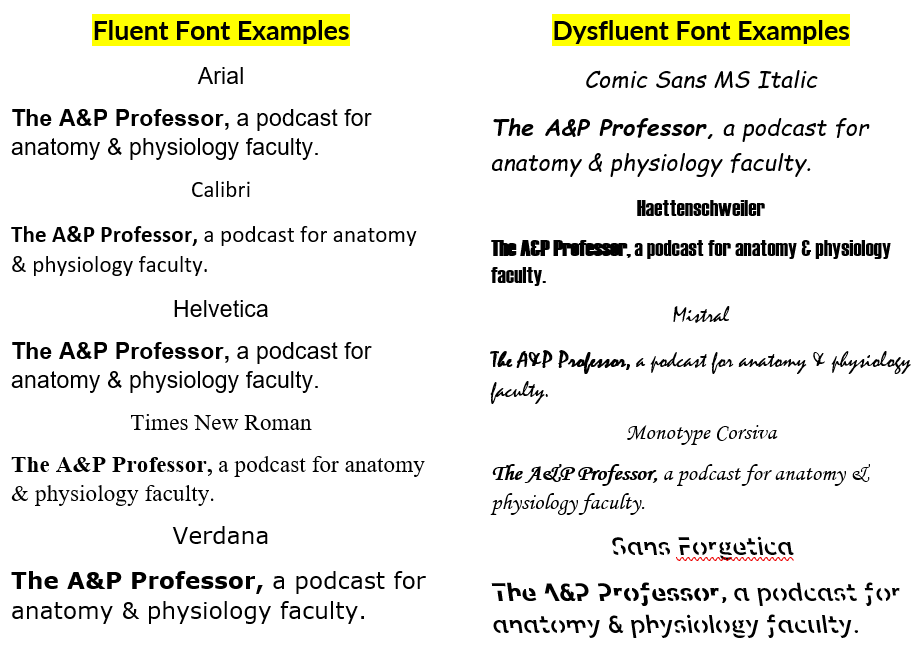
samples of fluent and dysfluent fonts


People

Contributors: David Curole, Terry Thompson

Mentions: Wendy Riggs, Natalie Wade, Jaime Chapman, Robert Bringhurst, Carla Delgado

Production: Aileen Park (announcer), Andrés Rodriguez (theme composer,  recording artist), Rev.com team (transcription), Kevin Patton (writer, editor, producer, host)


If the hyperlinks here are not active, go to TAPPradio.org to find the episode page.

★ More details at the episode page: theAPprofessor.org/podcast-episode-123.html

★ Transcript available in the transcript box: theAPprofessor.org/podcast-episode-123.html

★ Need help accessing resources locked behind a paywall? Check out this advice from Episode 32 to get what you need! my-ap.us/paywall

Take The A&P Professor experience to the next level!

theAPprofessor.org/community

Earn cash by referring other A&P faculty to this podcast:

theAPprofessor.org/refer

Tools & Resources

★ TAPP Science & Education Updates: theAPprofessor.org/updates

★ Amazon: amzn.to/2r6Qa3J

★ Text Expander: theapprofessor.org/textexpander

★ Rev.com: try.rev.com/Cw2nZ

★ Snagit & Camtasia: techsmith.pxf.io/9MkPW

★ Krisp Free Noise-Cancelling App: theAPprofessor.org/krisp

★ JotForm (build forms for free): theAPprofessor.org/jotform

★ QuillBot (writing tools): theAPprofessor.org/quillbot

★ The A&P Professor Logo Items: https://www.teepublic.com/stores/the-a-p-professor

Sponsors

★ Transcript and captions for this episode are supported by the American Association for Anatomy | anatomy.org

★ The Human Anatomy & Physiology Society provides marketing support for this podcast | theAPprofessor.org/haps

★ Distribution of this episode is supported by the Northeast College of Health Sciences online graduate program in Human Anatomy & Physiology Instruction (HAPI) | northeast.edu/hapi

Clicking on sponsor links helps let them know you appreciate their support of this podcast!

Follow The A&P Professor on  Twitter, Facebook, Blogger, Revue, Tumblr, or Instagram @theAPprofessor

The A&P Professor® and Lion Den® are registered trademarks of Lion Den Inc. (Kevin Patton)

As an Amazon Associate I earn from qualifying purchases. I may be compensated for links to sponsors and certain other links.


Click here to listen to this episode—or access the detailed notes and transcript.

Monday, August 13, 2018

The Syllabus Episode | Bonus | TAPP Episode 24


Introduction (2 min)
Do students read the syllabus? What is a syllabus? (8 min)
Reading and raiding the syllabus (14.5 min)
First-day activities | A syllabus quiz? (18.5 min)

Basic elements of a syllabus (13.5 min)
More things to put in a syllabus (12 min)
Study strategies, extra topics, & FAQs (8.5 min)
Conclusion (1 min)

If you cannot see or activate the audio player click here.
Follow The A&P Professor on Twitter, Facebook, Blogger, Nuzzel, Tumblr, or Instagram!

There is a peculiar aesthetic pleasure in constructing the form of a syllabus, or a book of essays, or a course of lectures. Visions and shadows of people and ideas can be arranged and rearranged like stained-glass pieces in a window, or chessmen on a board.
A. S. Byatt

woman leaning forward

(0:58) It's a BONUS episode, meaning that you get bonus minutes, meaning that it's a really, really long episode!
  • How eccentric do you think Kevin is? Other listeners want to know! Really.
    • 1-833-LION-DEN or 1-833-546-6336
    • podcast@theAPprofessor.org


(3:03) Do students read the syllabus? Maybe half? It's the other half who drive us nuts. Wait! do we always read the directions before asking questions?
What is a syllabus? It can be different things, right? Why do administrators seem to love the syllabus so much?

who needs a syllabus?


(11:09) Some general considerations when designing a syllabus include make sure that students can both read the syllabus through, and raid the syllabus for key information when they need it. The key is simplicity and logic in syllabus design.

(25:36) Is it just "here's the syllabus; see ya next class"—or is it an engaged look at important syllabus elements? The first day of class is key to starting things off on a good foot. What I learned from Krista, Michael, and Richard—and my own sideways twist on those first steps. What about a syllabus quiz? Is that a good or bad idea?

lecture hall

(44:24) What exactly goes into a syllabus? Who decides? What are the essentials? This isn't comprehensive, but it gets you

(57:47) Frank O'Neill recommends video walk-throughs, which have the added benefit of letting students know that you really do care about them. Consider also a table contents, abstract/summary, and/or index if the syllabus is long. How about a disclaimer, some playful tidbits, and links to external resources. And make sure your supervisors know what's in your syllabus!

(1:09:38) Consider putting hyperlinks or URLs in the syllabus to take students to other resources. Consider linking to a FAQ page, wher you explain your rationals for doing things the way that you do them in your course.

(1:18:07) Final thoughts. Okay, no real thoughts. Just be glad you made it this far!

If the hyperlinks here are not active, go to TAPPradio.org to find the episode page.
Amazon referrals help defray podcasting expenses.


Click here to listen to this episode—or access the detailed notes and transcript.

Tuesday, February 6, 2018

Pre-Testing for a Powerful Learning Boost | TAPP Radio 3

The newest episode of TAPP Radio is here!


Pre-testing is not just for assessment—it helps learning, too.
A weird sneeze injury.
The Anatomical Society's list of online resources.
How many proteins are there in a cell?

If you cannot see the audio player click here.

A recent analysis suggests that a reasonable average number of proteins in a cell is 42 million. How might we incorporate that bit of trivia in our A&P courses? (0:41)

The UK's Anatomical Society has put together a list of online resources under the auspices of their Education Committee (4:40)

Can the explosive power of a sneeze cause injury? You bet. Here's a recently reported case of a rupture of the pharynx. Yikes. (6:11)

Pre-Testing isn't just for measuring prior competence before new learning starts. By itself, regardless of its use in course assessment, it's a powerful learning tool. Listen to Kevin's experience with pre-testing in his A&P courses. (10:28)

More details at the episode page.

Transcript available at the script page.

If the hyperlinks above are not active, go to TAPPradio.org to find the episode page.

man doing online work on a park bench

Check out the detailed notes and transcript of this episode!

Tuesday, January 5, 2016

Engaging Students on the First Day of Class

When I was an undergraduate—back in the olden days—the first day of every class was always the same. The professor would come in a few minutes after the published start time, hand out a stack of syllabi still fresh with the fumes of the spirit duplicator solvent, and tell us about all the course policies and procedures (anticipating that we would not really read the syllabus). Perhaps there would be a few questions answered. Possibly, we'd get a content-based lecture that first day, but more often we'd just get an early release from class.

http://my-ap.us/1FDKa5Y
When I started teaching college, I did the same thing. I thought that this was how it was supposed to be done. And, despite having had some courses in how to teach effectively, I just fell into the ritual with which I'd grown up.

It didn't even occur to me how boring or pointless this activity was until I was at a HAPS meeting decades ago and went to a workshop entitled something like Engaging Students on the First Day of Class. Although the title was mildly intriguing, the main reason I went was to support my friends Richard Faircloth and Michael Glasgow from Anne Arundel Community College, who presented the workshop. Those of you who've given workshops know that it helps to have a few folks in the crowd who can be counted on to smile back at you even when you're sweating!

It turned out to be one of those many how-did-I-survive-without-knowing-about-this-before-now moments that one experiences at a HAPS Conference. I learned that I could make that first day into something much, much better than the traditional "here's what I expect" sermon.

Richard and Michael had us form small groups and showed us how we could make "syllabus day" a fun, active learning experience for students. An experience that could be far more effective in getting the essential messages across than what I had been doing. It must have worked because I can still see and hear some of what happened nearly two decades ago in my small group—and I took their message home and implemented it.

Their method boils down to this:
  1. Get your students into small groups. Right away—before you've handed out the syllabi or other materials.

  2. Give them a brief handout outlining what they are to do. Or you can project the directions on the screen. For example:

    1. Have them introduce themselves and briefly explain why they are taking A&P.

    2. Have them discuss and write down what pressing questions they have about the course.

    3. Tell them to send someone up to the professor to grab enough syllabi for everyone in the group.

    4. Ask them to use the syllabus and try to find the answers to the questions the group had written down.

  3. It's important NOT to answer their questions as you stroll around to chat and listen in on the groups—they have to find the answers in the syllabus.

  4. Have them re-assemble into a large group and ask them what questions they had that were not answered by their search or that need additional clarification.

By doing this, the students get to know a few other students right away—even the introverts. They get to be active, instead of passively sitting there "absorbing" from an active professor. Students are forced to think about what's important for them to know as they begin a new, perhaps scary-sounding, course. They learn how the syllabus is constructed as they explore it collaboratively looking for critical information. So they know how to find answers to questions they have later in the course. How many times have we wondered if they even looked as the syllabus once?

This method allows the professor to focus their efforts that day on the information that students really want to hear from them at that moment. And it tells you where your syllabus needs to be corrected or clarified!

I was very happy with the way my first experiment with this approach worked. Perhaps more importantly, my students were very happy with it. Ever since that first time, I've regularly had students tell me, "that was fun, I wish all my profs did their first day this way." It even shows up on the end-of-semester course evaluations—so it must have made an impression!

Over the years (nearly twenty), I've tweaked the process and adapted it to my particular course quirks. Because I always get certain questions, I often follow up with a demonstration of how to login to their course in the LMS, how to access the publisher website, and how to register their clickers. I also introduce them to the idea of human science—anatomy and physiology in particular. Ask them to think about why are here—and we discuss those goals and how they can be acheived. I sometimes even give them my secret methods for finding a parking space quickly.

If you'd like a starting point for creating your own first-day experiment, download these example handouts:


Photo (top): Griszka Niewiadomski
Photo (bottom): Gokhan Okur
Updated 6 January 2016

Wednesday, July 16, 2014

The Life Science Teaching Resource Community

Have you heard that the American Physiological Society (APS) has expanded their Archive of Teaching Resources into The Life Science Teaching Resource Community?

This new online community—LifeSciTRC for short—offers thousands of FREE resources that you can use in your A&P course!

This transition marks a culmination of efforts of APS and several other scientific societies to advance the Archive of Teaching Resources beyond an online library into a community of practice for life science educators at the K-12, undergraduate, graduate, and professional levels.

The LifeSciTRC offers more than 6,000 free, scientifically-accurate teaching resources along with many new tools that allow educators to share their ideas and teaching expertise including:
  • Community pages with news and recommended teaching resources
  • Blogs focusing on classroom and science topics relevant to educators
  • Forums for educator-led discussions
  • Resource rating and commenting areas where educators can share their experiences of using resources
  • Monthly newsletters highlighting community members, news, and resources
I can't speak highly enough of the quality and diversity of teaching resources available in the archive.  These are peer-reviewed submissions from all levels of teaching and learning.  Case studies, experiments, demonstrations, slide presentations—all kinds of great stuff!

The new system is really easy (and fun) to use.  It has a starred rating system, so you can see how others have rated each resource.  And you can earn badges by submitting and reviewing items.

In addition to the new name, the LifeSciTRC will feature three new scientific society partners:
  • The Physiological Society
  • Genetics Society of America
  • American Society of Plant Biologists
These societies will join the current partners:
  • APS
  • Human Anatomy and Physiology Society
  • Society for Developmental Biology
  • American Association of Anatomists
  • Massachusetts Society for Medical Research
  • Northwest Association for Biomedical Research
Educators looking for new teaching ideas or interaction with other educators are invited to visit LifeSciTRC.org and discover what they have to offer.

For more information, contact our colleague at APS, Miranda Byse, PhD, Program Manager at mbyse@the-aps.org or 240-743-8045.  Be sure to tell her where you heard the message!

Some content in this post came from APS

Monday, November 12, 2012

New life science journal eLife publishes first articles


Most journals that publish the "big news" in life science breakthroughs, such as Nature and Science, carry with them big price tags for accessing the information they contain.  Unless your institution subscribes, that leaves most A&P professors out of the loop on the information we need to update our courses.  More importantly, it leaves us out of the loop of information that helps us keep the excitement of science alive in our courses.

The Public Library of Science (PLoS) began publishing FREE online science journals a few years ago, and now a new MAJOR free online journal dedicated specifically to the life sciences and biomedicine has emerged.  See my-ap.us/SqSOJM for more information

First announced in summer 2011, eLife is a researcher-led initiative for the best in science and science communication. Backed by the Howard Hughes Medical Institute, the Max Planck Society, and the Wellcome Trust, the initiative’s first aim is to launch an open-access journal for outstanding advances in life science and biomedicine, which is also a platform for experimentation and showcasing innovation in research communication.

The eLife journal Web site is set for launch by the end of 2012, but the first collection of articles was released October 15 – listed at the eLife Web site with the full content available at the online archive of the U.S. National Library of Medicine, PubMed Central (PMC), and its mirror sites including UKPMC.

According to Randy Schekman, the journal’s Editor-in-chief, “We see no reason to delay the availability of these discoveries. Our editors have identified them as important, inspiring contributions of the high caliber expected for eLife. So, while the launch of our own journal Web site isn’t expected until December, we will best serve our authors, and science, by just getting them out there.”

eLife’s initial collection of content includes these topics that may be of interest to A&P professors:
  • A hormone involved in response to starvation that dramatically increases the lifespan of mice in which it is overexpressed, although further research into side effects is needed (Zhang et al.).  Information about this discovery will increase student interest in endocrine function, eh?

  • A critical signaling molecule involved in the interaction between a species of single-celled organisms and bacteria – an important advance in efforts to understand the evolution of multicellularity (Alegado et al.).  I often discuss the implications of the serial endosymbiosis theory in my teaching of cell biology— I think this new information may play into that whole scenario.

  • How cells cope with the stress of poorly folded proteins, and specifically how fission yeast deploys the same cellular machinery as other organisms but in an unusual and very different way (Kimmig et al.). I've mentioned the importance of understanding protein folding in A&P many times.

Links to the freely available full text for each article, plain-language summaries (the eLife digest), expert commentaries (Insights), and an editorial describing the motivations behind this move, are available at my-ap.us/U7OP25.  I think the eLife digest and the Insights are particularly useful for A&P professors and A&P students to use in expanding their understanding of human structure and function.

Want to know more?
For more information about eLife, visit my-ap.us/S5K9d3.
To sign up for free updates in the areas that interest you at my-ap.us/WToDyp

Content adapted from eLife press release 

Monday, October 3, 2011

Dendritic cell pioneers win Nobel Prize

The Nobel Assembly at Karolinska Institutet has today decided that

The Nobel Prize in Physiology or Medicine 2011
shall be divided, with one half jointly to
Bruce A. Beutler and Jules A. Hoffmann
for their discoveries concerning the activation of innate immunity
and the other half to
Ralph M. Steinman
for his discovery of the dendritic cell and its role in adaptive immunity


Summary

This year's Nobel Laureates have revolutionized our understanding of the immune system by discovering key principles for its activation.
Scientists have long been searching for the gatekeepers of the immune response by which man and other animals defend themselves against attack by bacteria and other microorganisms. Bruce Beutler and Jules Hoffmann discovered receptor proteins that can recognize such microorganisms and activate innate immunity, the first step in the body's immune response. Ralph Steinman discovered the dendritic cells of the immune system and their unique capacity to activate and regulate adaptive immunity, the later stage of the immune response during which microorganisms are cleared from the body.
The discoveries of the three Nobel Laureates have revealed how the innate and adaptive phases of the immune response are activated and thereby provided novel insights into disease mechanisms. Their work has opened up new avenues for the development of prevention and therapy against infections, cancer, and inflammatory diseases.

Two lines of defense in the immune system

We live in a dangerous world. Pathogenic microorganisms (bacteria, virus, fungi, and parasites) threaten us continuously but we are equipped with powerful defense mechanisms (please see image below). The first line of defense, innate immunity, can destroy invading microorganisms and trigger inflammation that contributes to blocking their assault. If microorganisms break through this defense line, adaptive immunity is called into action. With its T and B cells, it produces antibodies and killer cells that destroy infected cells. After successfully combating the infectious assault, our adaptive immune system maintains an immunologic memory that allows a more rapid and powerful mobilization of defense forces next time the same microorganism attacks. These two defense lines of the immune system provide good protection against infections but they also pose a risk. If the activation threshold is too low, or if endogenous molecules can activate the system, inflammatory disease may follow.
The components of the immune system have been identified step by step during the 20th century. Thanks to a series of discoveries awarded the Nobel Prize, we know, for instance, how antibodies are constructed and how T cells recognize foreign substances. However, until the work of Beutler, Hoffmann and Steinman, the mechanisms triggering the activation of innate immunity and mediating the communication between innate and adaptive immunity remained enigmatic.

Discovering the sensors of innate immunity

Jules Hoffmann made his pioneering discovery in 1996, when he and his co-workers investigated how fruit flies combat infections. They had access to flies with mutations in several different genes including Toll, a gene previously found to be involved in embryonal development by Christiane Nüsslein-Volhard (Nobel Prize 1995). When Hoffmann infected his fruit flies with bacteria or fungi, he discovered that Toll mutants died because they could not mount an effective defense. He was also able to conclude that the product of the Toll gene was involved in sensing pathogenic microorganisms and Toll activation was needed for successful defense against them.
Bruce Beutler was searching for a receptor that could bind the bacterial product, lipopolysaccharide (LPS), which can cause septic shock, a life threatening condition that involves overstimulation of the immune system. In 1998, Beutler and his colleagues discovered that mice resistant to LPS had a mutation in a gene that was quite similar to the Toll gene of the fruit fly. This Toll-like receptor (TLR) turned out to be the elusive LPS receptor. When it binds LPS, signals are activated that cause inflammation and, when LPS doses are excessive, septic shock. These findings showed that mammals and fruit flies use similar molecules to activate innate immunity when encountering pathogenic microorganisms. The sensors of innate immunity had finally been discovered.
The discoveries of Hoffmann and Beutler triggered an explosion of research in innate immunity. Around a dozen different TLRs have now been identified in humans and mice. Each one of them recognizes certain types of molecules common in microorganisms. Individuals with certain mutations in these receptors carry an increased risk of infections while other genetic variants of TLR are associated with an increased risk for chronic inflammatory diseases.

A new cell type that controls adaptive immunity

Ralph Steinman discovered, in 1973, a new cell type that he called the dendritic cell. He speculated that it could be important in the immune system and went on to test whether dendritic cells could activate T cells, a cell type that has a key role in adaptive immunity and develops an immunologic memory against many different substances. In cell culture experiments, he showed that the presence of dendritic cells resulted in vivid responses of T cells to such substances. These findings were initially met with skepticism but subsequent work by Steinman demonstrated that dendritic cells have a unique capacity to activate T cells.
Further studies by Steinman and other scientists went on to address the question of how the adaptive immune system decides whether or not it should be activated when encountering various substances. Signals arising from the innate immune response and sensed by dendritic cells were shown to control T cell activation. This makes it possible for the immune system to react towards pathogenic microorganisms while avoiding an attack on the body's own endogenous molecules.

From fundamental research to medical use

The discoveries that are awarded the 2011 Nobel Prize have provided novel insights into the activation and regulation of our immune system. They have made possible the development of new methods for preventing and treating disease, for instance with improved vaccines against infections and in attempts to stimulate the immune system to attack tumors. These discoveries also help us understand why the immune system can attack our own tissues, thus providing clues for novel treatment of inflammatory diseases.


Bruce A. Beutler was born in 1957 in Chicago, USA. He received his MD from the University of Chicago in 1981 and worked as a scientist at Rockefeller University in New York and the University of Texas in Dallas, where he discovered the LPS receptor. Since 2000 he has been professor of genetics and immunology at The Scripps Research Institute, La Jolla, USA.
Jules A. Hoffmann was born in Echternach, Luxembourg in 1941. He studied at the University of Strasbourg in France, where he obtained his PhD in 1969. After postdoctoral training at the University of Marburg, Germany, he returned to Strasbourg, where he headed a research laboratory from 1974 to 2009. He has also served as director of the Institute for Molecular Cell Biology in Strasbourg and during 2007-2008 as President of the French National Academy of Sciences.
Ralph M. Steinman was born in 1943 in Montreal, Canada, where he studied biology and chemistry at McGill University. After studying medicine at Harvard Medical School in Boston, MA, USA, he received his MD in 1968. He has been affiliated with Rockefeller University in New York since 1970, has been professor of immunology at this institution since 1988, and is also director of its Center for Immunology and Immune Diseases.


Key publications:

Poltorak A, He X, Smirnova I, Liu MY, Van Huffel C, Du X, Birdwell D, Alejos E, Silva M, Galanos C, Freudenberg M, Ricciardi-Castagnoli P, Layton B, Beutler B. Defective LPS signaling in C3H/HeJ and C57BL/10ScCr mice: Mutations in Tlr4 gene. Science 1998;282:2085-2088.
Lemaitre B, Nicolas E, Michaut L, Reichhart JM, Hoffmann JA. The dorsoventral regulatory gene cassette spätzle/Toll/cactus controls the potent antifungal response in drosophila adults. Cell 1996;86:973-983.
Steinman RM, Cohn ZA. Identification of a novel cell type in peripheral lymphoid organs of mice. J Exp Med 1973;137:1142-1162.
Steinman RM, Witmer MD. Lymphoid dendritic cells are potent stimulators of the primary mixed leukocyte reaction in mice. Proc Natl Acad Sci USA 1978;75:5132-5136.
Schuler G, Steinman RM. Murine epidermal Langerhans cells mature into potent immunostimulatory dendritic cells in vitro. J Exp Med 1985;161:526-546.

illustration High resolution image (pdf 3,6 Mb) 

The Nobel Assembly, consisting of 50 professors at Karolinska Institutet, awards the Nobel Prize in Physiology or Medicine. Its Nobel Committee evaluates the nominations. Since 1901 the Nobel Prize has been awarded to scientists who have made the most important discoveries for the benefit of mankind.

Nobel Prize® is the registered trademark of the Nobel Foundation 

The information above is taken directly from 
The 2011 Nobel Prize in Physiology or Medicine - Press Release
Nobelprize.org. 3 Oct 2011 my-ap.us/pE7zzC

Want to know more?
Immune Responses
[An animated activity from the Nobel Prize folks.] 

Find a brief explanation of dendritic cells in these textbooks:
Find FREE images and videos you can use in your course
Dendritic cells
http://my-ap.us/pkQycM

Watch a brief video on dendritic cells.

Sunday, February 14, 2010

Any dopes in Vancouver?


If you're like me, I mention the concept of blood doping when covering the life cycle of red blood cells (RBCs) and the homeostatic mechanisms that regulate the population numbers of RBCs.

In 2008 and 2009,  beginning around the time of the Beijing Olympics, I wrote a series of articles on doping in this blog and an extended version at The A&P Professor website.

I recently updated that extended doping article with a link to a recent news story from the Canadian Press service regarding the possibility of doping with the experimental anemia drug Hematide.

The doping issue is a great way to tie an unfortunately unending series of "real life" high-profile cases to the concepts of blood physiology.

Check out my Doping article, which includes several resources from major anti-doping agencies plus hints for incorporating doping issues in your A&P course.

You may also be interested in the PBS video Doping for Gold, which chronicles doping in a generation of European athletes. In the 1970s, female East German athletes came from nowhere to dominate international sport. Behind their success lay a secret, state-sponsored doping program that distributed untested steroids to athletes as young as 12. Many of these girls had no knowledge that they were being doped, and now, their damaged bodies and psyches deal with the cruelty of a government that pursued international glory at the expense of its most acclaimed citizens.

Sunday, January 24, 2010

More graduate biology courses at the HAPS Conference


OK, so you missed out on that cool cadaver class presented by HAPS Institute (HAPS-I) in San Diego this winter . . . because it filled up faster than I could tell you about it!  But now's your second chance for some great graduate biology courses especially for teachers of human anatomy and physiology courses:

1. Advances in Anatomy and Physiology 2010  (Ellen Arnestad and Kevin Patton)

2. Advanced Cardiovascular Physiology: The Heart at Work and at Rest (Robert Carroll)

3. Concepts in Human Embryology (Valerie O'Loughlin)

4. Molecular and Cellular Basis of Disease (Kelly McDonald)
These are great courses that feature both useful content about human A&P and experience with best practices in teaching these subjects.  These are courses that are MEANINGFUL to what you do every day in your own teaching.  And you'll be there with folks just like you . . . who teach secondary, college, and university A&P.

Each course earns you 2 graduate credits from the Biology Department of the University of Washington (Seattle). 

These courses begin with online work on April 13, involve seminars and/or workshops during the Denver HAPS Conference (May 29 - June 3), and continue with online work through August 19.  Each syllabus has additional details.  Conference registration (plus lodging, meals, and transportation, if needed) is required (in addition to HAPS-I course fees). 

Want to know more? 

Remember . . . THESE COURSES FILL EARLY.  So you want to get on this ASAP.  I mean it this time!

In fact, some spots have already been taken by past HAPS-I Scholars and by members of the HAPS-I Update email list, who all received notice of these course openings a few days ago.  (If you want prior notice of HAPS-I courses, go to http://www.hapsweb.org/displaycommon.cfm?an=1&subarticlenbr=234 to subscribe to either the HAPS-I Scholars Google Group or the HAPS-I Update Google Group.)

Registration is now open at http://www.hapsweb.org/displayconvention.cfm?conventionnbr=7898

For more information on the HAPS Annual Conference in Denver, go to http://www.hapsweb.org/displayconvention.cfm?conventionnbr=7450

EARLY BIRD CONFERENCE RATES APPLY UNTIL 2/1/2010!

Tuesday, May 12, 2009

Masters of Sex

I just downloaded the new book Masters of Sex to my Kindle.

Before I had a chance to get very far with it, I happened to tune into an interview with author Thomas Maier on our local public radio station. Now I'm even more anxious to explore this book further.

Maier does a great job of explaining and underscoring the pivotal role of William Masters and Virginia Johnson in discovering some of the basic principles of sexual anatomy and physiology.

Known to most as Masters and Johnson, in the book we come to know them as Bill and Ginny.

Most importantly, however, we more greatly appreciate their roles in pioneering the scientific study of sexual biology and developing therapies that (still) really help people. As we learn in the book, their accomplishments really were remarkable . . . and, alas, really are underappreciated.

I had the good fortune of knowing Bill Masters near the end of his life. He had just retired from the Masters and Johnson Institute when I asked him to be the keynote speaker at the 1995 Human Anatomy and Physiology Society (HAPS) Conference in St. Louis. He graciously agreed to something he had not done for years . . . and (as it turns out) never would again: speak at a scientific conference.

Wouldn't you think someone of his stature would have been a frequent speaker at such conferences? I asked him about that. It turns out that he was so vigorously harassed at scientific meetings (both by scientists in the meetings and protesters outside the meetings) that he adopted the strategy of avoiding such venues. But our meeting was different . . . we wanted to sit at the feet of the "Master" and learn about his adventures. He knew we were teachers wanting to learn and not suspicious investigators wanting to debunk.

And he did not disappoint! After showing us a film from his research program . . . a film of the "vaginal sweat" lubrication forming on the vaginal wall during the female sexual response (oh my gosh) . . . he regaled us with fascinating stories and anecdotes from a lifetime of pioneering research in the most fascinating area of human biology.

Bob Anthony - Kevin Patton - Bill Masters at HAPS 95

Bill and I spent many hours on the phone before and after that conference . . . he loved telling stories. His soft-spoken, self-effacing style of telling the stories seemed at odds with the honestly ground-breaking work he was describing.

All of my textbooks feature boxed essays that underscore the pioneering roles of Masters and Johnson. If you want to see why they deserve this place of honor, you'll want to read Masters of Sex.

Masters of Sex
Thomas Maier
Basic Books April 13, 2009 432 p.

Thomas Maier interview
St. Louis on the Air
KWMU/St. Louis 7 May 2009

Read about another great sex book at The A&P Professor website.

Tuesday, March 31, 2009

AAA likes The A&P Professor

News flash
A recent piece in American Association of Anatomists (AAA) News highlights the advantages of The A&P Professor website, blog, and FREE newsletter.

According to the article in the Hotlinks section of the AAA newsletter, The A&P Professor is a "good resource for faculty teaching anatomy and physiology."

That's a great compliment, considering that AAA itself is a good resource for A&P professors. For example, check out their list of links related to teaching and learning human anatomy. I'm a member . . . you should consider joining, too!

Thanks, AAA!

[See American Association of Anatomists News. Volume 18 Number 1 March 2009 p.27]

Tuesday, March 24, 2009

It's almost too late!


A while back I mentioned all the benefits of participating in HAPS Institute (HAPS-I), the Human Anatomy and Physiology Society's professional continuing education program for A&P professors that offers short, flexible graduate biology courses.

We have four courses that begin soon . . . April 15. These courses involve both online work and sessions at the upcoming 2009 Annual HAPS Conference in Baltimore MD at the end of May.

Two of those courses still have some room in them . . .

Advances in Anatomy & Physiology 2009 (2 graduate credits)
  • A great "first experience" in HAPS Institute
  • Begins online April 15, 2009
  • Learners engage the material presented in the conference Update Seminars more fully than just "walking in cold"
  • Learners have a chance to discuss the seminar presentations together to find those gems that we can "take back to our classroom."
  • Faculty: Ellen Arnestad and Kevin Patton
Advanced Respiratory Biology (2 graduate credits)
  • A reprise of last year's wildly popular course
  • Explore the "in and outs" of the respiratory system for a fully understanding
  • Begins online April 15, 2009
  • Features master teacher Mary Pat Wenderoth of University of Washington
The program also offers a completely online course . . . but there are only a couple of spots left!

Best Practices in Hybrid & Online Teaching of A&P (2 credits)
  • No conference attendance required
  • Begins online May 1, 2009
  • Taught by online A&P experts Tom Lancraft and Janice Yoder Smith
  • Great credential to have in your portfolio!
Want more information? Follow these links . . .

Here's the outside of the HAPS-I brochure

(use the frame buttons to ZOOM, then scroll or print)


Here's the inside of the HAPS-I brochure

(use the frame buttons to ZOOM, then scroll or print)


[The video players and other features may not be visible in a feed or newsletter item. Go to The A&P Professor blog to view these features.]

Tuesday, January 27, 2009

HAPS 2009 in Baltimore

Heads up! The "early bird special" for the 2009 Annual Conference in Baltimore MD is about to expire. After January 31, you'll have to pay a premium to attend the event of the year for A&P professors.

Go to the home page for HAPS (Human Anatomy and Physiology Society) to find the link to register for this great conference. If you've never been to one of these, you have no idea how great they are. Really. I guarantee that no matter what type of A&P course you teach, you'll find this meeting to wildly exceed any expectations you have.


While you're there, you can amplify your experience by also participating in one of several short graduate biology courses offered by HAPS Institute (HAPS-I). For more information on the HAPS-I program and the "conference courses" offered in conjunction with the Baltimore meeting, go to the HAPS-I start page.

Fair warning! The HAPS-I courses were opened about a week ago, and they are already nearly half full! These are great courses, so they fill up fast. Don't dilly-dally, my friends!

Brain Research 2009 Progress Report

I just received my copy of the print version of the FREE annual journal The 2009 Progress Report on Brain Research published by the Dana Alliance for Brain Initiatives.

As I told you in an earlier article about The 2008 Progress Report on Brain Research this is an interesting book that each year summarizes breakthrough research and conceptualizing in the fascinating area of brain research. I especially appreciate that it's written in an easily accessible style . . . I don't have to pretend to be a neuroscientist and get out my science dictionary to wade through layers of jargon. Nope. Instead, it's written in plain English and a clean style.

Every year, an essay by a prominent neuroscientist is featured. This year there is an essay from Floyd E. Bloom on recent advances in substance abuse research--advances that help us understand the normal pathways and receptors involved in everyday brain function.

This essay is of particular interest to me because it helps me consolidate and focus some of these recent advances that were revealed to us at a recent HAPS Annual Conference and explored in a related HAPS Institute course.

There are also interesting and timely updates in other areas of neuroscience, as you can see in this list:
You can access the contents FREE online at The 2009 Progress Report on Brain Research. You can also register to get a FREE copy of the print version of next year's issue.

Check out my list of free journals at The A&P Professor website for more FREE journals related to human anatomy and physiology.

Tuesday, November 4, 2008

Free genetics - genomics resources


At the NABT (National Association of Biology) professional development conference in Memphis TN a couple of weeks ago, I ran into the folks from the Community of Genetics Educators (CoGE).

At first glance, I thought this was strictly for folks teaching a course in genetics. Wrong! It's for biology educators in general who have some level of genetics content in their courses. Well, that's us!

Although our textbook Anatomy & Physiology has a chapter on genetics, I do not teach this as a separate unit in my course. However, I do weave the concepts of genetics and genomics throughout my course . . . as I suspect you do.

Wow, does CoGE (an effort of the National Institutes of Medicine [NIH]) have a lot of FREE resources to help me understand current genetics better . . . and use in my course materials!

Here's part of an email I recently received from CoGE telling you all about it. They told me to share it . . . so here it is:

"Here it is:

https://www.coge.nih.gov

It will take you about three minutes to register in.


Please do me a favor and leave a short bio. It helps people know who you are.


And leaving a photo is even better. Leave a photo when you register in between now and

the end of November and you quality for a special CoGE door prize (worth owning).

A few things you might want to know:


Everything is free and the site is part of educational programming at the National Institutes of Health. We will not share your email address, or ever try to sell you anything.


What is there?


(1) This coming Wednesday evening there is a live lecture on “The Genetic Information Non-Discrimination Act of 2008 (GINA).” Starts at 7pm and you can call in free from home and see the slides on any computer. There is an hour of Q&A from teachers attending with the speaker after a short talk

(2) Over 100 excellent copyright-free genetic illustrations by NIH illustrator Darryl Leja. Darryl pretty much defined how we draw the double helix with his excellent work during the mapping of the human genome.

(3) Resources submitted by other teachers and searchable. Lesson plans, valuable internet sites, and tips on everything from DNA and Darwin Day to extracting DNA from just about anything.


And a lot more.


Here’s what we know. If you do not take time to register now, you probably never will.


So please… pause, link in, and join the more than 500 other biology teachers already using CoGE.


In return you can find them, they can find you, and we all can share resources that work to

make bio teaching that much more effective and enjoyable.

Thanks,


Jeff Witherly
CoGE, Mayor

(don’t you love that title?)


https://www.coge.nih.gov
"
-------------------------------------------------------------------

And now for something completely different . . . a cute music video regarding Mendelian genetics (from YouTube, not from CoGE!)


[The video may not appear in your news feed or emailed newsletter. Go to The A&P Professor blog to access the video viewer. Go to The A&P Professor website to learn how to embed the video in your PowerPoint or webpage . . . or simply link to it from your own email or webpage.]