Showing posts with label analogy. Show all posts

Tuesday, April 5, 2022

Should We Extend Deadlines? | Models & Color Codes | TAPP 112


In this episode, host Kevin Patton asks, how do we handle the trepidation we experience when we are flooded with uncertainty after an intense learning experience? Some thoughts about being upfront about using models, analogies, and color codes in science. And we explore that difficult question: should we extend deadlines for students when they ask?

00:00 | Introduction

00:43 | Trepidation After New Learning

05:13 | Sponsored by AAA

05:49 | Transparency About Models, Analogies, and Color Codes

23:38 | Sponsored by HAPI

24:36 | Leniency With Deadlines

30:21 | Sponsored by HAPS

31:00 | Is Leniency Fair?

40:32 | Staying Connected


★ If you cannot see or activate the audio player, go to: theAPprofessor.org/podcast-episode-112.html

🏅 Apply for your credential (badge/certificate) for listening to this episode: theAPprofessor.org/podcast-episode-112.html/#badge

❓ Please take the anonymous survey: theAPprofessor.org/survey

☝️ Questions & Feedback: 1-833-LION-DEN (1-833-546-6336)

✔️ Follow The A&P Professor on Twitter, Facebook, Blogger, Revue, Tumblr, or Instagram! @theAPprofessor

📰 Get the thrice-weekly TAPP Science & Education Updates theAPprofessor.org/updates


“The process of leniency involves accepting the reality of the current situation and finding a satisfying meaning therein, as opposed to misconstruing or denying the facts of the situation.” (Sandra L. Schneider)


Trepidation After New Learning

4 minutes

You know that feeling of trepidation we get after a conference, course, or other intense learning experience? Where we feel uncertainty about whether we'll ever be able to retrieve it again and apply it. No worries. Let's talk that through.

Understanding How We Learn—A Chat with Yana Weinstein & Megan Sumeracki | Episode 27
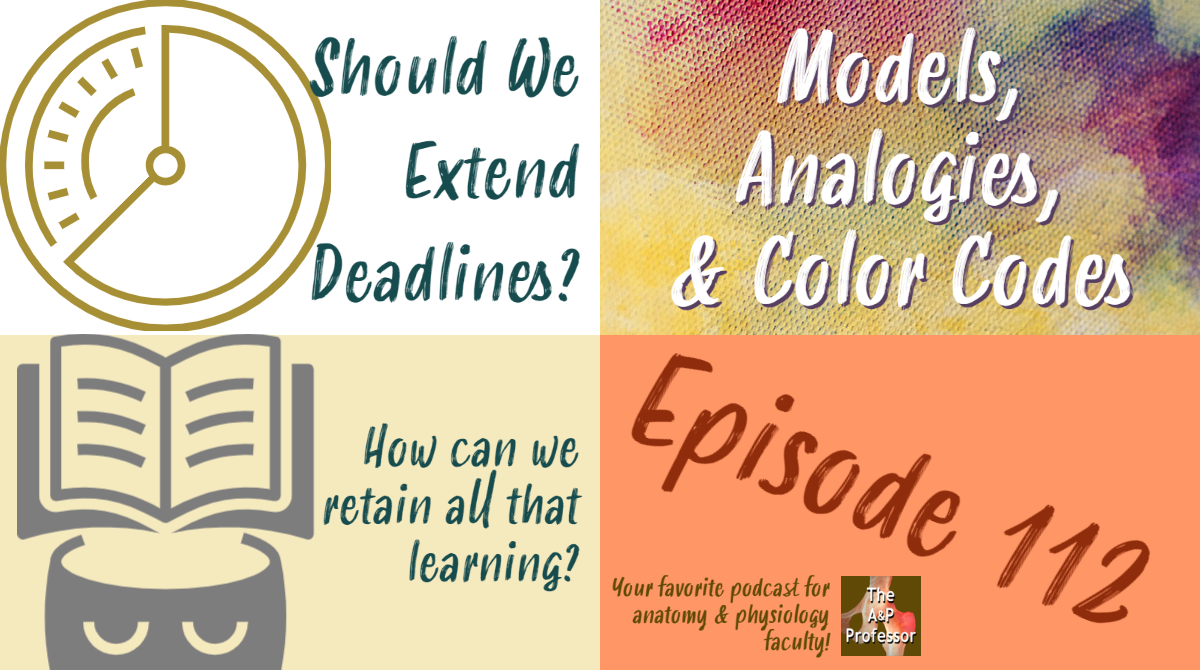
collage with captions: should we extend deadlines? Models, analogies, & color codes, How can we retain all that learning?


Sponsored by AAA

33 seconds

A searchable transcript for this episode, as well as the captioned audiogram of this episode, are sponsored by the American Association for Anatomy (AAA) at anatomy.org.

Searchable transcript

Captioned audiogram 

Don't forget—HAPS members get a deep discount on AAA membership!

AAA logo


Transparency About Models, Analogies, and Color Codes

18 minutes

As experts in science, we are already comfortable using models, analogies, and color codes. But some of our students may not have that familiarity and comfort. Maybe transparency about these tools at the beginning of the A&P course can help students get traction in our course.

The Case for Transparency | Episode 51

The Wallenda Model of Homeostasis | Episode 46

Fishbowl Model of Homeostasis | Concept Lists | TAPP Identity | Episode 45

The Storytelling Special | Episode 48

Actin & Myosin — A Love Story | Episode 15

★ Colors of chemical elements (summary of different systems) AandP.info/cpk

★ Jmol system of colors for chemicals elements (specifications and color charts) AandP.info/jscolors

★ A Guide For Teaching With Analogies (some basic principles to helps students who struggle with analogies) AandP.info/gfo


Sponsored by HAPI Online Graduate Program

54 seconds

The Master of Science in Human Anatomy & Physiology Instruction—the MS-HAPI—is a graduate program for A&P teachers, especially for those who already have a graduate/professional degree. A combination of science courses (enough to qualify you to teach at the college level) and courses in contemporary instructional practice, this program helps you be your best in both on-campus and remote teaching. Kevin Patton is a faculty member in this program at Northeast College of Health Sciences. Check it out!
northeastcollege.edu/hapi

Logo of Northeast College of Health Sciences, Human Anatomy & Physiology Instruction


Leniency With Deadlines

6.5 minutes

We usually have deadlines or specific dates for assignments, tests, exams, and projects. We can be strict with those deadlines or we can be lenient. Are there any advantages to be lenient with deadlines when we have them?

The Inclusive Anatomy & Physiology Course | Part 2 | 8 More Tips to Include All | TAPP 109 (includes the notion of deadlines as barriers to full inclusion)

Burnout! A Chat with Rebecca Pope-Ruark | TAPP 91 (where we talk about deadline flexibility as a strategy to mitigate student burnout)


Sponsored by HAPS

36 seconds

The Human Anatomy & Physiology Society (HAPS) is a sponsor of this podcast.  You can help appreciate their support by clicking the link below and checking out the many resources and benefits found there. Watch for virtual town hall meetings and upcoming regional meetings!
Anatomy & Physiology Society

theAPprofessor.org/haps

HAPS logo


Is Leniency Fair?

9.5 minutes

If we are lenient about deadlines with a student, is that fair to all the other students who may have struggled to be on time?

★ Why Deadlines Are Important (blog post that I link my students to; lists reasons why meeting deadlines has advantages for the student) AandP.info/why-deadlines-c16997

★ Respondus (software I use to build test banks; can generate multiple, randomized versions of the same test or exam with just a few keystrokes) AandP.info/6xe


If the hyperlinks here are not active, go to TAPPradio.org to find the episode page.

★ More details at the episode page: theAPprofessor.org/podcast-episode-112.html

★ Transcript available in the transcript box: theAPprofessor.org/podcast-episode-XX.html

★ Need help accessing resources locked behind a paywall? Check out this advice from Episode 32 to get what you need! my-ap.us/paywall

Take The A&P Professor experience to the next level!

theAPprofessor.org/community

Earn cash by referring other A&P faculty to this podcast:

theAPprofessor.org/refer

Tools & Resources

★ TAPP Science & Education Updates: theAPprofessor.org/updates

★ Amazon: amzn.to/2r6Qa3J

★ Text Expander: theapprofessor.org/textexpander

★ Rev.com: try.rev.com/Cw2nZ

★ Snagit & Camtasia: techsmith.pxf.io/9MkPW

★ Krisp Free Noise-Cancelling App: theAPprofessor.org/krisp

★ JotForm (build forms for free): theAPprofessor.org/jotform

★ The A&P Professor Logo Items: https://www.teepublic.com/stores/the-a-p-professor

Sponsors

★ Transcript and captions for this episode are supported by the American Association for Anatomy | anatomy.org

★ The Human Anatomy & Physiology Society provides marketing support for this podcast | theAPprofessor.org/haps

★ Distribution of this episode is supported by the Northeast College of Health Sciences online graduate program in Human Anatomy & Physiology Instruction (HAPI) | northeast.edu/hapi

Clicking on sponsor links helps let them know you appreciate their support of this podcast!

Follow The A&P Professor on  Twitter, Facebook, Blogger, Revue, Tumblr, or Instagram @theAPprofessor

The A&P Professor® and Lion Den® are registered trademarks of Lion Den Inc. (Kevin Patton)

As an Amazon Associate I earn from qualifying purchases. I may be compensated for links to sponsors and certain other links.


Click here to listen to this episode—or access the detailed notes and transcript.

Monday, February 11, 2019

The Last Best Story in Teaching Anatomy & Physiology | Episode 37


01:17 | Feedback in Online Tests
08:17 | The Anatomical Compass
14:47 | Sponsored by AAA
15:12 | Reserve hematopoiesis
18:09 | Sponsored by HAPS
18:54 | Featured: Last Best Story in Adult Neurogenesis & ANS Pathways
If you cannot see or activate the audio player click here.

Questions & Feedback: 1-833-LION-DEN (1-833-546-6336)
Follow The A&P Professor on Twitter, Facebook, Blogger, Nuzzel, Tumblr, or Instagram!

Scientific theories are tested every time someone makes an observation or conducts an experiment, so it is misleading to think of science as an edifice, built on foundations. Rather, scientific knowledge is more like a web. The difference couldn’t be more crucial. A tall edifice can collapse – if the foundations upon which it was built turn out to be shaky. But a web can be torn in several parts without causing the collapse of the whole. The damaged threads can be patiently replaced and re-connected with the rest – and the whole web can become stronger, and more intricate. (Massimo Pigliucci)

1 | Feedback in Online tests

7 minutes
In Episode 36, Adam Rich called in regarding how we can provide feedback to students taking online tests. I responded that I encourage students to get the correct response from their study buddies—or from me. After the episode aired, Krista Rompolski pointed out that this could be a challenge in very large courses. What do y'all think? Tell us. Really.


2 | The Anatomical Compass

6.5 minutes
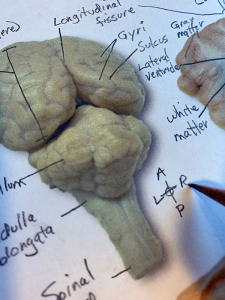
Although you and I are comfortable in orienting ourselves to anatomical directions when looking at diagrams, photographs, and specimens in anatomy, our beginning student often are not. The simple process of adding an "anatomical rosette" reflecting the anatomical directions in each encountered diagram can  help students develop the skill of understanding anatomical perspective.

 anatomical rosette


3 | Sponsored by AAA

0.5 minutes
The searchable transcript for this episode, as well as the captioned audiogram of this episode, are sponsored by The American Association of Anatomists (AAA) at anatomy.org. Their big meeting is in April at the Experimental Biology (EB) meeting in Orlando FL. Check it out!
 American Association of Anatomists

4 | Reserve Hematopoiesis

3 minutes
Hematopoietic stem cells  (HSCs) may have a "back-up system" that helps out after damage to the working population. These "reserve" HSCs (rHSCs) may step up when the primed HSCs (pHSCs) cannot keep up with the demand for hematopoiesis.
  • Scientists have identified a bone marrow backup system (summary article) my-ap.us/2BmcoE0
  • N-Cadherin-Expressing Bone and Marrow Stromal Progenitor Cells Maintain Reserve Hematopoietic Stem Cells
    (report by Zhao, et al. in Cell Reports) my-ap.us/2Bk7vLN

 hematopoietic stem cell


5 | Sponsored by HAPS

0.5 minutes
The Human Anatomy & Physiology Society (HAPS) is a sponsor of this podcast. Did you know there's a one-day regional HAPS conference in March? Check it out. You can help appreciate their support by clicking the link below and checking out the many resources and benefits found there.
 HAPS logo

6 | Featured: Last Best Story in Adult Neurogenesis & ANS Pathways

12 minutes
The "last best story" is what I tell my students I'm providing to them. That approach emphasizes the evolving nature of scientific understanding. In this episode, I mention two stories that are evolving right now.
reading a book

If the hyperlinks here are not active, go to TAPPradio.org to find the episode page.

Amazon and TextExpander referrals help defray podcasting expenses.

Transcript and captions for this episode
are supported by theAmerican Association of Anatomists.anatomy.org


The Human Anatomy & Physiology Societyalso provides support for this podcast.
theAPprofessor.org/haps


(Clicking on sponsor links 
helps let them know you appreciatetheir support of this podcast!)

Click here to listen to this episode—or access the detailed notes and transcript.


Monday, November 17, 2014

Your Textbook is a Mitten, Not a Glove


How well does the textbook you use in your course fit?  What I mean by that is:

  • Have you looked at whether the reading style is geared toward the students you typically encounter? Is the text written for beginners or experts?

  • Have you compared your actual expectations (objectives & expected outcomes) to the content available in the textbook?

  • Is the textbook organized in way that facilitates learning by both reading and raiding?

Of course, no textbook is going to fit you, your students, and your course like a glove.  Even if you create your own, or edit a custom version of existing text material, the fit will change as you and your course evolves as you gain teaching skills, adjust your techniques, and your students' needs change.

Textbooks fit like a mitten, not a glove. Because the best they can do is approximately fit course objectives and content, student learning needs, and your teaching approach.

But mittens are great.  They cover your hand and give you some wiggle room.

As a "mitten" your course textbook should cover what you need it to cover.  It's okay if it covers a bit more than you need.  That extra coverage will be used later for reference and future learning in professional and clinical courses.  Extra content also helps fill in prior learning gaps, which allows students to "get it" on their own as they read or raid.  And extra content may help students better see the context and importance of the required content.  Satisfying natural curiosity is not a bad thing, either.

Although well-fitting mittens cover a bit more than they need to, a mitten should not be too big.  So having so much content in a textbook that it's hard to stay focused mainly on the required content is not good for learning. Conversely, a mitten should not be so small that you can't get it around your big hand or wiggle your fingers a bit.

Some mittens have special features like a slit through which you can extend your fingers when you need more precise movements than your mitten will allow—as when opening your flask of hot tea.  If your students would benefit from a supplemental atlas, an audio glossary, a list of word parts for each term, or other special learning features of textbooks, then consider those carefully, too.

The key is to think of a textbook as an off-the-shelf item that will never fit precisely.  It's up to you to make sure it fits well enough.  And the only way to get that fit is to try on all the mittens.  Don't just glance at them, really put your hand in and see what they're like.

Plaid mittens are the best.  That has nothing to do with the analogy I'm making here—I just like plaid mittens.


Photo credits: Mélanie, Bin im Garten


Monday, February 25, 2013

Blood viscosity

Blood viscosity is a concept that is important in understanding blood flow.  It is, after all, one of the factors that affects peripheral resistance to blood flow.

One major factor influencing blood viscosity is hematocrit.  You may be interested in using the analogy of ketchup outlined a few months ago in my article for students Blood viscosity and peripheral resistance at theAPstudent.org

Recently, researchers also looked at the viscosity of the blood plasma alone (without the formed elements).  They found that blood plasma has unique characteristics of flow found only in non-Newtonian fluids, becoming less viscous with increasing pressure.  Again, just like ketchup. Plasma, unlike plain water, exhibits both viscous and elastic behaviors.

Researchers found in recent experiments that this characteristic of plasma may promote swirling where blood vessels diameters change—both at the beginning and end of a narrowed segment.  Thus, this could have an effect on formation of clots at stenoses or where a stent has been placed.

So, as you may have suspected all along, blood is not only thicker than water—it's weirder than water.

Want to know more?

  • Blood viscosity and peripheral resistance
    • Kevin Patton
    • The A&P Student 12 September 2012
    • [Analogy of ketchup flow for students.  Includes video.]
    • my-ap.us/XuR596
  • Blood Is Thicker Than Water – And Blood Plasma Is, Too
    • Science Daily Feb. 18, 2013
    • [Brief, plain-language article outlining the recent research.]
    • my-ap.us/YpGhas
  • Rheology of human blood plasma: Viscoelastic versus Newtonian behavior.
    • M. Brust, et al.
    • Phys. Rev. Lett, 110, 078305 (2013) DOI: 10.1103/PhysRevLett.110.078305
    • [Original journal article.  See photos from the experiments below.]
    • my-ap.us/15HVkle


Recording from one of the "drop-experiments": If blood plasma is placed between two plates and then they pulled apart, high-speed cameras show in conjunction with high-resolution microscope objectives that strands and droplets form. This demonstrates that plasma is elastic and viscous and does not behave like water.
Photo: Christof Schaefer, Phys. Rev. Lett. 110, 2013, 078305th Copyright (2013) by the American Physical Society

Plasma turbulence affects the blood. In one experiment, the researchers had plasma flow through a microfluidic constriction as in vasoconstriction. They showed turbulence at the end of the contraction, but also - as seen here in the pictures - sticking to its beginning. This turbulence is caused by the viscoelastic properties of blood plasma.
Photo: Mathias chest, Phys. Rev. Lett. 110, 2013, 078305th Copyright (2013) by the American Physical Society