Showing posts sorted by relevance for query HAPS-I. Sort by date Show all posts

Sunday, January 24, 2010

More graduate biology courses at the HAPS Conference


OK, so you missed out on that cool cadaver class presented by HAPS Institute (HAPS-I) in San Diego this winter . . . because it filled up faster than I could tell you about it!  But now's your second chance for some great graduate biology courses especially for teachers of human anatomy and physiology courses:

1. Advances in Anatomy and Physiology 2010  (Ellen Arnestad and Kevin Patton)

2. Advanced Cardiovascular Physiology: The Heart at Work and at Rest (Robert Carroll)

3. Concepts in Human Embryology (Valerie O'Loughlin)

4. Molecular and Cellular Basis of Disease (Kelly McDonald)
These are great courses that feature both useful content about human A&P and experience with best practices in teaching these subjects.  These are courses that are MEANINGFUL to what you do every day in your own teaching.  And you'll be there with folks just like you . . . who teach secondary, college, and university A&P.

Each course earns you 2 graduate credits from the Biology Department of the University of Washington (Seattle). 

These courses begin with online work on April 13, involve seminars and/or workshops during the Denver HAPS Conference (May 29 - June 3), and continue with online work through August 19.  Each syllabus has additional details.  Conference registration (plus lodging, meals, and transportation, if needed) is required (in addition to HAPS-I course fees). 

Want to know more? 

Remember . . . THESE COURSES FILL EARLY.  So you want to get on this ASAP.  I mean it this time!

In fact, some spots have already been taken by past HAPS-I Scholars and by members of the HAPS-I Update email list, who all received notice of these course openings a few days ago.  (If you want prior notice of HAPS-I courses, go to http://www.hapsweb.org/displaycommon.cfm?an=1&subarticlenbr=234 to subscribe to either the HAPS-I Scholars Google Group or the HAPS-I Update Google Group.)

Registration is now open at http://www.hapsweb.org/displayconvention.cfm?conventionnbr=7898

For more information on the HAPS Annual Conference in Denver, go to http://www.hapsweb.org/displayconvention.cfm?conventionnbr=7450

EARLY BIRD CONFERENCE RATES APPLY UNTIL 2/1/2010!

Thursday, July 24, 2008

HAPS

If you're a teacher of human anatomy and/or physiology and you're not a member of HAPS--the Human Anatomy and Physiology Society--then you should be!

HAPS is an organization dedicated solely to supporting folks like you and me. Folks from all levels of education from secondary, to community college, to four-year schools and universities, to medical education are welcomed into a collegial, supportive atmosphere.

The annual conference is an informal but power-packed week of update seminars by experts in most fields of human biology, workshops in which A&P professors share their tips, tricks, successes, and failures, and a lot of opportunities for networking with folks from all over North America.

Besides the annual conference and the occasional regional conference, there are resources such as a model curriculum, animal use resources, safety resources, cadaver use resources, standardized student testing, and so much more!

One of my favorite HAPS resources is the HAPS EDucator (HAPS ED), the official journal of the society. It's packed with organization news and updates, teaching tips, content updates, and more.

Another favorite is HAPS Institute . . . a rather biased opinion considering that I'm the Director of HAPS Institute (HAPS-I) and a member of the faculty. HAPS-I is the professional continuing education program of HAPS. The program offers several graduate biology courses each year in flexible formats geared to the academic life. Graduate biology credit from the University of Washington is granted in the courses, which focus on both content and teaching applications in areas often perceived as being hard to understand, hard to learn, and hard to teach. I'll be sharing more about HAPS-I in another message soon!

Monday, August 20, 2018

The First Ten Years of The A&P Professor!

On July 4, 2008, I published the first post on this blog—thereby launching The A&P Professor. 

I picked July 4—U.S. Independence Day—as my start date so that it would be easy for me to remember. It didn't work, though. It just yesterday occurred to me that I'd missed the tenth anniversary! Better a tiny bit late than never, eh?

I started The A&P Professor as a way to share what I'd learned—and am still learning—about the teaching of human anatomy & physiology. Having had a wonderful mentor in my early years of teaching of A&P (thank you, Sr. Virginia), and scores of colleagues sharing their A&P teaching wisdom in the Human Anatomy & Physiology Society (HAPS), I felt like I wanted to pass along the many treasures I'd collected over three decades.

And, well, I'm a writer. Meaning it's my nature to write things and share them. So I guess a blog was a natural fit for me, eh?

At first, I thought it might also be a way to share the "inside story" of my various textbooks, lab manuals, and other publications. But I soon realized that The A&P Professor works best when I don't do that. So I soon moved that aspect to other outlets and focus on the art and science of teaching A&P, period.

Soon came the website at theAPprofessor.org where I posted a lot of resources for teaching A&P. A year or so ago, the website got a big makeover and more modern design that works well on mobile devices. During that process, a lot of old stuff was tossed out and the website streamlined to be more of a professional development venue.

Along the way, I added a newsletter version of the blog, so that you can get an emailed copy of each new post as soon as it's posted—so you don't have to keep an eye on the blog.

The A&P Professor has long been registered as a trademark in the U.S., so we can all count on it being what it is and with the same person running it—and not something else entirely.

Along the way, I've added social media presence in Facebook, Twitter, Instagram, YouTube, and other channels. And a daily, curated roundup of science and teaching headlines at Nuzzel.

And, oh boy, have I heard from many of y'all over the years! It warms my heart when you stop me at a HAPS meeting, drop me an email note or tweet, or give me a call and tell me how much this or that thing I mentioned in my blog or another outlet has helped you. Or better, has got you thinking about a new direction to go in. You know, that feeling you get when a student or alum has told you that something you shared with them has truly helped them—or lit their own creative spark. There's not a feeling like it in the world, is there?

You're probably tired of hearing about (or just hearing) my podcast featuring content updates and teaching strategies for A&P. This latest (ad)venture is just the latest of the many ways I've been working to promote continuous improvement in the teaching of human anatomy and physiology. Mostly my own. As they say... when we teach, we learn. They're right!

I hope you'll continue your support of The A&P Professor for the next ten years.


For those who have not yet heard any of the new podcast series, try the first episode and move forward from there.


Tuesday, January 27, 2009

HAPS 2009 in Baltimore

Heads up! The "early bird special" for the 2009 Annual Conference in Baltimore MD is about to expire. After January 31, you'll have to pay a premium to attend the event of the year for A&P professors.

Go to the home page for HAPS (Human Anatomy and Physiology Society) to find the link to register for this great conference. If you've never been to one of these, you have no idea how great they are. Really. I guarantee that no matter what type of A&P course you teach, you'll find this meeting to wildly exceed any expectations you have.


While you're there, you can amplify your experience by also participating in one of several short graduate biology courses offered by HAPS Institute (HAPS-I). For more information on the HAPS-I program and the "conference courses" offered in conjunction with the Baltimore meeting, go to the HAPS-I start page.

Fair warning! The HAPS-I courses were opened about a week ago, and they are already nearly half full! These are great courses, so they fill up fast. Don't dilly-dally, my friends!

Tuesday, March 24, 2009

It's almost too late!


A while back I mentioned all the benefits of participating in HAPS Institute (HAPS-I), the Human Anatomy and Physiology Society's professional continuing education program for A&P professors that offers short, flexible graduate biology courses.

We have four courses that begin soon . . . April 15. These courses involve both online work and sessions at the upcoming 2009 Annual HAPS Conference in Baltimore MD at the end of May.

Two of those courses still have some room in them . . .

Advances in Anatomy & Physiology 2009 (2 graduate credits)
  • A great "first experience" in HAPS Institute
  • Begins online April 15, 2009
  • Learners engage the material presented in the conference Update Seminars more fully than just "walking in cold"
  • Learners have a chance to discuss the seminar presentations together to find those gems that we can "take back to our classroom."
  • Faculty: Ellen Arnestad and Kevin Patton
Advanced Respiratory Biology (2 graduate credits)
  • A reprise of last year's wildly popular course
  • Explore the "in and outs" of the respiratory system for a fully understanding
  • Begins online April 15, 2009
  • Features master teacher Mary Pat Wenderoth of University of Washington
The program also offers a completely online course . . . but there are only a couple of spots left!

Best Practices in Hybrid & Online Teaching of A&P (2 credits)
  • No conference attendance required
  • Begins online May 1, 2009
  • Taught by online A&P experts Tom Lancraft and Janice Yoder Smith
  • Great credential to have in your portfolio!
Want more information? Follow these links . . .

Here's the outside of the HAPS-I brochure

(use the frame buttons to ZOOM, then scroll or print)


Here's the inside of the HAPS-I brochure

(use the frame buttons to ZOOM, then scroll or print)


[The video players and other features may not be visible in a feed or newsletter item. Go to The A&P Professor blog to view these features.]

Wednesday, December 9, 2009

Too late for cadaver class!


I had hoped to tell you all about a great new course offered by HAPS Institute . . . Anatomy of the Abdomen and Thorax . . . but it filled up in less than half a day!

Lucky for us (and the dozen or so folks on the waitlist), this is the first in a series of several courses that center around a weekend workshop in a cadaver lab with expert dissectors.

The Anatomy of the Abdomen and Thorax course held in February in San Diego is just the first in a series of courses that will be held at various locations in North America in the coming months and years.

These courses carry three graduate credits from the University of Washington (Seattle) biology department. All HAPS-I courses are meant for folks who already teach anatomy and physiology (high-school through graduate levels) fill in their background in various topics within human biology . . . or simply to brush up on the lastest concepts.  Even if you already have a graduate degree and "don't need the credit" you'll find these courses to be both fun and useful.

All HAPS-I courses also involve emerging methods of active learning and thus showcase methods of teaching and learning that participants can adapt into their own courses.

Want to know more about HAPS-I and its courses? Click here for more information.

However, when new HAPS-I courses open up . . . ACT QUICKLY because they DO fill quickly!

Sunday, August 3, 2008

Cadavers, anyone?

People are DYING to get into this course!

Some of you already know that I'm the Director of HAPS Institute (HAPS-I), the professional continuing education program of the Human Anatomy and Physiology Society (HAPS). This program offers graduate biology courses in flexible formats to A&P professors just like you!

I'll explain more about HAPS-I in later posts, but right now I have urgent news:

We're offering a repeat of one of our most popular courses SOON!

USING CADAVERS IN A&P
(3 credits, Univ of Washington)

This is for anyone who is using cadavers, wants to use cadavers, or is just curious about using cadavers in their undergraduate program. You'll go back with a lot of great photos of organs, etc, that you can use in your own courses plus plenty of great tips on how to implement cadaver use at your institution. I sat in on last spring's course and it was GREAT. I picked up a lot just by OSMOSIS. Think how much more you'll get by actually PARTICIPATING!

The course begins September 8 with online readings and discussions.

The workshop will be at the cadaver lab at Grand Rapids Community College (downtown Grand Rapids MI) on Sep 26-27-28. We'll have a session Friday evening in the hotel following an optional pay- your-own welcome dinner. Then all day Saturday on campus in various sessions in and out of the lab. Saturday optional pay-your-own dinner in Grand Rapids. Then a Sunday morning wrap-up session on campus until 11am.

Then you'll discuss things and work on your learning object through the end of November.

Accommodations at $89 per night are available at the nearby Days Inn Hotel (a few easy blocks from campus). Call (616) 235-7611 and ask for the HAPS Institute rate.

The enrollment form, syllabus, faculty, course details, and so on, are posted at
at http://www.hapsweb.org/displaycommon.cfm?an=1&subarticlenbr=204

THIS COURSE FILLED FAST last time and HAD A LONG WAIT LIST so if you are interested, you have to ENROLL NOW to ensure a spot. Last time there was crying and wailing when we had to shut the door . . . don't let that happen to you. Those on the waiting list from last year are mostly already in the course (we're almost half full already!).

Tuesday, January 5, 2016

Engaging Students on the First Day of Class

When I was an undergraduate—back in the olden days—the first day of every class was always the same. The professor would come in a few minutes after the published start time, hand out a stack of syllabi still fresh with the fumes of the spirit duplicator solvent, and tell us about all the course policies and procedures (anticipating that we would not really read the syllabus). Perhaps there would be a few questions answered. Possibly, we'd get a content-based lecture that first day, but more often we'd just get an early release from class.

http://my-ap.us/1FDKa5Y
When I started teaching college, I did the same thing. I thought that this was how it was supposed to be done. And, despite having had some courses in how to teach effectively, I just fell into the ritual with which I'd grown up.

It didn't even occur to me how boring or pointless this activity was until I was at a HAPS meeting decades ago and went to a workshop entitled something like Engaging Students on the First Day of Class. Although the title was mildly intriguing, the main reason I went was to support my friends Richard Faircloth and Michael Glasgow from Anne Arundel Community College, who presented the workshop. Those of you who've given workshops know that it helps to have a few folks in the crowd who can be counted on to smile back at you even when you're sweating!

It turned out to be one of those many how-did-I-survive-without-knowing-about-this-before-now moments that one experiences at a HAPS Conference. I learned that I could make that first day into something much, much better than the traditional "here's what I expect" sermon.

Richard and Michael had us form small groups and showed us how we could make "syllabus day" a fun, active learning experience for students. An experience that could be far more effective in getting the essential messages across than what I had been doing. It must have worked because I can still see and hear some of what happened nearly two decades ago in my small group—and I took their message home and implemented it.

Their method boils down to this:
  1. Get your students into small groups. Right away—before you've handed out the syllabi or other materials.

  2. Give them a brief handout outlining what they are to do. Or you can project the directions on the screen. For example:

    1. Have them introduce themselves and briefly explain why they are taking A&P.

    2. Have them discuss and write down what pressing questions they have about the course.

    3. Tell them to send someone up to the professor to grab enough syllabi for everyone in the group.

    4. Ask them to use the syllabus and try to find the answers to the questions the group had written down.

  3. It's important NOT to answer their questions as you stroll around to chat and listen in on the groups—they have to find the answers in the syllabus.

  4. Have them re-assemble into a large group and ask them what questions they had that were not answered by their search or that need additional clarification.

By doing this, the students get to know a few other students right away—even the introverts. They get to be active, instead of passively sitting there "absorbing" from an active professor. Students are forced to think about what's important for them to know as they begin a new, perhaps scary-sounding, course. They learn how the syllabus is constructed as they explore it collaboratively looking for critical information. So they know how to find answers to questions they have later in the course. How many times have we wondered if they even looked as the syllabus once?

This method allows the professor to focus their efforts that day on the information that students really want to hear from them at that moment. And it tells you where your syllabus needs to be corrected or clarified!

I was very happy with the way my first experiment with this approach worked. Perhaps more importantly, my students were very happy with it. Ever since that first time, I've regularly had students tell me, "that was fun, I wish all my profs did their first day this way." It even shows up on the end-of-semester course evaluations—so it must have made an impression!

Over the years (nearly twenty), I've tweaked the process and adapted it to my particular course quirks. Because I always get certain questions, I often follow up with a demonstration of how to login to their course in the LMS, how to access the publisher website, and how to register their clickers. I also introduce them to the idea of human science—anatomy and physiology in particular. Ask them to think about why are here—and we discuss those goals and how they can be acheived. I sometimes even give them my secret methods for finding a parking space quickly.

If you'd like a starting point for creating your own first-day experiment, download these example handouts:


Photo (top): Griszka Niewiadomski
Photo (bottom): Gokhan Okur
Updated 6 January 2016

Wednesday, February 26, 2020

Mid-Winter Winterizing of Our Courses | Bonus Episode 63


Host Kevin Patton alerts us to the potential impact of influenza and other outbreaks on our courses and provides advice and options for preparation, handling impacts, and more! In the absence of outbreaks, these tips also help cope with normal winter absences resulting from illnesses.

00:42 | Why Winterize in Mid Winter?
04:16 | Sponsored by AAA
04:33 | Learning from Past Epidemics and Pandemics
08:49 | Sponsored by HAPI
09:11 | Staying Home. I Mean It!
16:04 | Sponsored by HAPS
21:49 | Survey Says...
22:19 | Final Thoughts
26:56 | Staying Connected

If you cannot see or activate the audio player click here.

Please take the anonymous survey: theAPprofessor.org/survey

Questions & Feedback: 1-833-LION-DEN (1-833-546-6336)
Follow The A&P Professor on Twitter, Facebook, Blogger, Nuzzel, Tumblr, or Instagram!

Just think: your family are the people most likely to give you the flu. (Jane Wagner)

Why Winterize in Mid Winter?

3.5 minutes
We are now in a flu (influenza) season and on the verge of a coronavirus pandemic. Maybe we should have talked about this earlier, eh? But better late than never!
  • CDC expects ‘community spread’ of coronavirus, as top official warns disruptions could be ‘severe’ (news summary) my-ap.us/2TjciVO
  • World is approaching coronavirus tipping point, say experts (news summary) my-ap.us/2vel7bp
  • Image: influenza structure my-ap.us/2Vlk58u
influenza virus structure

Sponsored by AAA

0.5 minutes
  • A searchable transcript for this episode, as well as the captioned audiogram of this episode, are sponsored by the American Association for Anatomy (AAA) at anatomy.org.
AAA logo

Learning From Past Epidemics and Pandemics

4 minutes
Back in the Spanish flu pandemic of 1918, St. Louis had a much lower impact than other major U.S. cities. The key was implementation of "social distancing," which we can implement in our personal lives—and in our courses.
  • Quarantine during 1918 Spanish flu epidemic saves lives (retrospective on how closing things down helped stem an epidemic in St. Louis) my-ap.us/38VFJUJ
  • Information About Social Distancing (fact sheet) my-ap.us/2TaEla1
  • Influenza—Flu (CDC information hub regarding influenza) my-ap.us/3a5W8WN
  • Image: Spanish flu in St. Louis 1918 my-ap.us/3c4mABR
St. Louis Spanish Flu 1918

Sponsored by HAPI Online Graduate Program

0.5 minute
The Master of Science in Human Anatomy & Physiology Instruction—the MS-HAPI—is a graduate program for A&P teachers. A combination of science courses (enough to qualify you to teach at the college level) and courses in contemporary instructional practice, this program helps you power up  your teaching. Kevin Patton is a faculty member in this program. Check it out!
NYCC Human Anatomy and Physiology Instruction

Staying Home. I Mean It!

7 minutes
Yeah, we want to come to school. We want our students to be regular participants in class. But, you know, sometimes the public good takes precedent over what we think is "right" or honorable.
covid-19 virus

Sponsored by HAPS

0.5 minutes
The Human Anatomy & Physiology Society (HAPS) is a sponsor of this podcast.  You can help appreciate their support by clicking the link below and checking out the many resources and benefits found there. Don't forget the HAPS Awards, which provide assistance for participating in the HAPS Annual Conference.
HAPS logo

The Preparation Phase

5.5 minutes
Preparation is a great strategy to minimize harm, right?
Don't forget to call in with your ideas on stealth teaching (for an upcoming episode).
viewing a preview presentation

Survey Says...

0.5 minute
  • Please take about 5 minutes to answer some questions—it will really help improve this podcast!
survey

Final Thoughts

4.5 minutes
sneeze

Apology: Long after recording this episode, I realized that the term "Spanish flu" that I used is a derogatory term. My intent was not to cause harm and I apologize to everyone hurt by my use of the term. Please listen to Episode 72 for the audio apology.

Click here to listen to this episode—or access the detailed notes and transcript.

Monday, February 11, 2019

The Last Best Story in Teaching Anatomy & Physiology | Episode 37


01:17 | Feedback in Online Tests
08:17 | The Anatomical Compass
14:47 | Sponsored by AAA
15:12 | Reserve hematopoiesis
18:09 | Sponsored by HAPS
18:54 | Featured: Last Best Story in Adult Neurogenesis & ANS Pathways
If you cannot see or activate the audio player click here.

Questions & Feedback: 1-833-LION-DEN (1-833-546-6336)
Follow The A&P Professor on Twitter, Facebook, Blogger, Nuzzel, Tumblr, or Instagram!

Scientific theories are tested every time someone makes an observation or conducts an experiment, so it is misleading to think of science as an edifice, built on foundations. Rather, scientific knowledge is more like a web. The difference couldn’t be more crucial. A tall edifice can collapse – if the foundations upon which it was built turn out to be shaky. But a web can be torn in several parts without causing the collapse of the whole. The damaged threads can be patiently replaced and re-connected with the rest – and the whole web can become stronger, and more intricate. (Massimo Pigliucci)

1 | Feedback in Online tests

7 minutes
In Episode 36, Adam Rich called in regarding how we can provide feedback to students taking online tests. I responded that I encourage students to get the correct response from their study buddies—or from me. After the episode aired, Krista Rompolski pointed out that this could be a challenge in very large courses. What do y'all think? Tell us. Really.


2 | The Anatomical Compass

6.5 minutes
Although you and I are comfortable in orienting ourselves to anatomical directions when looking at diagrams, photographs, and specimens in anatomy, our beginning student often are not. The simple process of adding an "anatomical rosette" reflecting the anatomical directions in each encountered diagram can  help students develop the skill of understanding anatomical perspective.

 anatomical rosette


3 | Sponsored by AAA

0.5 minutes
The searchable transcript for this episode, as well as the captioned audiogram of this episode, are sponsored by The American Association of Anatomists (AAA) at anatomy.org. Their big meeting is in April at the Experimental Biology (EB) meeting in Orlando FL. Check it out!
 American Association of Anatomists

4 | Reserve Hematopoiesis

3 minutes
Hematopoietic stem cells  (HSCs) may have a "back-up system" that helps out after damage to the working population. These "reserve" HSCs (rHSCs) may step up when the primed HSCs (pHSCs) cannot keep up with the demand for hematopoiesis.
  • Scientists have identified a bone marrow backup system (summary article) my-ap.us/2BmcoE0
  • N-Cadherin-Expressing Bone and Marrow Stromal Progenitor Cells Maintain Reserve Hematopoietic Stem Cells
    (report by Zhao, et al. in Cell Reports) my-ap.us/2Bk7vLN

 hematopoietic stem cell


5 | Sponsored by HAPS

0.5 minutes
The Human Anatomy & Physiology Society (HAPS) is a sponsor of this podcast. Did you know there's a one-day regional HAPS conference in March? Check it out. You can help appreciate their support by clicking the link below and checking out the many resources and benefits found there.
 HAPS logo

6 | Featured: Last Best Story in Adult Neurogenesis & ANS Pathways

12 minutes
The "last best story" is what I tell my students I'm providing to them. That approach emphasizes the evolving nature of scientific understanding. In this episode, I mention two stories that are evolving right now.
reading a book

If the hyperlinks here are not active, go to TAPPradio.org to find the episode page.

Amazon and TextExpander referrals help defray podcasting expenses.

Transcript and captions for this episode
are supported by theAmerican Association of Anatomists.anatomy.org


The Human Anatomy & Physiology Societyalso provides support for this podcast.
theAPprofessor.org/haps


(Clicking on sponsor links 
helps let them know you appreciatetheir support of this podcast!)

Click here to listen to this episode—or access the detailed notes and transcript.


Monday, June 21, 2021

More Slide Tricks | Effective Teaching Presentations | TAPP 95


Everybody loves to hate teaching with slides. But maybe that's because we've not fully developed our skills! Host Kevin Patton build on previous advice to improve our mastery of the slide-of-hand we need for effective learning. Let's turn that hate into love! This is the first of a two-episode series.

00:00 | Introduction

00:58 | Buy One, Get One

02:06 | I Need Help!

10:20 | Sponsored by AAA

11:47 | Less Text, More Story

24:25 | Sponsored by HAPI

25:49 | Chunky Style Slides

39:44 | Sponsored by HAPS

41:08 | Where Art Thou?

48:16 | Slide Tricks

50:12 | Staying Connected


If you cannot see or activate the audio player, go to: theAPprofessor.org/podcast-episode-95.html

🏅 Apply for your credential (badge/certificate) for listening to this episode: theAPprofessor.org/podcast-episode-95.html/#badge

❓ Please take the anonymous survey: theAPprofessor.org/survey

☝️ Questions & Feedback: 1-833-LION-DEN (1-833-546-6336)

✔️ Follow The A&P Professor on Twitter, Facebook, Blogger, Revue, Tumblr, or Instagram! @theAPprofessor

📰 Get the almost-daily TAPP Science & Education Updates theAPprofessor.org/updates

The purpose of life is not to be happy. It is to be useful, to be honorable, to be compassionate, to have it make some difference that you have lived and lived well. (Ralph Waldo Emerson)


Buy One, Get One

1 minute

This is the first of two episodes in a series about using slides to teach effectively. Yeah, I know—everybody hates the idea of using slides. But maybe it's because we don't know how to use them well. And yeah, some of this has been covered in different ways in previous episodes. But this kind of overlap—or layering—is a proven learning technique, right?

Teaching Slides: Smooth and Simple Animations Dramatize the Story of A&P | TAPP 89

Slides Serve the Story of Anatomy & Physiology | Episode 66

Simple Ideas for Pandemic Teaching | Episode 67

The Storytelling Special | Episode 48

photo of an empty lecture hall from the back


I Need Help!

8 minutes

We're all a bit overloaded and overwhelmed these days, right? Yeah, I'm feeling that pain right now. I need help. Will you please help me?

TAPP Journal Club with Krista Rompolski

Test Question Templates Help Students Learn | TAPP 70

4 people, arm in arm, with T shirts printed with "Volunteer"


Sponsored by AAA

1.5 minute

A searchable transcript for this episode, as well as the captioned audiogram of this episode, are sponsored by the American Association for Anatomy (AAA) at anatomy.org.

Searchable transcript

Captioned audiogram 

Don't forget—HAPS members get a deep discount on AAA membership!

AAA logo


Less Text, More Story

12.5 minutes

I've said this before. I say it all the time. You're sick of me saying it. But you know what? We need that continual and consistent messaging so that maybe it will eventually become part of our working memory—our conscious awareness. So here, we go again.

Teaching Slides: Smooth and Simple Animations Dramatize the Story of A&P | TAPP 89

Slides Serve the Story of Anatomy & Physiology | Episode 66

Simple Ideas for Pandemic Teaching | Episode 67

The Storytelling Special | Episode 48

★ 10 tips on how to make slides that communicate your idea, from TED’s in-house expert (example of a TED Talk) my-ap.us/3gI6FgP

storytelling


Sponsored by HAPI Online Graduate Program

1.5 minute

The Master of Science in Human Anatomy & Physiology Instruction—the MS-HAPI—is a graduate program for A&P teachers, especially for those who already have a graduate/professional degree. A combination of science courses (enough to qualify you to teach at the college level) and courses in contemporary instructional practice, this program helps you be your best in both on-campus and remote teaching. Kevin Patton is a faculty member in this program at Northeast College of Health Sciences. Check it out!

nycc.edu/hapi

Logo of Northeast College of Health Sciences, Human Anatomy & Physiology Instruction


Chunky Style Slides

14 minutes

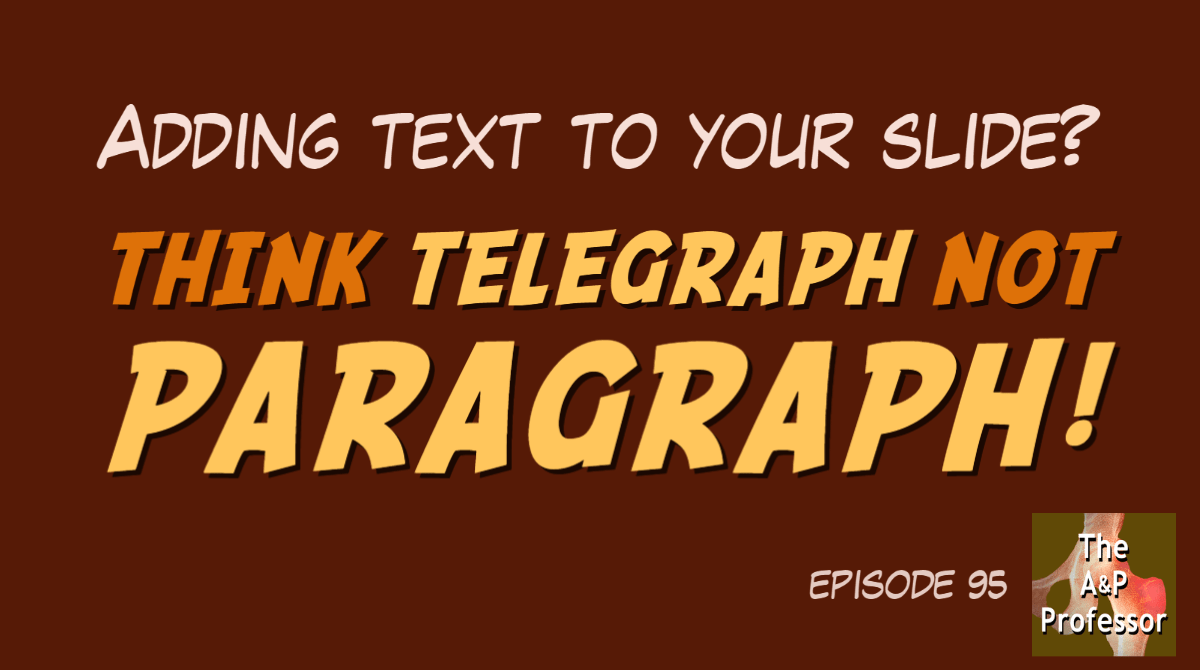
If we follow the Universal Design for Learning (UDL) mindset, we know that chunking content into pieces that are easy for students to focus on. But why do we often end up putting a lot of concepts on one teaching slide? Here, I suggest that "chunky style" may be best for learning. And I also suggest that a useful mantra to chant while putting text into our slides is, "think telegraph, not paragraph."

★ Guidelines for Universal Design for Learning (UDL) my-ap.us/UDLguidelines

slogan "Adding text to your slide? Think telegraph, not paragraph."


Sponsored by HAPS

1 minute

The Human Anatomy & Physiology Society (HAPS) is a sponsor of this podcast.  You can help appreciate their support by clicking the link below and checking out the many resources and benefits found there. Watch for virtual town hall meetings and upcoming regional meetings!

Anatomy & Physiology Society

theAPprofessor.org/haps

HAPS logo


Where Art Thou?

7 minutes

Lots of ideas on using images effectively in our slides. Images may be the true heart and purpose of using slides to teach.

Finding Media | Images and More for Teaching Anatomy & Physiology

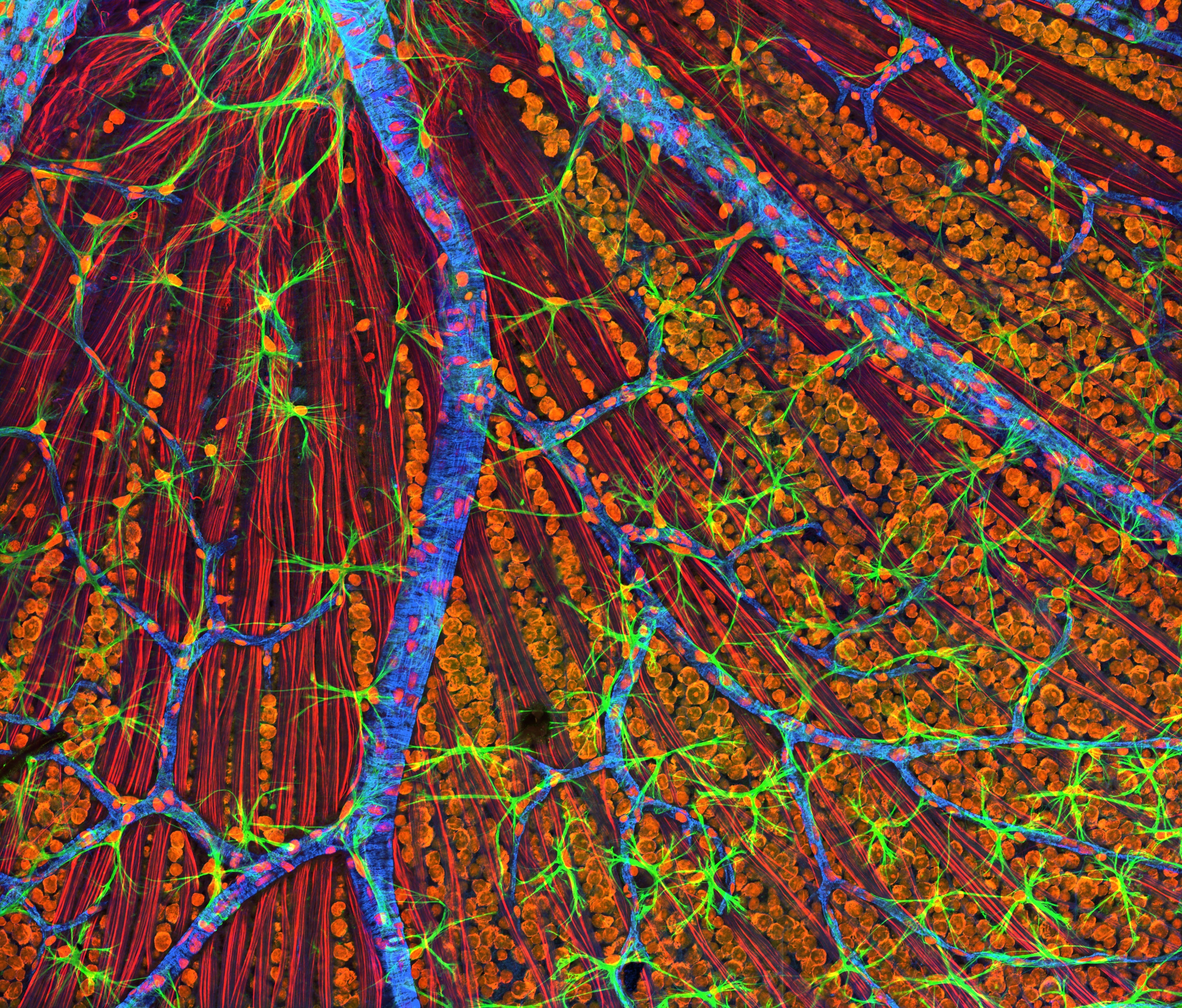
retina


Slide Tricks

2 minutes

A wrap up of points made in this episode—there are so many! And a look ahead at the next episode.

silhouette of a person doing a handstand with a skateboard


If the hyperlinks here are not active, go to TAPPradio.org to find the episode page.

★ More details at the episode page: theAPprofessor.org/podcast-episode-95.html

★ Transcript available in the transcript box: theAPprofessor.org/podcast-episode-95.html

★ Need help accessing resources locked behind a paywall? Check out this advice from Episode 32 to get what you need! https://youtu.be/JU_l76JGwVw?t=440
 
Take The A&P Professor experience to the next level! 

theAPprofessor.org/community
 
Earn cash by referring other A&P faculty to this podcast: 

theAPprofessor.org/refer
 
Tools & Resources

★ TAPP Science & Education Updates: theAPprofessor.org/updates

★ Amazon: amzn.to/2r6Qa3J

★ Text Expander: theapprofessor.org/textexpander

★ Rev.com: try.rev.com/Cw2nZ

★ Snagit & Camtasia: techsmith.pxf.io/9MkPW

★ Krisp Free Noise-Cancelling App: theAPprofessor.org/krisp

★ The A&P Professor Logo Items: https://www.teepublic.com/stores/the-a-p-professor
 
Sponsors

★ Transcript and captions for this episode are supported by the American Association for Anatomy | anatomy.org

★ The Human Anatomy & Physiology Society provides marketing support for this podcast | theAPprofessor.org/haps

★ Distribution of this episode is supported by the Northeast College of Health Sciences online graduate program in Human Anatomy & Physiology Instruction (HAPI) | nycc.edu/hapi

Clicking on sponsor links helps let them know you appreciate their support of this podcast!

Follow The A&P Professor on  Twitter, Facebook, Blogger, Revue, Tumblr, or Instagram @theAPprofessor

The A&P Professor® and Lion Den® are registered trademarks of Lion Den Inc. (Kevin Patton)

As an Amazon Associate I earn from qualifying purchases. I may be compensated for links to sponsors and certain other links.


Click here to listen to this episode—or access the detailed notes and transcript.

Tuesday, September 9, 2008

Need a tissue?

The official announcement came at the end of last week:

The new Human Anatomy & Physiology (HAPS) Histology Image Database is now available!

This is a "wiki" project that is comprised of an online community of A&P professors who contribute photographs of different human tissues to be used in the "public domain" for A&P education. That means you have permission to use them for PowerPoint presentations, test items, case studies, lab demonstrations and quizzes, wallpaper for your computer . . . whatever you can think of.

[WARNING: In reality, there may be some copyright-restricted images peppered throughout the database. However, these are to have clear copyright statements attached to them so that you can tell which have restrictions.]

Details about how to use the wiki are found at the histology page at the HAPS website.

The image database is located at hapshistology.wetpaint.com but you can't get in without an invitation.

I'm a member of the wiki, so I can invite you . . . just email me at info@theapprofessor.org and tell me
  • if you are a HAPS member (or not a HAPS member)
  • where you teach A&P and
  • that you want to join the HAPS Histology wiki.
You don't have to be a member of HAPS to join the wiki, but you'll find that you'll want to join this organization after you start interacting with us. And you'll get a higher level of privileges in the wiki if you are a HAPS member, too!

To join HAPS go to the membership invitation page at the HAPS website.

And stay tuned, because I'll soon be sharing some FREE PowerPoint slides based on some of these images!

Monday, April 22, 2019

Kevin's Unofficial Guide to the HAPS Annual Conference | 2019 Edition | Episode 42


00:40 | Welcome
01:20 | Introduction to Kevin's Guide
06:27 | Sponsored by HAPS
07:19 | Way Before the Conference
11:23 | Just Before the Conference
26:42 | Sponsored by AAA
27:12 | Structure of the Conference
30:25 | Musical Interlude: Greg Crowther
33:29 | Update Days
48:22 |  Sponsored by HAPI Online Graduate Program
49:31 | Professional Development Approach
54:36 | Workshop Days (with Jerry Anzalone)
1:03:46| Mindi Calls In
1:06:08 | Other Stuff at the Meeting
1:11:31 | After the Conference

If you cannot see or activate the audio player click here.

Questions & Feedback: 1-833-LION-DEN (1-833-546-6336)

Follow The A&P Professor on Twitter, Facebook, Blogger, Nuzzel, Tumblr, or Instagram!

If you've heard this story before, don't stop me, because I'd like to hear it again. (Groucho Marx)

1 | Welcome

1 minute
Yes, we've done this before—it was last year around this time. But this is an all-new, improved, and updated version for 2019. And this time, we have a couple of guests. And music. And more music. Dance, if you like (serving suggestion).

 Kevin's Unofficial Guide to the HAPS Annual Conference


2 | Introduction to Kevin's Guide

4.5 minutes
Okay, you don't really need a guide to the HAPS Annual Conference. These are just some extra tips for getting the most out of it.
  • Kevin's creds for creating this Guide:
    • Preparing for his 30th consecutive HAPS Annual Conference
    • President Emeritus, active committee member
    • Former Annual Conference Coordinator (1995) and Update Coordinator (2005)
  • There is an official guide, by the way. Go to theAPprofessor.org/haps and click on the Events tab.
  • Upcoming HAPS Annual Conferences:
    • 2019
      • Portland OR, May 22-26
      • University of Portland
    • 2020
      • Ottawa, Ontario May 23-27
      • University of Ottawa
    • 2021
      • Albuquerque NM, May 26-30
      • Central New Mexico Community College

3 | Sponsored by HAPS

1 minute
The Human Anatomy & Physiology Society (HAPS) is a sponsor of this podcast.  You can help appreciate their support by clicking the link below and checking out the many resources and benefits found there. AND mention your appreciation to the HAPS leadership while you are at the conference—or anytime that you communicate with them.
Anatomy & Physiology Society 
theAPprofessor.org/haps

 HAPS logo


4 | Way Before the Conference

4 minutes
Register for the conference (and the conference hotel) as early as possible to get the best rates.
Skelly is the cartoon skeleton mascot for the HAP Annual Conferences.

 HAPS 2019 logo


5 | Just Before the Conference

15.5 minutes
A few tips:
  • Get the app and register (search "HAPS 2019" in your device's app store)
  • Go to the HAPS website and get familiar with everything theAPprofessor.org/haps
    • Read up on the Update Speakers
    • Scan the workshops and start narrowing down choices
    • Get to know the staff and leadership (mentioned in Segment 4)
  • Get and bring business cards
  • Dress code
    • Casual (very casual, business casual, business attire, whatever)
    • Or get playful (like Jon Jackson) and wear something amazing (and anatomically correct)
  • Bring your historic HAPSwear (pins, hats, tee shirts, etc.)
    • HAPS conference pins available online or at the registration desk
    • The A&P Professor pins (available from Kevin at the conference)
  • Bring a small, packable item to donate to the HAPS fundraising auction
  • Save room to bring stuff back
    • Like the items you win at the HAPS fundraising auction
    • Samples, handouts, catalogs, souvenirs, etc.

6 | Sponsored by AAA

1 minute
The searchable transcript for this episode, as well as the captioned audiogram of this episode, are sponsored by The American Association of Anatomists (AAA) at anatomy.org. Their big meeting is in April at the Experimental Biology (EB) meeting in Orlando FL. Check it out!
 American Association of Anatomists

7 | Structure of the Conference

3 minutes
The basic plan
  • There are two "Update" days in the hotel.
    • Preceded by an Opening Reception
    • Update seminars
    • Exhibit hall is open
    • Fundraising auction
  • Then, two "Workshop" days at the host institution.
    • Includes committee meetings

8 | Musical Interlude: Greg Crowther

3 minutes
Greg Crowther, A&P professor and musician/composer shares a song he uses to welcome students to the A&P course. It's used here as a sort of welcome to the HAPS Annual conference.


9 | Update Days

15 minutes
  • Update seminars
  • Networking
    • Commit to meeting new people
      • Use the participant list from the HAPS conference app
      • Business cards
    • Opening reception
      • Tom Lehman's tee-shirt swap (bring a shirt from your institution, take a different one home)
      • TAPP pins (get one from Kevin)
    • First-timers Breakfast & Second-timers breakfast
  • Exhibit hall
  • Poster presentations
  • Fundraising auction
  • General membership meeting
 TAPP pin

10 | Sponsored by HAPI Online Graduate Program

1 minute
The Master of Science in Human Anatomy & Physiology Instruction—the MS-HAPI—is graduate program for A&P teachers. A combination of science courses (enough to qualify you to teach at the college level) and courses in instructional practice, this program helps you power up  your teaching. Kevin Patton is a faculty member in this program. Check it out!
There will be a HAPI table in the Exhibit Hall at the 2019 HAPS Annual Conference. Stop by and say hi!
nycc.edu/hapi
 NYCC Human Anatomy and Physiology Instruction

11 | Professional Development Approach

5 minutes

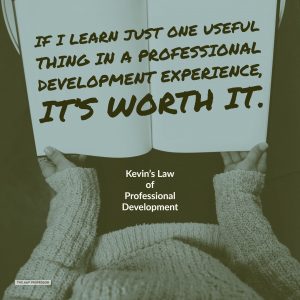
 Kevin's Law


12 | Workshop Days

9 minutes
  • Listen to what others are saying about hot topics, great presenters, cool demos, and other info before making your final choices.
  • Have a backup choice (or two) in case of cancellations or full workshops.
  • Kevin's workshop at the 2019 HAPS Annual Conference
    • Running Concept Lists: A Simple Strategy to Identify, Connect, and Apply Core Concepts of Anatomy & Physiology
    • Sunday May 26, Workshop B505, Room: Shiley (Hall) 319

13 | Mindi Calls In

2 minutes
Mindi Fried (Southern Vermont College) gives her perspective as a former first-timer looking forward to her second-timer experience at HAPS 2019.


14 | Other Stuff at the Meeting

5.5 minutes
  • Often, there are HAPS Institute (HAPS-I) courses available at the HAPS Annual Conference
  • Committee meetings
  • Field trips are often available (get on the mailing list, as slots do sometimes open)
  • Attendance prizes at the end of the second update day

15 | Another Musical Interlude

5 minutes
NOTE: this segment is only available in the YouTube version of this episode, available at youtu.be/G96bB_-5sQQ
Greg Crowther, A&P professor and musician/composer shares another song: Myofibrils.
  • This parody (written by Greg Crowther) is sung to the tune of "My Sharona" (written by Doug Fieger and Burton Averre and performed by The Knack).
    • This song outlines the molecular mechanisms by which muscle cells contract. The major players include calcium, troponin, tropomyosin, actin, and myosin.
    • Lyrics, lesson plan, study questions, mp3 audio file, and music video are available at https://my-ap.us/2VXNfrqyoutu.be/GC_CUfLP6Pc
  • Access Greg's music (lyrics to use with familiar melodies, original songs, audio files, sheet music, including some lesson plans & worksheets) to use in your A&P course.
  • Finding Media | Images and More for Teaching Anatomy & Physiology (list of media resources for teaching A&P; includes Greg's sources)

16 | After the Conference

3 minutes
Connect to The A&P Professor podcast so that you don't miss any episodes!
pocket briefcase
If the hyperlinks here are not active, go to TAPPradio.org to find the episode page.

Sponsors
Transcript and captions for this episode
are supported by the 
also provides marketing support for this podcast. 
Distribution of this episode is supported by 
NYCC's online graduate program in 
Amazon and TextExpander referrals help defray podcasting expenses. 
(Clicking on sponsor links 
helps let them know you appreciate
their support of this podcast!)
Follow The A&P Professor on  Twitter, Facebook, Blogger, Nuzzel, Tumblr, or Instagram!


Click here to listen to this episode—or access the detailed notes and transcript.