Showing posts with label muscle. Show all posts

Friday, February 16, 2018

Concept Maps Help Students Find Their Way| TAPP Radio 5


Use concept mapping for student learning and assessment.
Blood doping is a perennial news topic that helps apply central concepts of A&P.

If you cannot see the audio player click here.

(0:48) Blood doping stories related to the 2018 Winter Olympics (or in any context) are effective in helping student students apply and integrate diverse concepts in anatomy and physiology

(6:32) The featured topic is concept mapping and its uses in helps students learn and helping instructors assess learning and diagnose misconceptions and other learning concerns.
Sample concept map

Click here to listen to this episode—or access the detailed notes and transcript.

Monday, July 21, 2014

Biological Pacemaker Using Gene Therapy


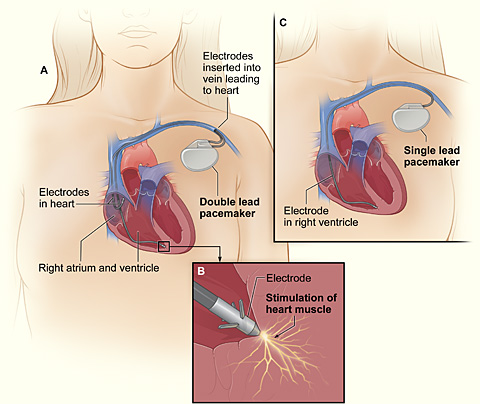
Researchers recently induced ordinary cardiac muscle fibers into becoming functioning pacemaker cells by injecting a therapeutic gene.

Working with pigs, a common model for human cardiovascular research, researchers first destroyed the natural pacemaker cells in each subject's heart and installed an electronic pacemaker. They then inserted a gene for transcription factor TBX18 into cardiac muscle tissue using an adenovirus.  Using adenovirous vectors for inserting genes is a common strategy in gene therapy.

Within a couple of days, ordinary myocardial fibers had developed the structure and function of pacemaker cells.  In about 5 days, the electronic pacemakers were no longer needed.

However, this biological pacemaking peaked at about 8 days, then eventually disappeared.  This may occur because the virus-infected cells are probably destroyed by the body's immune defenses.  So researchers are thinking that perhaps, at the very least, this could eventually lead to a temporary treatment for certain arrythmias in humans.


What can we use from this in teaching undergraduate A&P?  


  • This is an interesting bit of news that helps illustrate the frontiers of human biomedical sciences.
  • This story provides a good case to provoke a discussion of the nature of gene therapy.  
    • Why did the effect last only 8 or so day?  
    • What does this tell us about transcription factor TBX18?  
    • What benefit might this treatment have if developed for humans?
  • This may add interest to an discussion of the function of the electrical system of the heart in general, and artificial pacemakers in particular.
  • The case also provides a scenario in which the body attacks and destroys virus-infected cells.
FREE image you can use in your course

Want to know more?


Next Generation: Biological Pacemakers

  • R Williams, The Scientist (the-scientist.com) July 16, 2014
  • Plain-English article summarizing the discovery.  Includes quotes from the researchers.
  • my-ap.us/1ruocYu


Biological pacemaker created by minimally invasive somatic reprogramming in pigs with complete heart block
  • Y-F. Hu et al., Science Translational Medicine, 6:245ra94, 2014. DOI:10.1126/scitranslmed.3008681
  • Original research report.
  • my-ap.us/1nfErcA
FREE image you can use in your course

Photo credit: vfdbsn

Friday, July 27, 2012

Doping. Again.

Most of us mention the concept of doping in our A&P courses because it's an ever present issue in our society and therefore a good way to help students apply their knowledge of human structure and function to practical scenarios.  As I've mentioned in previous posts, in Olympic years it becomes an even more potent way to draw students interest into the world of human A&P.

Once again, we're hearing doping stories in the news.  On the heels of continuing scandals in the sport of cycling, we are now hearing reports of doping in Olympic athletes.

As many longtime readers of this blog know, besides several blog articles, I have a resource page on doping for A&P teachers at my companion website The A&P Professor.

There is also a recent article in The Scientist outlining advances in detection of doping in athletes.  This article is not only informative for personal enjoyment of the current Olympic games--because we'll all be more knowledgeable--but it's a great resource to prepare for the student questions we'll be getting soon.  And in the near future.

Want to know more?
Anti-Doping Research Gets Creative: Scientists work hard to keep up with ever-evolving performance enhancement techniques that go undetected by existing tests.
Sabrina RichardsThe Scientist Online July 26, 2012
[Comprehensive, easy-to-follow article on the latest in anti-doping strategies. Might be good assigned reading for your course.]
my-ap.us/SXKHU0

Kevin's blog articles on doping
 . . . and how to use doping to illustrate A&P in your classroom
my-ap.us/aa3AjM

Resource page on doping at The A&P Professor website
my-ap.us/942vMZ

Saturday, July 21, 2012

Andrew Huxley

A few weeks ago, science lost one of its greats . . . Andrew Fielding Huxley. 

As explained in my textbooks, "The British physiologist Andrew F. Huxley (born 1917) is  largely responsible for explaining how muscle fibers contract. After making pioneering discoveries in how nerves conduct impulses, a feat for which he shared the 1963 Nobel Prize in Medicine or Physiology, Huxley turned his attention to muscle fibers. It was he who in the 1950s proposed the sliding filament model, along with its mechanical explanation of muscle contraction."

Sometimes, our students don't fully appreciate that much of what we know about basic functions of the body have been discovered only within the last few decades.  They may not realize that people alive during their lifetimes were the ones who discovered central concepts of human structure and function, such as how nerves conduct action potentials and how muscle fibers contract.

The reason I include stories of Huxley and others in both my A&P textbooks and in my classroom discussions is that I think the story of science is important in gaining deep understanding of the concepts learned in A&P.  Learning "just the facts" devoid of their context and without any understanding of how we learned what we know does not give our students what they need to navigate the ongoing evolution of our scientific understanding of human A&P.

I also like to include stories of the people who helped shape our current understanding of the body's structure and function because it reveals the diversity of backgrounds, approaches, ethnic/national origins, gender, and age of the folks who have made striking discoveries and provided critical insights. I think that helps students understand that they, too, can play a role in the progress of science.

If you want to brush up on Huxley's role in the progress of science--so that you can perhaps drop it during your classroom discussions of nerve impulses and muscle contraction--check out the resources I have provided.

Want to know more?
Sir Andrew Huxley obituary: He shared the Nobel prize for unravelling the mechanism of the nerve impulse
Anthony Tucker   
guardian.co.uk, Thursday 31 May 2012 13.05 EDT
[Nice article summarizing the life and contributions of A. Huxley]
my-ap.us/O6jMUL   

Andrew Huxley, Nobel-Winning Physiologist, Dies at 94
By DENISE GELLENE
New York Times (online) June 4, 2012

[Another comprehensive obituary of Huxley]
my-ap.us/O7flW7
Click here for a photo you can use in your course.

Monday, February 28, 2011

Prezi practice practicals

In my blog The Electronic Professor, I recently wrote about the Prezi alternative to PowerPoint presentations.

In a nutshell, Prezi creates large, complex sets of information that you can zoom into either at will or in a preplanned way.

As I was exploring around the Prezi presentations that have been made public, I found a great idea . . . why not use Prezi to create practice lab practicals?

My students always find it hard to get ready for practicals.  Obviously, part of the issue is the massive amount of content that we ask them to learn.  But, perhaps more imporatantly, it's hard for them to imagine the kinds of questions that they are likely to get. We set up "practice practicals" in our open lab when we can . . . and that helps a lot.  But wouldn't it be great to have an easy to access online place our students can practice for their praticals?

Well, Rob Swatski at the York Campus of Harrisburg Area Community College (York, PA) has already cracked this egg!

Take a look at his Virtual Lab Exam for muscles in A&P 1.


You have to start clicking around and get the feel for how this practice lab practical is set up . . . but once you have the hang of it, it's amazing.  You can see how students can practice the content and also get a feel for EXACTLY the kinds of things they'll be asked to do on their practical.

Another idea that Rob came up with is shown in this presentation that introduces the microscope.  Rob uses the particular characteristics of Prezi to full advantage to produce a resource that is useful for both teaching and learning in the A&P lab.


Imagine how useful this sort of thing can be for
  • online tests and quizzes for labs
  • exploring large, complex anatomical structures in a lecture class
  • virtual dissections
  • student presentations
  • zooming in on tissues or bone markings while teaching histology
Let's hear YOUR ideas!