Tuesday, August 17, 2021

Quizzed About Tests | FAQs About Patton Test Strategies | TAPP 99


In this episode, I answer a bunch of questions from Jerry Anzalone about the whacky strategies I have for testing in the A&P course. I discuss open online tests with multiple attempts, cumulative testing, pre-tests, test integrity, and much more. A virtual roundup of oddities!

0:00:00 | Introduction

0:00:54 | Quizzed About Tests

0:05:45 | Retaking Tests

0:29:37 | More on Retaking Tests

0:36:33 | Sponsored by AAA

0:38:27 | High Stakes and Low Stakes

0:46:06 | Sponsored by HAPI

0:47:30 | Open Book Tests

0:56:24 | Sponsored by HAPS

0:57:25 | Academic Integrity

1:06:17 | Final Thoughts

1:11:27 | Staying Connected


★ If you cannot see or activate the audio player, go to: theAPprofessor.org/podcast-episode-99.html

🏅 Apply for your credential (badge/certificate) for listening to this episode: theAPprofessor.org/podcast-episode-99.html/#badge

❓ Please take the anonymous survey: theAPprofessor.org/survey

☝️ Questions & Feedback: 1-833-LION-DEN (1-833-546-6336)

✔️ Follow The A&P Professor on Twitter, Facebook, Blogger, Revue, Tumblr, or Instagram! @theAPprofessor

📰 Get the almost-daily TAPP Science & Education Updates theAPprofessor.org/updates

I shall be telling this with a sigh
Somewhere ages and ages hence:
Two roads diverged in a wood, and I—
I took the one less traveled by,
And that has made all the difference. (Robert Frost)


Quizzed About Tests

5 minutes

Kevin's friend Jerry Anzalone calls in to the podcast hotline with questions about Kevin's somewhat unusual methods of online testing in the A&P course.

★ Have some follow-up questions? A completely different question? Some answers of your own?

★ Call the podcast hotline: 1.833.546.6336
old-style phone with caption: podcast hotline 833.546.6336


Retaking Tests

24 minutes

Kevin summarizes the core ideas behind his online testing strategy: retrieval practice, spacing, interleaving, randomized question sets/pools, and more, in response to Jerry Anzalone's question...
You mentioned that you give your students the opportunity to retake the assessments as many times as necessary until they can answer the questions correctly. How exactly does that work in your courses?

★ Spaced Retrieval Practice | Episode 1

★ Revisiting Retrieval Practice | Episode 68

★ Taking Bold Steps in Teaching | Notetaking | Science Updates | TAPP 90

★ Teaching For Long Term Learning | Episode 7

★ Testing as Teaching


soccer ball with caption: what does athletic practice have to do with retaking tests?


More On Retaking Tests

7 minutes

The discussion continues by moving on to the topics of pre-tests and cumulative testing.

★ Pre-Testing for a Powerful Learning Boost | Episode 3

★ Cumulative Testing Makes Learning Last | Episode 4

★ Long Term Learning | Five Strategies for Teaching A&P
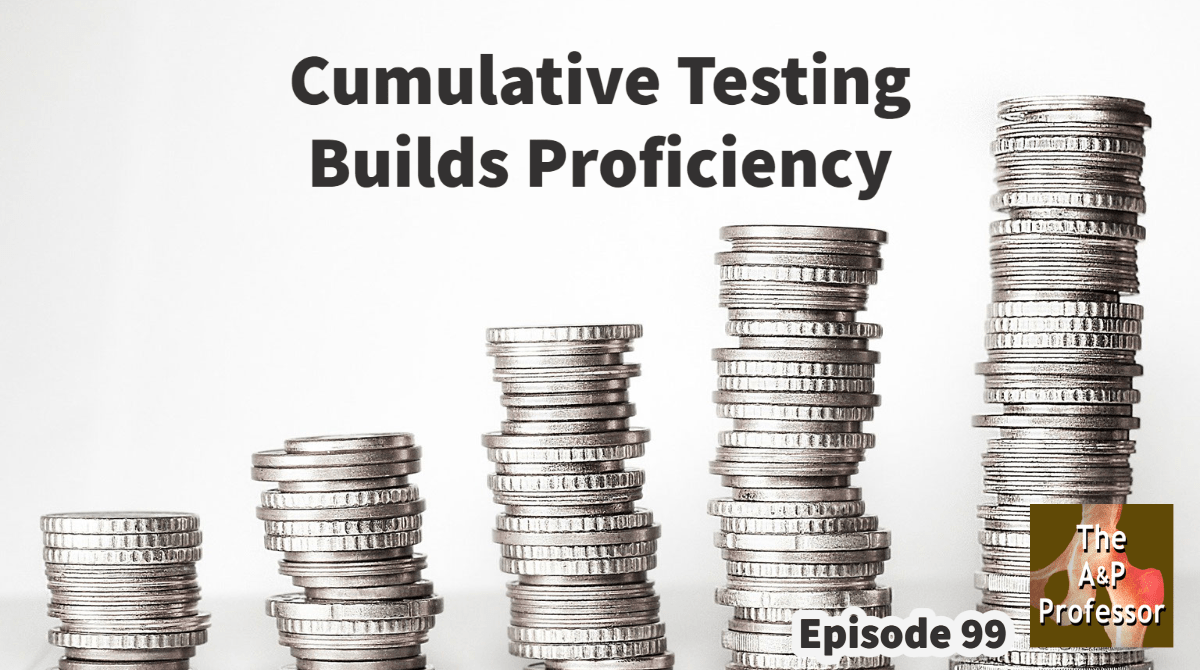
increasingly high stacks of coins with caption: cumulative testing build proficiency

Sponsored by AAA

2 minutes

A searchable transcript for this episode, as well as the captioned audiogram of this episode, are sponsored by the American Association for Anatomy (AAA) at anatomy.org.

Searchable transcript

Captioned audiogram 

Don't forget—HAPS members get a deep discount on AAA membership!

AAA logo


High Stakes and Low Stakes

7.5 minutes

Kevin answers Jerry's next couple of questions...
Do unlimited retakes apply only to formative assessments such as low stakes quizzes?
How much of the overall course grade do these unlimited test opportunities make up?

★ Taking Bold Steps in Teaching | Notetaking | Science Updates | TAPP 90

grilled steaks with caption: high-stakes, low stakes testing


Sponsored by HAPI Online Graduate Program

1.5 minute

The Master of Science in Human Anatomy & Physiology Instruction—the MS-HAPI—is a graduate program for A&P teachers, especially for those who already have a graduate/professional degree. A combination of science courses (enough to qualify you to teach at the college level) and courses in contemporary instructional practice, this program helps you be your best in both on-campus and remote teaching. Kevin Patton is a faculty member in this program at Northeast College of Health Sciences. Check it out!
nycc.edu/hapi

Logo of Northeast College of Health Sciences, Human Anatomy & Physiology Instruction


Open Book Tests

9 minutes

Kevin talks hows and whys in response to this question from Jerry:
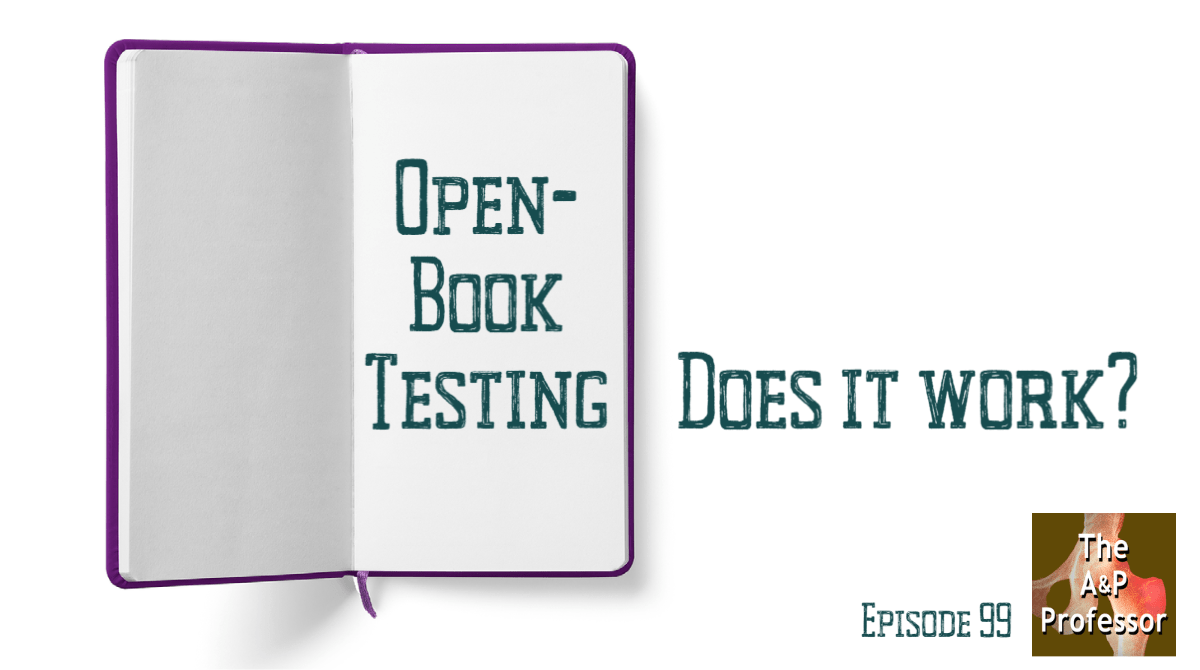
You also mentioned open-book or open-resource tests. How do you use open-book tests as assessments in your courses. For example, do your courses include one or more mid-term exams, multiple unit or module or chapter tests, frequent quizzes, and which of these, if any, are open book?an open blank book with caption: open-book testing, does it work?
 

Sponsored by HAPS

1 minute

The Human Anatomy & Physiology Society (HAPS) is a sponsor of this podcast.  You can help appreciate their support by clicking the link below and checking out the many resources and benefits found there. Watch for virtual town hall meetings and upcoming regional meetings!
Anatomy & Physiology Society

theAPprofessor.org/haps

HAPS logo


Academic Integrity

8.5 minutes

Kevin answers Jerry's final question:
Finally, how do you try to maintain standards of academic integrity with repeat test opportunities and open book tests?

★ What the Best College Teachers Do

★ ★ Book Details: geni.us/8AoG9QY

★ ★ The A&P Professor Book Club

★ ★ Already read the book? Claim your credential

★ Promoting Academic Integrity in Our Course | Episode 25

★ The Cheater! Academic Integrity in Remote Learning | TAPP 81

★ Taking Bold Steps in Teaching | Notetaking | Science Updates | TAPP 90

heavy chain with caption: online test security, academic integrity


Final Thoughts

5 minutes

These strategies are not the only way to do things, but may be interesting if they spark ideas among listeners.


If the hyperlinks here are not active, go to TAPPradio.org to find the episode page.

★ More details at the episode page: theAPprofessor.org/podcast-episode-99.html

★ Transcript available in the transcript box: theAPprofessor.org/podcast-episode-99.html

★ Need help accessing resources locked behind a paywall? Check out this advice from Episode 32 to get what you need! my-ap.us/paywall
 
Take The A&P Professor experience to the next level! 

★ theAPprofessor.org/community
 
Earn cash by referring other A&P faculty to this podcast: 

★ theAPprofessor.org/refer
 
Tools & Resources

★ TAPP Science & Education Updates: theAPprofessor.org/updates

★ Amazon: amzn.to/2r6Qa3J

★ Text Expander: theapprofessor.org/textexpander

★ Rev.com: try.rev.com/Cw2nZ

★ Snagit & Camtasia: techsmith.pxf.io/9MkPW

★ Krisp Free Noise-Cancelling App: theAPprofessor.org/krisp

★ JotForm (build forms for free): theAPprofessor.org/jotform

★ The A&P Professor Logo Items: https://www.teepublic.com/stores/the-a-p-professor
 
Sponsors

★ Transcript and captions for this episode are supported by the American Association for Anatomy | anatomy.org

★ The Human Anatomy & Physiology Society provides marketing support for this podcast | theAPprofessor.org/haps

★ Distribution of this episode is supported by the Northeast College of Health Sciences online graduate program in Human Anatomy & Physiology Instruction (HAPI) | nycc.edu/hapi

Clicking on sponsor links helps let them know you appreciate their support of this podcast!

Follow The A&P Professor on  Twitter, Facebook, Blogger, Revue, Tumblr, or Instagram @theAPprofessor

The A&P Professor® and Lion Den® are registered trademarks of Lion Den Inc. (Kevin Patton)

As an Amazon Associate I earn from qualifying purchases. I may be compensated for links to sponsors and certain other links.


Click here to listen to this episode—or access the detailed notes and transcript.

Monday, August 2, 2021

Star Power Helps Students Identify Learning Goals | TAPP 98


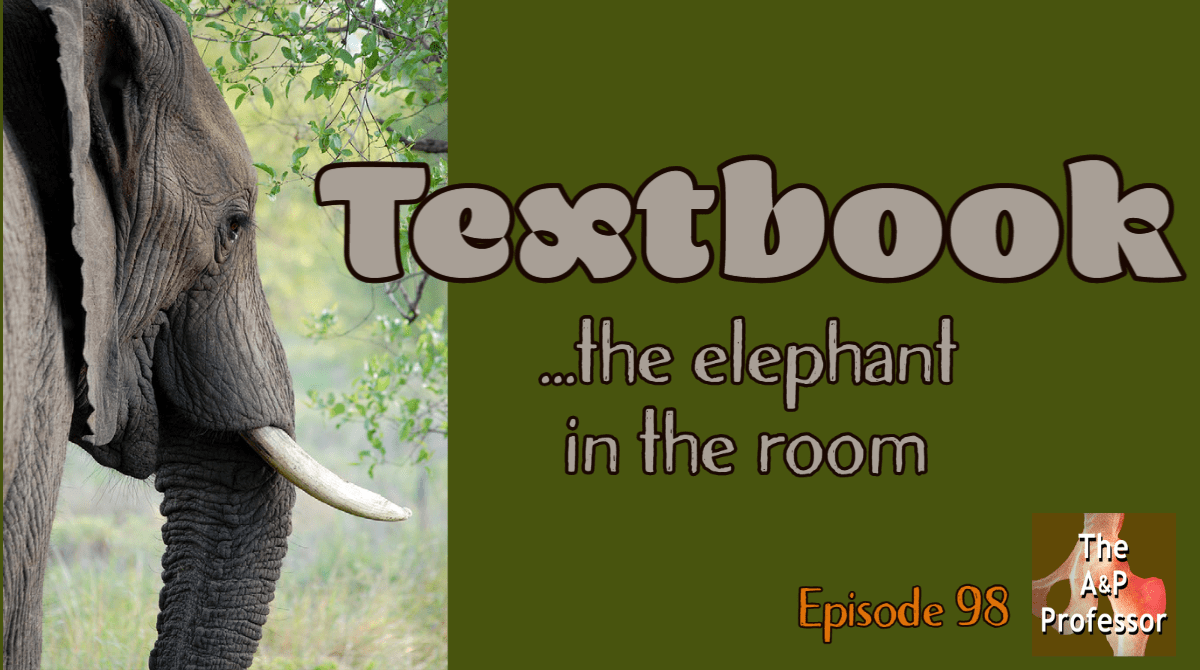
Students often ignore published learning objectives, but we often use subtle clues to help them understand what they need to know. In this episode, Kevin Patton discusses how to be less subtle about that, while also teaching our students how to spot important clues. That elephant in the room? It's the textbook. Cilia are amazing and vital. In COVID-19, we see how cilia damage can kill us. Did you know that cells make soap? Listen and learn why.

  • 00:00 | Introduction
  • 00:54 | The Appearing Elephant Trick
  • 06:05 | Sponsored by AAA
  • 07:26 | COVID-19 and Cilia Damage
  • 10:54 | Soapy Cell Defense
  • 15:04 | Sponsored by HAPI
  • 16:35 | The Star Story
  • 29:59 | Sponsored by HAPS
  • 31:05 | Helping Students Identify Learning Goals
  • 40:43 | Staying Connected

If you cannot see or activate the audio player, go to: theAPprofessor.org/podcast-episode-98.html

🏅 Apply for your credential (badge/certificate) for listening to this episode: theAPprofessor.org/podcast-episode-98.html/#badge

❓ Please take the anonymous survey: theAPprofessor.org/survey

☝️ Questions & Feedback: 1-833-LION-DEN (1-833-546-6336)

✔️ Follow The A&P Professor on Twitter, Facebook, Blogger, Revue, Tumblr, or Instagram! @theAPprofessor

📰 Get the almost-daily TAPP Science & Education Updates theAPprofessor.org/updates


As I stared at the stars, I realized that there were always this many of them. It was only when the other lights were removed that I could see what had been there all along. (Morgan Matson)


The Appearing Elephant Trick

5 minutes

What does the Appearing Elephant illusion have to do with teaching and learning anatomy & physiology? That mystery is revealed in this segment—in more ways than one!

★ Do A&P Textbooks Have Too Much Content? | TAPP 94

★ Six More Textbook Tricks | TAPP 97

★ HOW TO MAKE AN ELEPHANT APPEAR! (video showing how to make an elephant appear in the middle of a parking lot—seriously) youtu.be/2-WHR8muZk0

image of elephant with caption: textbook, the elephantin the room


Sponsored by AAA

1.5 minute

A searchable transcript for this episode, as well as the captioned audiogram of this episode, are sponsored by the American Association for Anatomy (AAA) at anatomy.org.

Searchable transcript

Captioned audiogram 

Don't forget—HAPS members get a deep discount on AAA membership!

AAA logo


COVID-19 and Cilia Damage

3.5 minutes

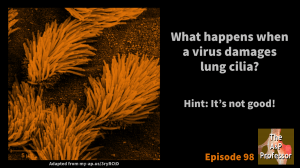
We know that the SARS-CoV-2 virus potentially wreaks all kinds of havoc in the infected human body. Here's one viral effect that may help students better understand the vital role of cilia.

★ SARS-CoV-2 infection induces the dedifferentiation of multiciliated cells and impairs mucociliary clearance (journal article in Nature Communications; has some cool images you have permission to use in your course; also two AWESOME videos demonstrating movement of mucus blanket by cilia) my-ap.us/3jaVeyv

★ The coronavirus cuts cells’ hairlike cilia, which may help it invade the lungs | Trimming the structures prevents mucus from moving the invaders out toward the throat (summary of the discover in Science News) my-ap.us/3zG9B4j

★ Lung cell images show how intense a coronavirus infection can be | Microscopic views reveal virus particles coating the hairlike cilia of an airway cell (a related article in Science News)my-ap.us/3BLlQON

★ Cilia image adapted from my-ap.us/3ryRCtD

micrograph of cilia with caption: what happens when a virus damages lung cilia?


Soapy Cell Defense

4 minutes

When we think of immune defense, we often first think of professional immune cells like macrophages and lymphocytes. But each cell has it's own defenses, too—for example, interferon. But did you know that soap is another of those cell defenses? Listen and find out how that works.

★ APOL3 (apolipoprotein L3 details; for the biochem enthusiasts) my-ap.us/3fn1kug

★ A human apolipoprotein L with detergent-like activity kills intracellular pathogens (journal article from Science) my-ap.us/3BNy21C

★ Human cells make a soaplike substance that busts up bacteria | A surprising cellular defensive strategy could inspire new antibiotics (summary of the discovery from Science News) my-ap.us/3zJvNdW

image of bars of soap with caption: our cells make soap? but, um, why?


Sponsored by HAPI Online Graduate Program

1.5 minute

The Master of Science in Human Anatomy & Physiology Instruction—the MS-HAPI—is a graduate program for A&P teachers, especially for those who already have a graduate/professional degree. A combination of science courses (enough to qualify you to teach at the college level) and courses in contemporary instructional practice, this program helps you be your best in both on-campus and remote teaching. Kevin Patton is a faculty member in this program at Northeast College of Health Sciences. Check it out!

nycc.edu/hapi

Logo of Northeast College of Health Sciences, Human Anatomy & Physiology Instruction


The Star Story

13.5 minutes

Kevin goes back in time to tell a story of his freshman year at the university, when an incident in a chemistry class altered his life forever. Yes, that's when he became a superhero. Just checking to see if anybody actually reads these notes that I spend so much time on. No time travel, but indeed story of a freshman chem course and a teaching and learning method that Kevin still uses.

★ The Storytelling Special | Episode 48

image of stars with caption "star power"


Sponsored by HAPS

1 minute

The Human Anatomy & Physiology Society (HAPS) is a sponsor of this podcast.  You can help appreciate their support by clicking the link below and checking out the many resources and benefits found there. Watch for virtual town hall meetings and upcoming regional meetings!

Anatomy & Physiology Society

theAPprofessor.org/haps

HAPS logo


Helping Students Identify Learning Goals

9.5 minutes

In this segment we learn why Kevin told us that weird story about chemistry, Dr. Malone, and stars. It turns out, there's a strategy for teaching, learning, and notetaking that we and our students can use.

★ Star Power (and other stories written for A&P students; feel free to link to them in your course so your students can use them) my-ap.us/StudentStar

image of stars and caption: helping students identify learning goals


If the hyperlinks here are not active, go to TAPPradio.org to find the episode page.

★ More details at the episode page: theAPprofessor.org/podcast-episode-98.html

★ Transcript available in the transcript box: theAPprofessor.org/podcast-episode-98.html

★ Need help accessing resources locked behind a paywall? Check out this advice from Episode 32 to get what you need!
my-ap.us/paywall
 
Take The A&P Professor experience to the next level! 

★ theAPprofessor.org/community
 
Earn cash by referring other A&P faculty to this podcast: 

★ theAPprofessor.org/refer
 
Tools & Resources

★ TAPP Science & Education Updates: theAPprofessor.org/updates

★ Amazon: amzn.to/2r6Qa3J

★ Text Expander: theapprofessor.org/textexpander

★ Rev.com: try.rev.com/Cw2nZ

★ Snagit & Camtasia: techsmith.pxf.io/9MkPW

★ Krisp Free Noise-Cancelling App: theAPprofessor.org/krisp

★ JotForm (build forms for free): theAPprofessor.org/jotform

★ The A&P Professor Logo Items: https://www.teepublic.com/stores/the-a-p-professor
 
Sponsors

★ Transcript and captions for this episode are supported by the American Association for Anatomy | anatomy.org

★ The Human Anatomy & Physiology Society provides marketing support for this podcast | theAPprofessor.org/haps

★ Distribution of this episode is supported by the Northeast College of Health Sciences online graduate program in Human Anatomy & Physiology Instruction (HAPI) | nycc.edu/hapi

Clicking on sponsor links helps let them know you appreciate their support of this podcast!

Follow The A&P Professor on  Twitter, Facebook, Blogger, Revue, Tumblr, or Instagram @theAPprofessor

The A&P Professor® and Lion Den® are registered trademarks of Lion Den Inc. (Kevin Patton)

As an Amazon Associate I earn from qualifying purchases. I may be compensated for links to sponsors and certain other links.


Click here to listen to this episode—or access the detailed notes and transcript.

Monday, July 19, 2021

Six More Textbook Tricks | Teaching With Your Textbook Effectively | TAPP 97


We faculty rarely talk about how to use textbooks effectively. Not with each other, not with students, not with anybody. And we've probably not ever had any training in how to use what is a key tool in teaching and learning the typical A&P course. This episode solves that problem!

00:00 | Introduction

00:46 | More Textbook Tricks

03:20 | Transparency

06:46 | Sponsored by AAA

08:04 | Read and Raid

12:46 | Sponsored by HAPI

14:17 | Honor The Textbook

32:44 | Sponsored by HAPS

34:28 | (You) Read The Textbook

39:44 | Teach Your Students How to Read Textbooks

49:26 | Loving & Learning About Textbooks

51:16 | Staying Connected

If you cannot see or activate the audio player, go to: theAPprofessor.org/podcast-episode-97.html

🏅 Apply for your credential (badge/certificate) for listening to this episode: theAPprofessor.org/podcast-episode-97.html/#badge

❓ Please take the anonymous survey: theAPprofessor.org/survey

☝️ Questions & Feedback: 1-833-LION-DEN (1-833-546-6336)

✔️ Follow The A&P Professor on Twitter, Facebook, Blogger, Revue, Tumblr, or Instagram! @theAPprofessor

📰 Get the almost-daily TAPP Science & Education Updates theAPprofessor.org/updates

“While you can't hold on to everything forever, you're a fool if you sell back your college books at semester's end: have you learned nothing of this life?” (Ander Monson)


More Textbook Tricks

2.5 minutes

In Episode 94, I discussed the reasons why our A&P textbooks often seem to be too large. In this episode, I return to the scene of the crime to discuss some other aspects of how we look at our textbooks and how we use them.

★ Do A&P Textbooks Have Too Much Content? | TAPP 94

★ Your Textbook is a Mitten, Not a Glove (Kevin's brief article mentioned in this segment) https://my-ap.us/2E0sZP1
READ and RAID your textbook (Kevin's brief article for students on a useful approach to using their A&P textbook) my-ap.us/2P3KuBZ

★ Selling your textbook? (Kevin's brief article for students on why they need to keep their A&P textbook—to access that "extra content" in their later courses & career) my-ap.us/3g8Q9Fm

open book with text: Do A&P Textbooks have too much content? Episode 94


Transparency

3.5 minutes

In Episode 51, I discussed why we should be transparent with students about how and why we do things in our course. In this episode, I apply that principle to the A&P textbook.

★ The Case for Transparency | Episode 51

Episode 51

Sponsored by AAA

1.5 minute

A searchable transcript for this episode, as well as the captioned audiogram of this episode, are sponsored by the American Association for Anatomy (AAA) at anatomy.org.

Searchable transcript

Captioned audiogram 

Don't forget—HAPS members get a deep discount on AAA membership!

AAA logo


Read and Raid

4.5 minutes

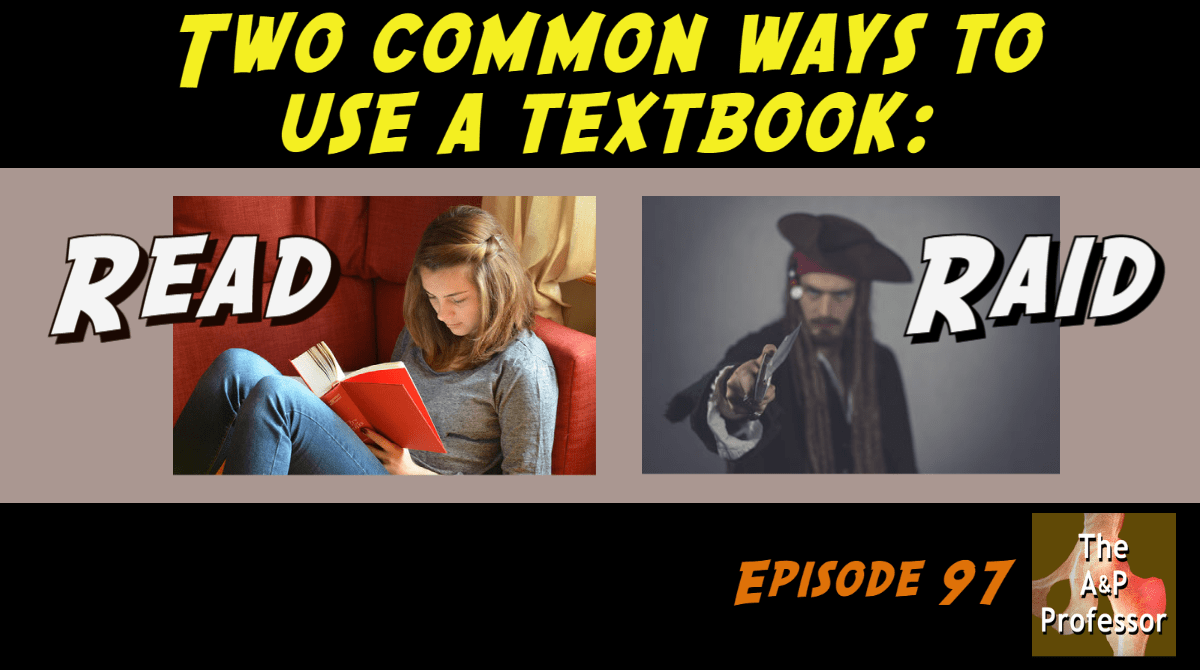
In Episode 75, I briefly explained the "read and raid" principle of using textbooks briefly, when discussing how it can be applied to the course syllabus. Here, I discuss the original notion of read and raid by discussion how it works in the A&P textbook.

★ The Syllabus Special | TAPP 75

★ READ and RAID your textbook (a link for students; explains the “read & raid principle” as applied to textbooks) my-ap.us/2P3KuBZ

two common ways to use a textbook: read, raid


Sponsored by HAPI Online Graduate Program

1.5 minute

The Master of Science in Human Anatomy & Physiology Instruction—the MS-HAPI—is a graduate program for A&P teachers, especially for those who already have a graduate/professional degree. A combination of science courses (enough to qualify you to teach at the college level) and courses in contemporary instructional practice, this program helps you be your best in both on-campus and remote teaching. Kevin Patton is a faculty member in this program at Northeast College of Health Sciences. Check it out!

nycc.edu/hapi

Logo of Northeast College of Health Sciences, Human Anatomy & Physiology Instruction


Honor The Textbook

18.5 minutes

If we want to model professional behavior, we can voice any disagreements we have with our course textbook without resorting to disagreeable "hating" on the textbook. And we should remember to give feedback to the authors when we find mistakes or other issues. That's the kind of professional we want to be, right?

man with book at a computer


Sponsored by HAPS

1.5 minute

The Human Anatomy & Physiology Society (HAPS) is a sponsor of this podcast.  You can help appreciate their support by clicking the link below and checking out the many resources and benefits found there. Watch for virtual town hall meetings and upcoming regional meetings!

Anatomy & Physiology Society

theAPprofessor.org/haps

HAPS logo


(You) Read The Textbook

5.5 minutes

We should read the textbook every time we teach. It's a habit that pays big dividends for teaching and learning.

★ Stiff! The Curious Lives of Human Cadavers (book mentioned here as being an upcoming selection of the HAPS Book Club has also been listed in The A&P Professor Book Club) theapprofessor.org/bookclub.html#badge-B019

man reading


Teach Your Students How to Read Textbooks

9.5 minutes

Reading a textbook requires a strategy. We are in a position to help our students find their strategy by using metacognition and available published textbook strategies.

★ Reading Strategies: Reading the Textbook (Kevin's page for A&P students that you can link to from your course) lionden.com/reading.htm

★ The A&P Student Reading Strategies (collection of posts from Kevin's blog for A&P students) theAPstudent.blogspot.com/search/label/reading

woman reading a book


Loving & Learning About Textbooks

2 minutes

There's a lot more to a textbook than most of us think. What I mean is that we ought to think more about how to best use our course textbook and how to best coach our students in learning from their A&P textbook.

books


If the hyperlinks here are not active, go to TAPPradio.org to find the episode page.

★ More details at the episode page: theAPprofessor.org/podcast-episode-97.html

★ Transcript available in the transcript box: theAPprofessor.org/podcast-episode-97.html

★ Need help accessing resources locked behind a paywall? Check out this advice from Episode 32 to get what you need! https://youtu.be/JU_l76JGwVw?t=440
 
Take The A&P Professor experience to the next level! 

★ theAPprofessor.org/community
 
Earn cash by referring other A&P faculty to this podcast: 

★ theAPprofessor.org/refer
 
Tools & Resources

★ TAPP Science & Education Updates: theAPprofessor.org/updates

★ Amazon: amzn.to/2r6Qa3J

★ Text Expander: theapprofessor.org/textexpander

★ Rev.com: try.rev.com/Cw2nZ

★ Snagit & Camtasia: techsmith.pxf.io/9MkPW

★ Krisp Free Noise-Cancelling App: theAPprofessor.org/krisp

★ JotForm (build forms for free): theAPprofessor.org/jotform

★ The A&P Professor Logo Items: https://www.teepublic.com/stores/the-a-p-professor
 
Sponsors

★ Transcript and captions for this episode are supported by the American Association for Anatomy | anatomy.org

★ The Human Anatomy & Physiology Society provides marketing support for this podcast | theAPprofessor.org/haps

★ Distribution of this episode is supported by the Northeast College of Health Sciences online graduate program in Human Anatomy & Physiology Instruction (HAPI) | nycc.edu/hapi

Clicking on sponsor links helps let them know you appreciate their support of this podcast!

Follow The A&P Professor on  Twitter, Facebook, Blogger, Revue, Tumblr, or Instagram @theAPprofessor

The A&P Professor® and Lion Den® are registered trademarks of Lion Den Inc. (Kevin Patton)

As an Amazon Associate I earn from qualifying purchases. I may be compensated for links to sponsors and certain other links.


Click here to listen to this episode—or access the detailed notes and transcript.
Monday, July 5, 2021

Even More Slide Tricks | Ultimate Effective Teaching Presentations | TAPP 96


We continue our two-part series that explores simple ways that we can make our teaching slides more engaging—and therefore more effective for learning. Let's leave behind those boring slide templates and make our presentations work better for our lectures, case studies, labs, and other learning activities.

00:00 | Introduction

00:46 | Previous Slide Tricks

06:23 | Sponsored by AAA

07:36 | Proper Use of Terminology

14:34 | Distorting Images

15:50 | Sponsored by HAPI

17:06 | Terrific Title Slides

29:12 | Sponsored by HAPS

30:07 | Avoid Presenting in Edit Mode

32:12 | Don't Read Slides & Don't Always Follow Rules

34:33 | Staying Connected


If you cannot see or activate the audio player, go to: theAPprofessor.org/podcast-episode-96.html

🏅 Apply for your credential (badge/certificate) for listening to this episode: theAPprofessor.org/podcast-episode-96.html/#badge

❓ Please take the anonymous survey: theAPprofessor.org/survey

☝️ Questions & Feedback: 1-833-LION-DEN (1-833-546-6336)

✔️ Follow The A&P Professor on Twitter, Facebook, Blogger, Revue, Tumblr, or Instagram! @theAPprofessor

📰 Get the almost-daily TAPP Science & Education Updates theAPprofessor.org/updates


Logic will get you from A to B. Imagination will take you everywhere. (Albert Einstein)


Previous Slide Tricks

5.5 minutes

Before getting down to learning new tricks, we take a moment to review the tricks already learned (or reviewed) in the previous episode—Episode 95.

★ More Slide Tricks | Effective Teaching Presentations | TAPP 95

★ Also review:

★ ★ Teaching Slides: Smooth and Simple Animations Dramatize the Story of A&P | TAPP 89

★ ★ Slides Serve the Story of Anatomy & Physiology | Episode 66

★ ★ Simple Ideas for Pandemic Teaching | Episode 67

★ ★ The Storytelling Special | Episode 48

cover for episode 96: Even More Slide Tricks with photo of lecture hall


Sponsored by AAA

1.5 minute

A searchable transcript for this episode, as well as the captioned audiogram of this episode, are sponsored by the American Association for Anatomy (AAA) at anatomy.org.

Searchable transcript

Captioned audiogram 

Don't forget—HAPS members get a deep discount on AAA membership!

AAA logo


Proper Use of Terminology

7 minutes

If we use different terminology or formatting (e.g., of ion notation, chemical formulae, etc.) than our textbook, we need to connect that for students. Even better, stick with the content and style of the textbook. Proper usage models professional and accurate communication for students.

★ International Terminology

★ More on Spelling, Case, & Grammar | Episode 56

★ Communication, Clarity, & Medical Errors | Episode 55

★ The Eponym Episode | Using Modern Terminology | Episode 40

★ More on Eponyms in A&P Terminology | Episode 41

mammillary


Distorting Images

1.5 minutes

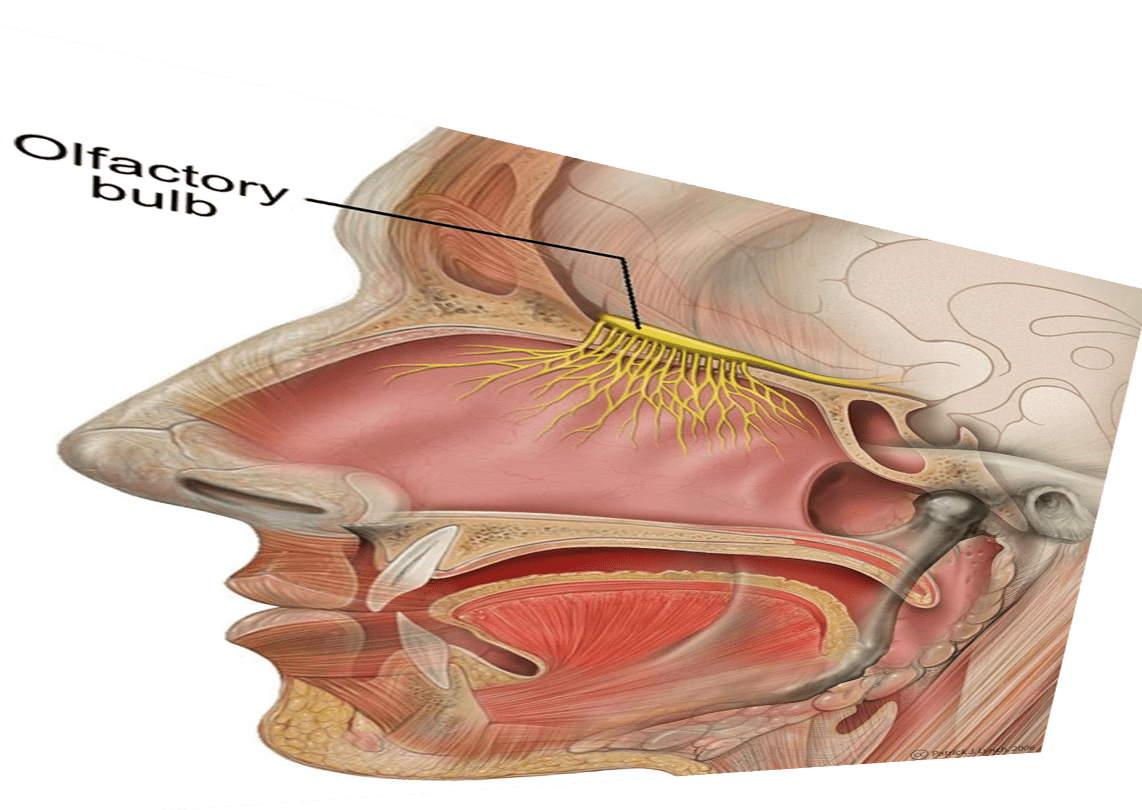
We want to make our images on slides as large as possible. But if we enlarge disproportionately—to make it fit just right—then it may confuse students. At the very least, it will appear unprofessional and perhaps a bit jarring. Just don't, okay?

distorted image of sagittal section of head showing the olfactory bulb


Sponsored by HAPI Online Graduate Program

1.5 minute

The Master of Science in Human Anatomy & Physiology Instruction—the MS-HAPI—is a graduate program for A&P teachers, especially for those who already have a graduate/professional degree. A combination of science courses (enough to qualify you to teach at the college level) and courses in contemporary instructional practice, this program helps you be your best in both on-campus and remote teaching. Kevin Patton is a faculty member in this program at Northeast College of Health Sciences. Check it out!

nycc.edu/hapi

Logo of Northeast College of Health Sciences, Human Anatomy & Physiology Instruction


Terrific Title Slides

12 minutes

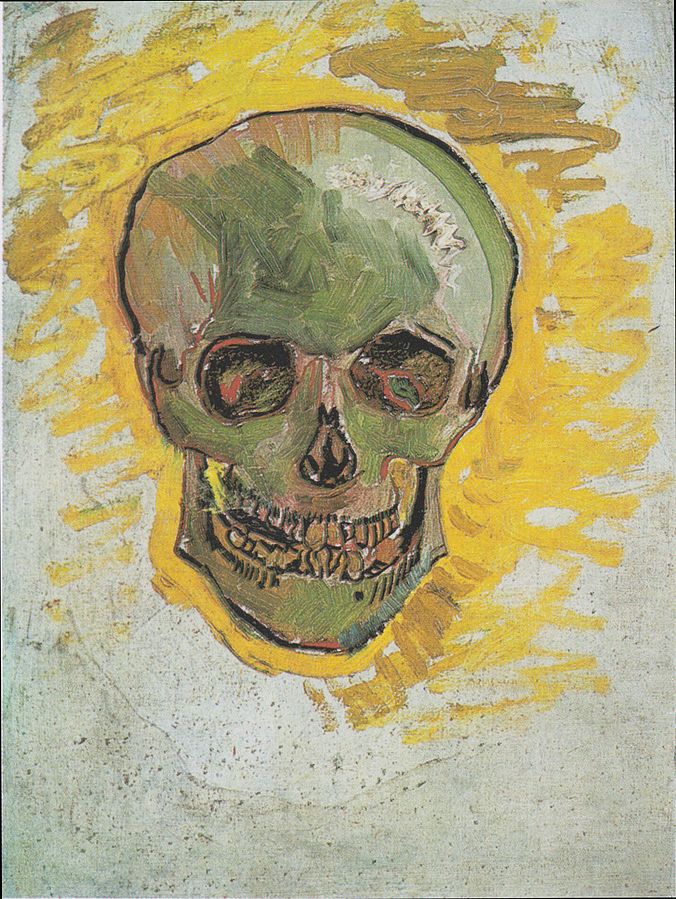
Why use boring title slides that simply have the topic, chapter title, and/or chapter number? That signal to students, "prepare to be bored." Yep, I think so. Let's chunk our slide decks into short modules, each with an interesting title slide that tells students, "we're going on another adventure!" Here are some ideas.

★ 10 creative Ideas for your Title- and End-Slides in Presentations my-ap.us/3jvIMeo

★ Using Media in Our A&P Course & Advice From Barbara Waxer | Episode 28

★ Finding Media | Images and More for Teaching Anatomy & Physiology

★ Public Domain Images For Artists - 25+ Collections | MoMa UK (curated collection of art you can use in your presentations) my-ap.us/2Tb7QfU

Vincent Van Gogh's painting of a skull


Sponsored by HAPS

1 minute

The Human Anatomy & Physiology Society (HAPS) is a sponsor of this podcast.  You can help appreciate their support by clicking the link below and checking out the many resources and benefits found there. Watch for virtual town hall meetings and upcoming regional meetings!

Anatomy & Physiology Society

theAPprofessor.org/haps

HAPS logo


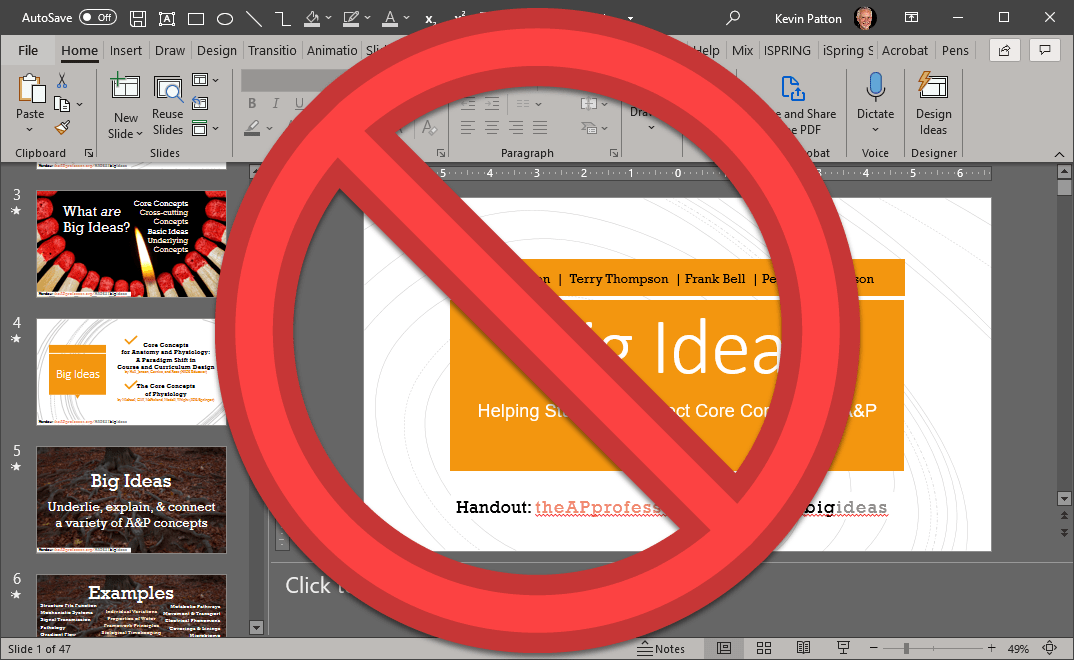
Avoid Presenting in Edit Mode

2 minutes

Lots of ideas on using images effectively in our slides. Images may be the true heart and purpose of using slides to teach.

★ Finding Media | Images and More for Teaching Anatomy & Physiology

edit screen of PowerPoint with red circle & slash symbol


Don't Read Slides & Don't Always Follow Rules

2.5 minutes

Just don't.

person doing trick on skateboard


If the hyperlinks here are not active, go to TAPPradio.org to find the episode page.

★ More details at the episode page: theAPprofessor.org/podcast-episode-96.html

★ Transcript available in the transcript box: theAPprofessor.org/podcast-episode-96.html

★ Need help accessing resources locked behind a paywall? Check out this advice from Episode 32 to get what you need! https://youtu.be/JU_l76JGwVw?t=440
 
Take The A&P Professor experience to the next level! 

★ theAPprofessor.org/community
 
Earn cash by referring other A&P faculty to this podcast: 

★ theAPprofessor.org/refer
 
Tools & Resources

★ TAPP Science & Education Updates: theAPprofessor.org/updates

★ Amazon: amzn.to/2r6Qa3J

★ Text Expander: theapprofessor.org/textexpander

★ Rev.com: try.rev.com/Cw2nZ

★ Snagit & Camtasia: techsmith.pxf.io/9MkPW

★ Krisp Free Noise-Cancelling App: theAPprofessor.org/krisp

★ The A&P Professor Logo Items: https://www.teepublic.com/stores/the-a-p-professor
 
Sponsors

★ Transcript and captions for this episode are supported by the American Association for Anatomy | anatomy.org

★ The Human Anatomy & Physiology Society provides marketing support for this podcast | theAPprofessor.org/haps

★ Distribution of this episode is supported by the Northeast College of Health Sciences online graduate program in Human Anatomy & Physiology Instruction (HAPI) | nycc.edu/hapi

Clicking on sponsor links helps let them know you appreciate their support of this podcast!

Follow The A&P Professor on  Twitter, Facebook, Blogger, Revue, Tumblr, or Instagram @theAPprofessor

The A&P Professor® and Lion Den® are registered trademarks of Lion Den Inc. (Kevin Patton)

As an Amazon Associate I earn from qualifying purchases. I may be compensated for links to sponsors and certain other links.


Click here to listen to this episode—or access the detailed notes and transcript.
Monday, June 21, 2021

More Slide Tricks | Effective Teaching Presentations | TAPP 95


Everybody loves to hate teaching with slides. But maybe that's because we've not fully developed our skills! Host Kevin Patton build on previous advice to improve our mastery of the slide-of-hand we need for effective learning. Let's turn that hate into love! This is the first of a two-episode series.

00:00 | Introduction

00:58 | Buy One, Get One

02:06 | I Need Help!

10:20 | Sponsored by AAA

11:47 | Less Text, More Story

24:25 | Sponsored by HAPI

25:49 | Chunky Style Slides

39:44 | Sponsored by HAPS

41:08 | Where Art Thou?

48:16 | Slide Tricks

50:12 | Staying Connected


If you cannot see or activate the audio player, go to: theAPprofessor.org/podcast-episode-95.html

🏅 Apply for your credential (badge/certificate) for listening to this episode: theAPprofessor.org/podcast-episode-95.html/#badge

❓ Please take the anonymous survey: theAPprofessor.org/survey

☝️ Questions & Feedback: 1-833-LION-DEN (1-833-546-6336)

✔️ Follow The A&P Professor on Twitter, Facebook, Blogger, Revue, Tumblr, or Instagram! @theAPprofessor

📰 Get the almost-daily TAPP Science & Education Updates theAPprofessor.org/updates

The purpose of life is not to be happy. It is to be useful, to be honorable, to be compassionate, to have it make some difference that you have lived and lived well. (Ralph Waldo Emerson)


Buy One, Get One

1 minute

This is the first of two episodes in a series about using slides to teach effectively. Yeah, I know—everybody hates the idea of using slides. But maybe it's because we don't know how to use them well. And yeah, some of this has been covered in different ways in previous episodes. But this kind of overlap—or layering—is a proven learning technique, right?

★ Teaching Slides: Smooth and Simple Animations Dramatize the Story of A&P | TAPP 89

★ Slides Serve the Story of Anatomy & Physiology | Episode 66

★ Simple Ideas for Pandemic Teaching | Episode 67

★ The Storytelling Special | Episode 48

photo of an empty lecture hall from the back


I Need Help!

8 minutes

We're all a bit overloaded and overwhelmed these days, right? Yeah, I'm feeling that pain right now. I need help. Will you please help me?

★ TAPP Journal Club with Krista Rompolski

★ Test Question Templates Help Students Learn | TAPP 70

4 people, arm in arm, with T shirts printed with "Volunteer"


Sponsored by AAA

1.5 minute

A searchable transcript for this episode, as well as the captioned audiogram of this episode, are sponsored by the American Association for Anatomy (AAA) at anatomy.org.

Searchable transcript

Captioned audiogram 

Don't forget—HAPS members get a deep discount on AAA membership!

AAA logo


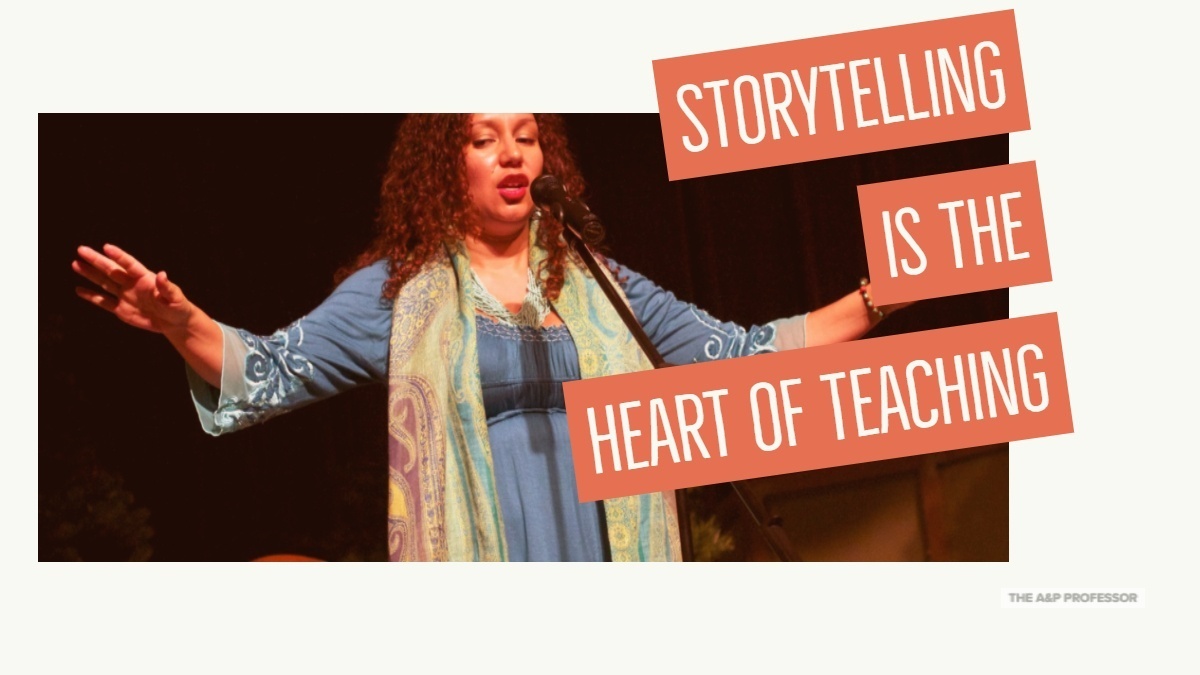
Less Text, More Story

12.5 minutes

I've said this before. I say it all the time. You're sick of me saying it. But you know what? We need that continual and consistent messaging so that maybe it will eventually become part of our working memory—our conscious awareness. So here, we go again.

★ Teaching Slides: Smooth and Simple Animations Dramatize the Story of A&P | TAPP 89

★ Slides Serve the Story of Anatomy & Physiology | Episode 66

★ Simple Ideas for Pandemic Teaching | Episode 67

★ The Storytelling Special | Episode 48

★ 10 tips on how to make slides that communicate your idea, from TED’s in-house expert (example of a TED Talk) my-ap.us/3gI6FgP

storytelling


Sponsored by HAPI Online Graduate Program

1.5 minute

The Master of Science in Human Anatomy & Physiology Instruction—the MS-HAPI—is a graduate program for A&P teachers, especially for those who already have a graduate/professional degree. A combination of science courses (enough to qualify you to teach at the college level) and courses in contemporary instructional practice, this program helps you be your best in both on-campus and remote teaching. Kevin Patton is a faculty member in this program at Northeast College of Health Sciences. Check it out!

nycc.edu/hapi

Logo of Northeast College of Health Sciences, Human Anatomy & Physiology Instruction


Chunky Style Slides

14 minutes

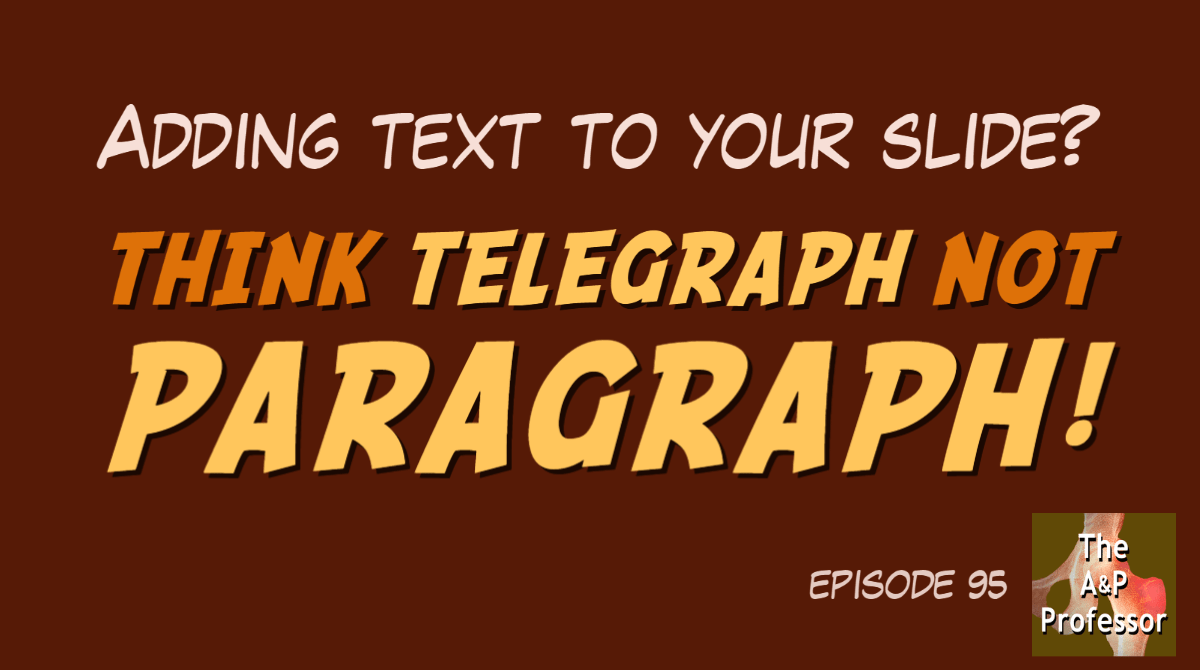
If we follow the Universal Design for Learning (UDL) mindset, we know that chunking content into pieces that are easy for students to focus on. But why do we often end up putting a lot of concepts on one teaching slide? Here, I suggest that "chunky style" may be best for learning. And I also suggest that a useful mantra to chant while putting text into our slides is, "think telegraph, not paragraph."

★ Guidelines for Universal Design for Learning (UDL) my-ap.us/UDLguidelines

slogan "Adding text to your slide? Think telegraph, not paragraph."


Sponsored by HAPS

1 minute

The Human Anatomy & Physiology Society (HAPS) is a sponsor of this podcast.  You can help appreciate their support by clicking the link below and checking out the many resources and benefits found there. Watch for virtual town hall meetings and upcoming regional meetings!

Anatomy & Physiology Society

theAPprofessor.org/haps

HAPS logo


Where Art Thou?

7 minutes

Lots of ideas on using images effectively in our slides. Images may be the true heart and purpose of using slides to teach.

★ Finding Media | Images and More for Teaching Anatomy & Physiology

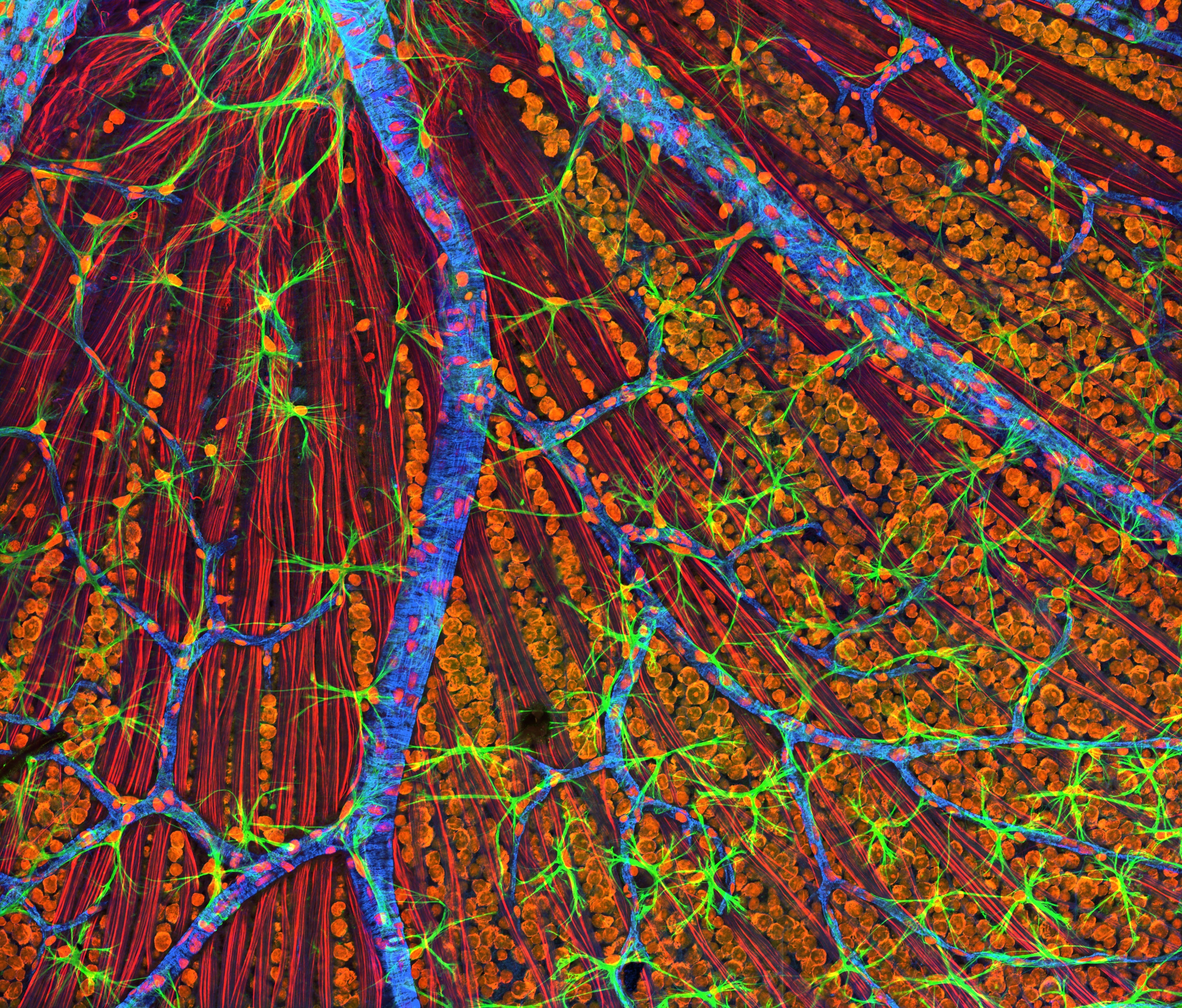
retina


Slide Tricks

2 minutes

A wrap up of points made in this episode—there are so many! And a look ahead at the next episode.

silhouette of a person doing a handstand with a skateboard


If the hyperlinks here are not active, go to TAPPradio.org to find the episode page.

★ More details at the episode page: theAPprofessor.org/podcast-episode-95.html

★ Transcript available in the transcript box: theAPprofessor.org/podcast-episode-95.html

★ Need help accessing resources locked behind a paywall? Check out this advice from Episode 32 to get what you need! https://youtu.be/JU_l76JGwVw?t=440
 
Take The A&P Professor experience to the next level! 

★ theAPprofessor.org/community
 
Earn cash by referring other A&P faculty to this podcast: 

★ theAPprofessor.org/refer
 
Tools & Resources

★ TAPP Science & Education Updates: theAPprofessor.org/updates

★ Amazon: amzn.to/2r6Qa3J

★ Text Expander: theapprofessor.org/textexpander

★ Rev.com: try.rev.com/Cw2nZ

★ Snagit & Camtasia: techsmith.pxf.io/9MkPW

★ Krisp Free Noise-Cancelling App: theAPprofessor.org/krisp

★ The A&P Professor Logo Items: https://www.teepublic.com/stores/the-a-p-professor
 
Sponsors

★ Transcript and captions for this episode are supported by the American Association for Anatomy | anatomy.org

★ The Human Anatomy & Physiology Society provides marketing support for this podcast | theAPprofessor.org/haps

★ Distribution of this episode is supported by the Northeast College of Health Sciences online graduate program in Human Anatomy & Physiology Instruction (HAPI) | nycc.edu/hapi

Clicking on sponsor links helps let them know you appreciate their support of this podcast!

Follow The A&P Professor on  Twitter, Facebook, Blogger, Revue, Tumblr, or Instagram @theAPprofessor

The A&P Professor® and Lion Den® are registered trademarks of Lion Den Inc. (Kevin Patton)

As an Amazon Associate I earn from qualifying purchases. I may be compensated for links to sponsors and certain other links.


Click here to listen to this episode—or access the detailed notes and transcript.
Monday, June 7, 2021

Do A&P Textbooks Have Too Much Content? | TAPP 94


Oh, that huge A&P textbook I teach from! Do I really need to cover all of it? Host Kevin Patton discusses his take on this age-old problem. Does the color of my marking pen send a signal that I don't want to send to my students? A breakthrough in understanding how teeth sense cold. And what in the world is a tunneling nanotube—and can I get one at my local hardware store? Greek names for SARS-CoV-2 variants simplifies conversation and avoids stigma.

00:00 | Introduction

00:43 | How Do Teeth Sense Cold?

07:04 | Sponsored by AAA

08:32 | Red & Green for Student Feedback

18:03 | What's a TNT?

23:52 | Sponsored by HAPI

25:06 | Greek Names for COVID Variants

30:24 | Are A&P Textbooks Too Long? Are Mittens Too Big?

36:41 | Sponsored by HAPS

39:15 | Are A&P Textbooks Too Long? What About Novels?

46:35 | Staying Connected


If you cannot see or activate the audio player, go to: theAPprofessor.org/podcast-episode-94.html

Apply for your credential (badge/certificate) for listening to this episode: theAPprofessor.org/podcast-episode-94.html/#badge

Please take the anonymous survey: theAPprofessor.org/survey

Questions & Feedback: 1-833-LION-DEN (1-833-546-6336)

Follow The A&P Professor on Twitter, Facebook, Blogger, Revue, Tumblr, or Instagram! @theAPprofessor

Get the almost-daily TAPP Science & Education Updates theAPprofessor.org/updates

Do A&P textbooks have too much content? Don't tell me that thought has never occurred to you! (Kevin Patton)


How Do Teeth Sense Cold?

6.5 minutes

We know that teeth damaged by caries (cavities), decay, injury, wear, etc., can be very sensitive to cold—such as ice cream or cold drinks. But we've struggled to come up with a mechanism for that. A new discovery proposes that the ion channel TRCP5 may be the responsible cold sensor. And that may lead to some easy fixes for cold-sensitive teeth. 

★ Odontoblast TRPC5 channels signal cold pain in teeth (discovery from Science Advances mentioned in this segment) my-ap.us/3w888Cg

★ Transient receptor potential cation channel, subfamily C, member 5 (TRPC5) is a cold-transducer in the peripheral nervous system (some earlier research on the cold-sensing function of TRPC5) my-ap.us/3pnhdEM

★ Image from PxHere

person with ice cream cone


Sponsored by AAA

1.5 minute

A searchable transcript for this episode, as well as the captioned audiogram of this episode, are sponsored by the American Association for Anatomy (AAA) at anatomy.org.

Searchable transcript

Captioned audiogram 

Don't forget—HAPS members get a deep discount on AAA membership!

AAA logo


Red & Green for For Student Feedback

9.5 minutes

Kevin revisits his recommendation to use a green pen—not a red pen—for marking grades and giving student feedback. That holds over to digital communications, such as course announcements and instructions, too. Listen to the reasons—you may be surprised!

★ No Red Pens! (Kevin’s blog post on this topic; with links to additional information/research) my-ap.us/2SbyDbr

★ Give Your Course a Half Flip With a Full Twist | Episode 6 (Kevin's earlier discussion of green pens for marking)

★ Coblis—Color Blindness Simulator (you can paste in your text with color fonts, or an image, and see what it might look like in major color vision variants) my-ap.us/2T33Xt6

★ Green Pens geni.us/p2BW

★ Photo by animatedheaven from PxHere

the word "Success!" being underlined with a green pen


What's a TNT?

5.5 minutes

The tunneling nanotube (TNT) is not an organelle we typically discuss in the undergrad A&P course—just like a lot of other recently-discovered organelles. But sometimes it's worth mentioning the ongoing work of discovery in this area—and the excitement of such exploration—as a way to connect students with our course content.

★ Tunneling nanotubes: Reshaping connectivity (review-opinion article mentioned in this segment) my-ap.us/3fUpM6X

★ Wiring through tunneling nanotubes--from electrical signals to organelle transfer (an earlier work from Journal of Cell Science) my-ap.us/3poC5LW

★ Got Proteasomes? (Kevin's brief post about why he teaches proteasomes in A&P) my-ap.us/3pp0NvA

★ Image from Radiation Oncology

two red cells connected by a long tunneling nanotube (TNT)


Sponsored by HAPI Online Graduate Program

1.5 minute

The Master of Science in Human Anatomy & Physiology Instruction—the MS-HAPI—is a graduate program for A&P teachers, especially for those who already have a graduate/professional degree. A combination of science courses (enough to qualify you to teach at the college level) and courses in contemporary instructional practice, this program helps you be your best in both on-campus and remote teaching. Kevin Patton is a faculty member in this program. Check it out!

nycc.edu/hapi

NYCC Human Anatomy and Physiology Instruction


Greek Names for COVID Variants

5.5 minutes

Considering the adverse social effects of calling the 1918 influenza "Spanish flu" and the SARS-CoV-2 "the China virus," the World Health Organization has proposed calling variants of SARS-CoV-2 by letters of the Greek alphabet (alpha, beta, gamma, ...) in ordinary conversation. These are to supplement the more technical systems of naming the variants in the scientific literature.

★ Coronavirus variants get Greek names — but will scientists use them? | From Alpha to Omega, the labelling system aims to avoid confusion and stigmatization. (News item in Nature) my-ap.us/3uPC70F

★ Tracking SARS-CoV-2 variants (WHO information that includes a longer list of SARS-CoV-2 variants) my-ap.us/3vZJ0xQ

★ Mid-Winter Winterizing of Our Courses | Bonus Episode 63 (where Spanish flu is discussed)

★ Even More Pandemic Teaching Tips | TAPP 72 (where I apologize for using the term Spanish flu)

★ Image from Wikimedia

upper and lower case Greek letter "alpha"


Are A&P Textbooks Too Long? Are Mittens Too Big?

6.5 minutes

I first heard complaints about A&P textbooks being too large in the mid-1970s—when they were much smaller on average than today's A&P textbooks. But are they really too large? Let's explore that notion.

★ Your Textbook is a Mitten, Not a Glove (Kevin's brief article mentioned in this segment) https://my-ap.us/2E0sZP1
READ and RAID your textbook (Kevin's brief article for students on a useful approach to using their A&P textbook) my-ap.us/2P3KuBZ

★ Selling your textbook? (Kevin's brief article for students on why they need to keep their A&P textbook—to access that "extra content" in their later courses & career) my-ap.us/3g8Q9Fm

★ Plaid Mittens geni.us/yicVmBi

★ Photo from PxHere

person covering their face with mitten-covered hands


Sponsored by HAPS

1 minute

The Human Anatomy & Physiology Society (HAPS) is a sponsor of this podcast.  You can help appreciate their support by clicking the link below and checking out the many resources and benefits found there. Watch for virtual town hall meetings and upcoming regional meetings!

Anatomy & Physiology Society

theAPprofessor.org/haps

HAPS logo


Are A&P Textbooks Too Long? What About Novels?

7.5 minutes

Okay, novels can be too long. But only when they're not good. Long, good novels are, um, usually pretty darn good. But we don't dive into every detail of a novel when learning about it in a literature course, do we? What's this got to do with A&P? Listen and find out!

★ The Stranger (novella by Albert Camus) geni.us/Rwbw

★ Photo from PxHere

reading a book


If the hyperlinks here are not active, go to TAPPradio.org to find the episode page.

★ More details at the episode page: theAPprofessor.org/podcast-episode-94.html

★ Transcript available in the transcript box: theAPprofessor.org/podcast-episode-94.html

★ Need help accessing resources locked behind a paywall? Check out this advice from Episode 32 to get what you need! https://youtu.be/JU_l76JGwVw?t=440
 
Take The A&P Professor experience to the next level!

★ theAPprofessor.org/community
 
Earn cash by referring other A&P faculty to this podcast:

★ theAPprofessor.org/refer
 
Tools & Resources

★ TAPP Science & Education Updates: theAPprofessor.org/updates

★ Amazon: amzn.to/2r6Qa3J

★ Text Expander: theapprofessor.org/textexpander

★ Rev.com: try.rev.com/Cw2nZ

★ Snagit & Camtasia: techsmith.pxf.io/9MkPW

★ Krisp Free Noise-Cancelling App: theAPprofessor.org/krisp

★ The A&P Professor Logo Items: https://www.teepublic.com/stores/the-a-p-professor
 
Sponsors

★ Transcript and captions for this episode are supported by the American Association for Anatomy | anatomy.org

★ The Human Anatomy & Physiology Society provides marketing support for this podcast | theAPprofessor.org/haps

★ Distribution of this episode is supported by NYCC's online graduate program in Human Anatomy & Physiology Instruction (HAPI) | nycc.edu/hapi

Clicking on sponsor links helps let them know you appreciate their support of this podcast!

Follow The A&P Professor on  Twitter, Facebook, Blogger, Revue, Tumblr, or Instagram @theAPprofessor

The A&P Professor® and Lion Den® are registered trademarks of Lion Den Inc. (Kevin Patton)

As an Amazon Associate I earn from qualifying purchases. I may be compensated for links to sponsors and certain other links.


Click here to listen to this episode—or access the detailed notes and transcript.